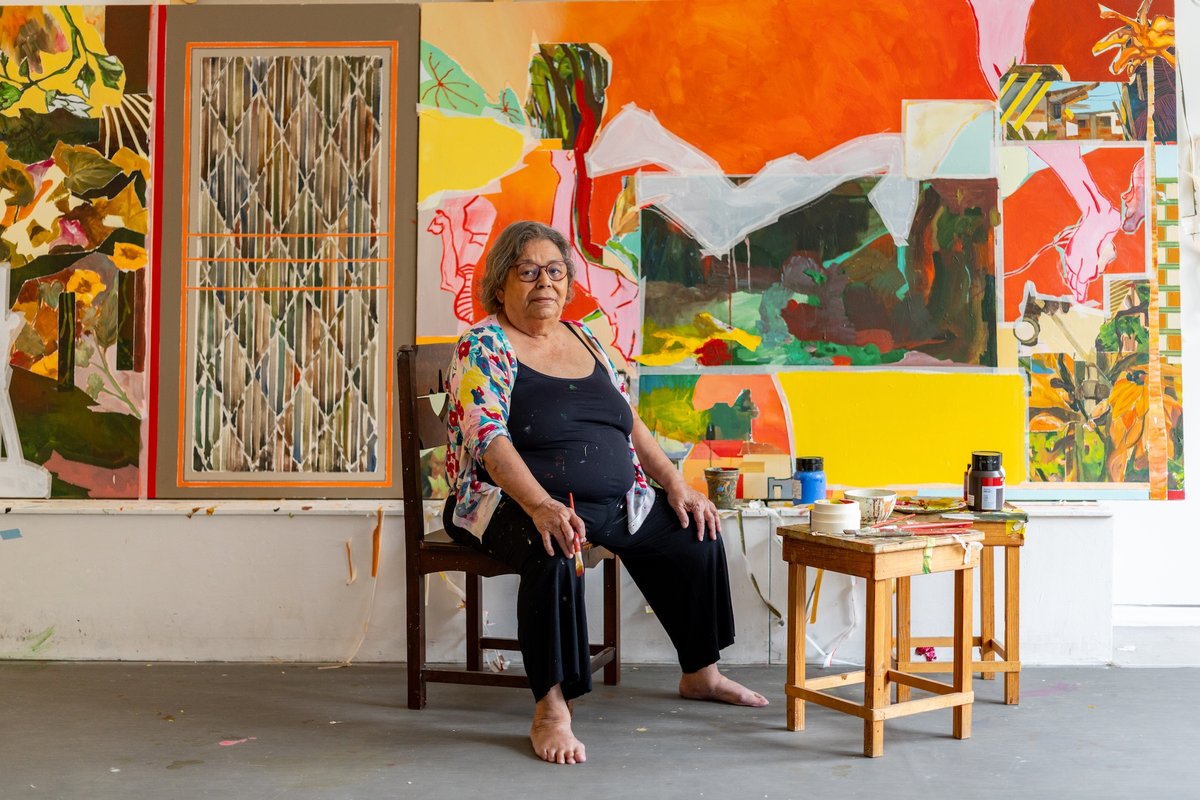
Lucia Laguna spent most of her working life teaching literature in Rio de Janeiro’s public and private schools, picking up a brush only after she retired in 1994, at age 53. This late start hardly slowed her down, and she went on to become one of the most distinctive names in Brazilian contemporary painting. Born in the northern part of Rio de Janeiro state in 1941, Laguna died at her home in Rio on 21 September, she was 85. Her galleries in Rio de Janeiro and São Paulo (Fortes D’Aloia & Gabriel), New York and Paris (Galerie Lelong) and London (Sadie Coles HQ) confirmed the news of her death.
Laguna had her first solo exhibition in 1998, at the Centro Cultural Cândido Mendes in Rio, when she was 57. Her first gallery show followed in 2006, when she was 65.
“I chose painting as my medium because it made sense to me,” Laguna said in a 2024 interview published by SP-Arte’s editorial platform. “I had experience with both written arts and manual crafts—I even did embroidery and things like that. My husband and I owned a children’s toy factory. Once you’ve been in that environment and move into art, you realise that what you were doing there [at the toy factory] was essentially sculpture. Everything is connected. Making that transition was very easy, very simple.”
Márcia Fortes of Fortes D’Aloia & Gabriel, which started representing Laguna in 2012, says the artist developed a singular and distinctive style. “You look and you say, ‘This is a Lucia Laguna.’ It’s very recognisable,” Fortes tells The Art Newspaper. “She really invented a way of painting all her own.”
Laguna’s subject matter was typically whatever she saw outside her studio window in Rio's North Zone: the tangle of cables, antennas and improvised rooftops covering Morro da Mangueira, the favela that gave the city one of its most famous samba schools. She broke these scenes into dense canvases that sat somewhere between landscape and abstraction.
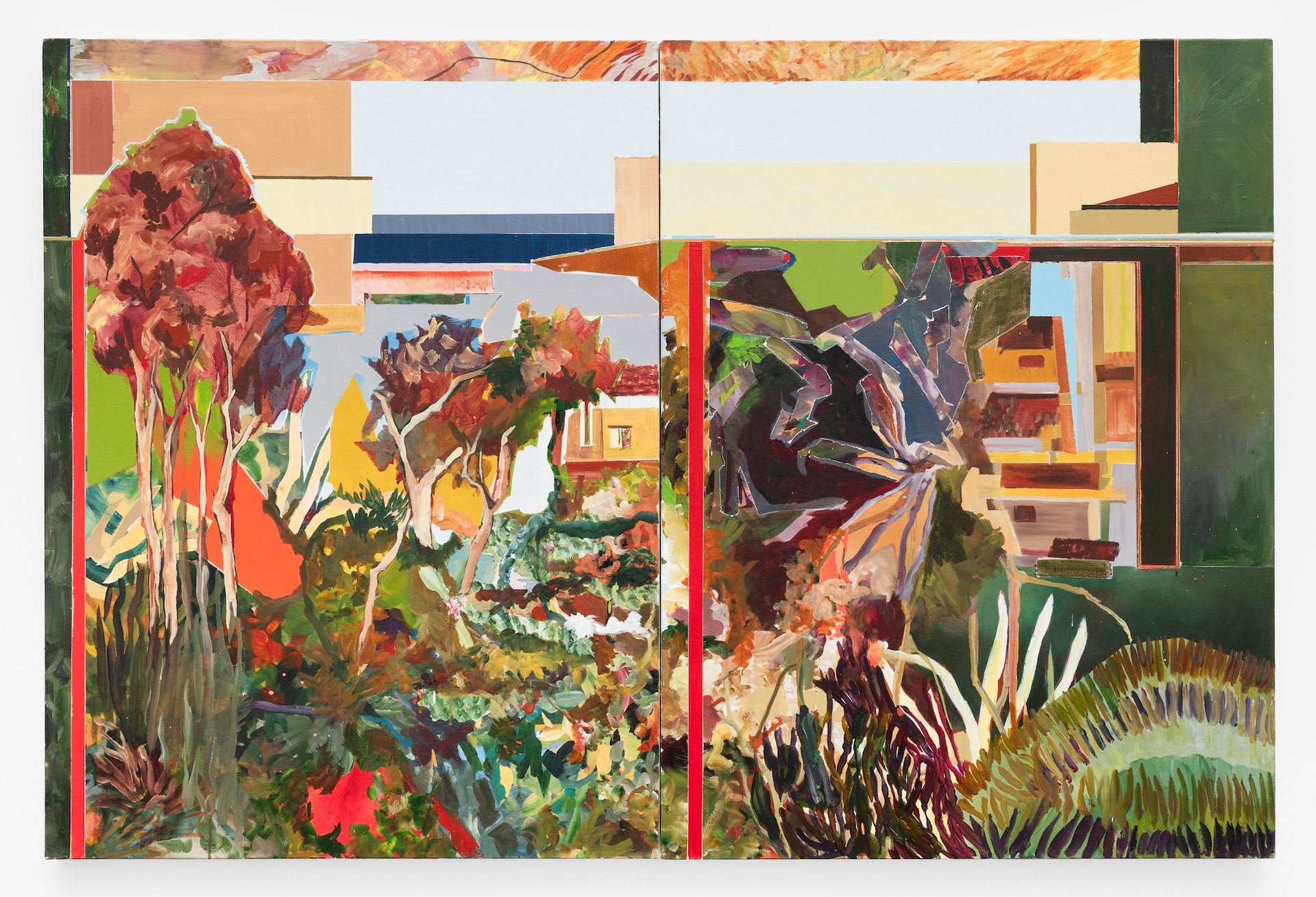
Lucia Laguna, Paisagem nº 183 (Landscape nº 183), 2026 © Lucia Laguna. Courtesy of the artist; Fortes D’Aloia & Gabriel, São Paulo/Rio de Janeiro; and Galerie Lelong, New York.
“I don’t think I have a style at all,” Laguna said in the 2024 SP-Arte interview. “Style is something personal—it comes from your own private world. In my case, I eliminate certain areas and introduce others. I layer parts of the painting. Fundamentally, that is what painting is: looking through a window at a reality outside.” She added: “My intention from the start was to reproduce what I saw through the window—reconstructing landscapes from my own point of view and trying to surprise the viewer.”
Fortes emphasises Laguna’s singular place in contemporary painting, adding that the complexity of her method made her work impossible to predict or replicate. “She used a lot of masking tape. She would add and remove things within those spaces,” Fortes says. “It was a process of accumulation and erasure. [At times] there were as many as 16 layers. It was a very rich style of painting.”
Laguna also rotated her canvases as she worked, Fortes adds: “So, you might see a palm tree amid small houses, and suddenly it’s sideways or upside down, while another house appears from a different direction.”
According to Fortes, her gallery first learned about Laguna through two key figures in the Brazilian art scene: the artist Beatriz Milhazes and the curator Paulo Herkenhoff. It was Herkenhoff, she says, who was particularly persistent, arguing that Laguna needed broader international exposure. When Fortes started showing Laguna’s work at international art fairs, the question of her age always came up.
"When collectors asked me if she was a young artist, I usually told them, ‘She’s the oldest living emerging artist,’” Fortes says.
Laguna had initially worked with a smaller gallery in Rio de Janeiro. When that gallery closed, Fortes D’Aloia & Gabriel took her on. That was shortly before the opening of the 30th Bienal de São Paulo in 2012, and Fortes recalls discovering how strong-willed Laguna could be during the installation process.
“There were paintings resting on the floor, paintings high up on the wall, paintings at various heights clustered together—in short, it was like an open-studio presentation,” Fortes says. She tried to persuade Laguna that a more “conventional, cleaner look” would suit a newcomer to the art world, but the artist would not hear of it. “She was very sure about it, and it worked.”
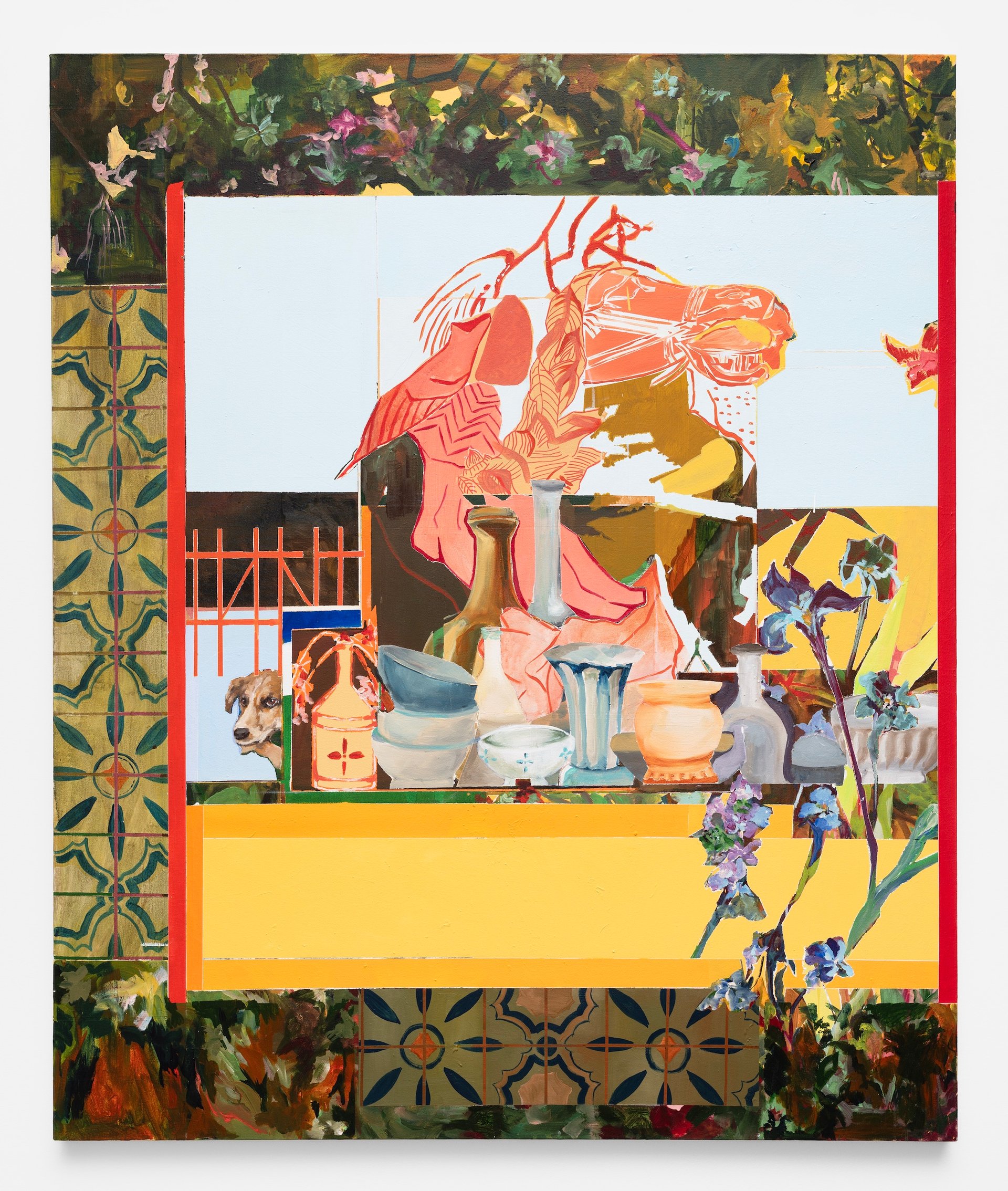
Lucia Laguna, Paisagem nº 177 (Landscape nº 177), 2026 © Lucia Laguna. Courtesy of the artist; Fortes D’Aloia & Gabriel, São Paulo/Rio de Janeiro; and Galerie Lelong, New York
Throughout the 2010s, Laguna became well-known in Brazil but did not receive much international exposure. That changed in 2021, the year she turned 80. Fortes recounts a serendipitous encounter at that year’s Art Basel fair in Switzerland, which was held in September and that some dealers skipped because of the pandemic. Fortes D’Aloia & Gabriel took part, occupying a stand usually held by 303 Gallery, directly across from Sadie Coles HQ.
“My outer wall had a beautiful diptych by Laguna, and Sadie worked looking at that painting all day, every day,” Fortes says. “One day, I saw her admiring the work, and I jumped at the chance to show her Laguna’s portfolio.”
A week later, according to Fortes, Coles called to offer Laguna a solo exhibition. The artist opened her first London solo show, Life Is Only Possible Reinvented, in November 2022 at Sadie Coles HQ.
“Throughout her career, Lucia developed a body of work defined by her engagement with landscape, memory and everyday life,” a spokesperson for Sadie Coles HQ said in a statement. “Her paintings incorporate fragments of the city, houses, gardens and her surroundings, which are transformed into complex compositions through processes of accumulation and erasure, in successive layers of paint. Her work, at once intimate and open to the world, occupies a fundamental place in contemporary Brazilian art.”
Laguna’s first solo exhibition in the US and debut with Galerie Lelong, Apenas Meus Cabelos São Brancos (Only My Hair Is White), opened in New York in May. The bright, colour-filled canvases, some enormous in scale, once again reflected her distinctive view of her surroundings.
“As the geographer Milton Santos put it: ‘The world is what one sees from where one stands.’ That was my starting point. I was there—on Rua Nazário [in Rio de Janeiro]—surrounded by a landscape: a garden, my own home. So, that was what I would paint,” she said in the 2024 interview. “All that vast expanse of buildings, the urban sprawl and the city’s suffocating density—it was all right there.”