“My pictures describe me correctly,” Richard Dadd announces at the beginning of Jennifer Higgie’s Bedlam: A Novel. The declaration is seductive but invented. First published in 2006 and reissued to coincide with the exhibition Richard Dadd: Beyond Bedlam at the Royal Academy of Arts, Higgie’s novel imagines what the Victorian painter’s surviving archive cannot supply: an inner life. The lyrical, lucid fiction follows Dadd on his 1842-43 journey through Europe and the Eastern Mediterranean, as heightened perception turned into delusion. Several months after returning to England, the paranoid traveller murdered his father. Dadd spent the remaining 42 years of his life confined, first at Bethlem Royal Hospital, popularly known as Bedlam, and then Broadmoor psychiatric hospital.
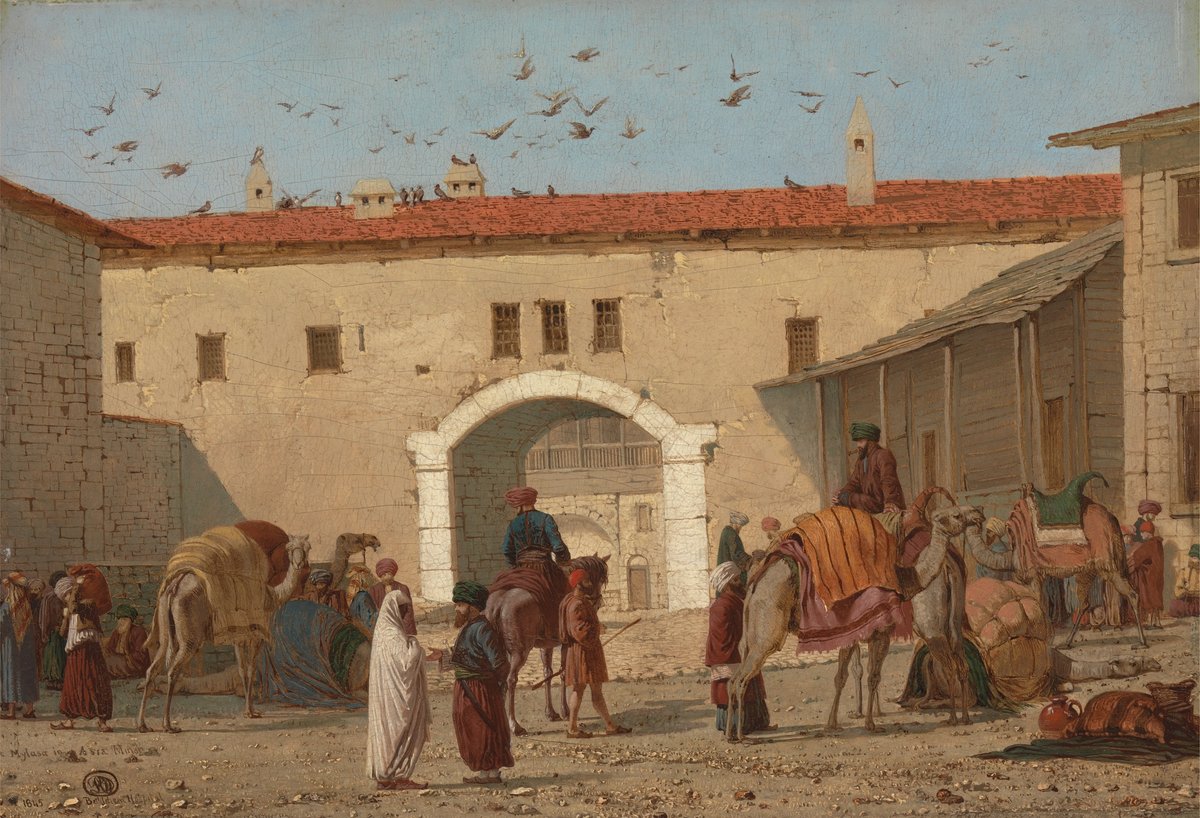
In brief sections that move between prose poetry and Woolfian-style streams of consciousness, Higgie transforms Dadd’s sketchbooks—fine-lined records of lush landscapes, ornate temples, staggering vistas and vignettes of people in local costume—into a first-person travelogue that spans Germany, Italy, Greece, the Ottoman Empire, Palestine and Egypt. The careful parsing of each new place’s colours, customs, fabrics, scents and foliage soon gives way to ecstatic physical sensations: mounting temperatures, a quickening heartbeat, blood thickening in the veins.
“The idea of the sun has been growing in me since I was born,” Dadd reflects early in his travel journal. Gradually, the sun turns from an artistic preoccupation to a private hallucination, bound up with the Egyptian god Osiris. It is Osiris and his messengers, or demons, that instruct Dadd to mistrust appearances. Higgie deftly traces how the artist’s observations acquire the force of revelation. The progression is incremental: the visible world remains exquisitely particular with “cool lemon-coloured women” and villages resembling “deserted ant hills” even as illusory objects and spirits begin to address him directly. “Everything that exists,” he declares, “whispers to me”.
Murder foretold
And yet the novel’s retrospective structure turns too many details into omens. It opens at Broadmoor in 1885, with Dadd reflecting on the “fulcrum” of his life; thereafter, every mention of a father, a knife or a blade flashing in sunlight seems to anticipate the patricide. The journey begins to feel overdetermined.
As its title suggests, the Royal Academy exhibition and accompanying catalogue push in the opposite direction, seeking to loosen the hold Dadd’s sensational biography has on his art. The catalogue’s four essays situate the artist within the historic traditions in which he was trained and the broader culture with which he remained engaged throughout his confinement. Dadd’s images emerged not only from what Charles Baudelaire described as “the wind of the wing of madness”, but from artistic convention, popular literature, institutional circumstances and contemporary socio-political debates.
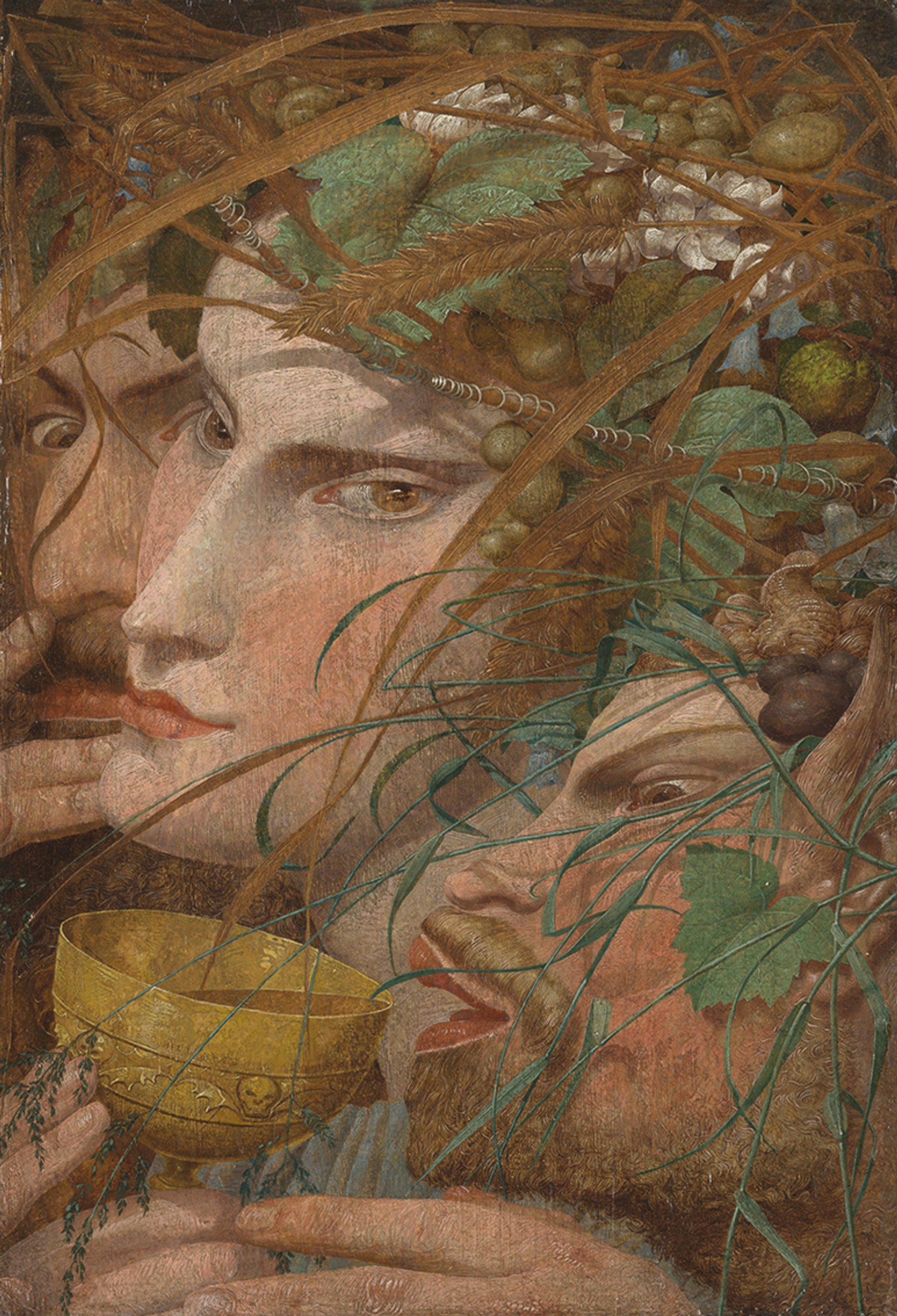
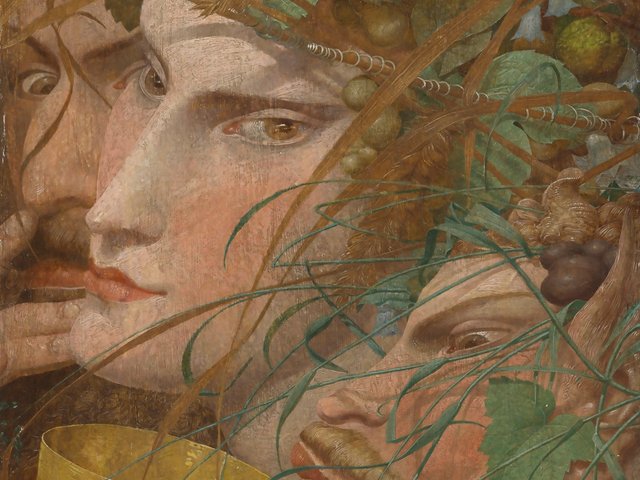
Dadd’s Bacchanalian Scene (1862) Courtesy of Tate
The first essay begins with Dadd at Broadmoor in 1877 discussing Edward Poynter’s Atalanta’s Race (1875) with a journalist and recalling his own thwarted ambition to become a Royal Academician. Nicholas Tromans, a specialist in 19th-century British painting and the exhibition’s curator, uses the exchange to restore Dadd’s professional pride and clear-eyed sense of exclusion to the record. He goes on to reconstruct the uneasy career Dadd maintained while hospitalised, during which the doctors and attendants who controlled his daily life also became his sitters, patrons and critics. Bethlem’s steward, George Henry Haydon, even commissioned his best-known work, the phantasmagoric The Fairy Feller’s Master-Stroke (1855-64), on which Dadd laboured for nearly a decade.
Sarah Thomas brings to bear the Victorian world beyond the hospital walls on the watercolour The Child’s Problem (1857). In this intricate work, a distressed boy confronts a chessboard while his adult opponent dozes on a nearby chaise. Behind them hang framed depictions of a supplicant figure with bound hands raised and a slave ship helmed by a Black captain. Both references Thomas connects to the abolitionist movement circulating through Dadd’s milieu. Whether they express his political views or represent another of his elaborate visual puns, she leaves unresolved. For Dadd, history, she writes, is “both everywhere and nowhere”.
‘Sleep-jumbled memories’
Meanwhile, Cora Gilroy-Ware identifies the ghosts haunting Dadd’s fairies. Their classical nude forms and spiralling arabesques carry what one contemporary called the “sleep-jumbled memories of things”: classical casts, reproductive engravings, works by John Flaxman, Daniel Maclise and Henry Fuseli, and figures drawn from Shakespeare and Greek mythology. However singular and sensational Dadd’s visions appeared, Gilroy-Ware shows them to be crowded with precedent, laden with references.
The catalogue’s willingness to preserve ambiguity about what lies “beyond Bedlam” for Dadd is reversed in its final essay, in which psychiatrist Robert Howard retrospectively diagnoses him with schizophrenia. Howard’s refusal to romanticise psychosis—and attention to Dadd’s profound terror and loss of agency—offers a welcome counterweight to the familiar image of the lone genius suffering for his art. Nevertheless, Howard’s closing portrait of a 21st-century Dadd recast as an artistic celebrity, buoyed by a robust social media presence and an enlightened treatment team, registers as slightly glib amid the continuing criminalisation and marginalisation of people with severe mental illness.
“Perhaps it is the story that chooses the man,” Higgie’s Dadd observes, “and wraps him in it until he suffocates.” Both volumes show how tightly madness and murder have wrapped themselves around the artist. The most compelling account may be one capacious enough to accommodate what remains unknowable. Dadd’s pictures may indeed describe him, but never “correctly” or completely—at least to those of us standing outside their frames.
• Nicholas Tromans, Natasha Fyffe, Cora Gilroy-Ware, Robert Howard and Sarah Thomas, Richard Dadd: Beyond Bedlam, Royal Academy of Arts, 160pp, 110 col. illust., £30/£25 RA Shop online (hb), published 10 July
• Jennifer Higgie, Bedlam: A Novel, Verso, 240pp, £10.99 (pb), first published 2006, reissued July 2026
• Richard Dadd: Beyond Bedlam, Royal Academy of Arts, London, until 25 October
• Tara Anne Dalbow is a Los Angeles-based writer and curator