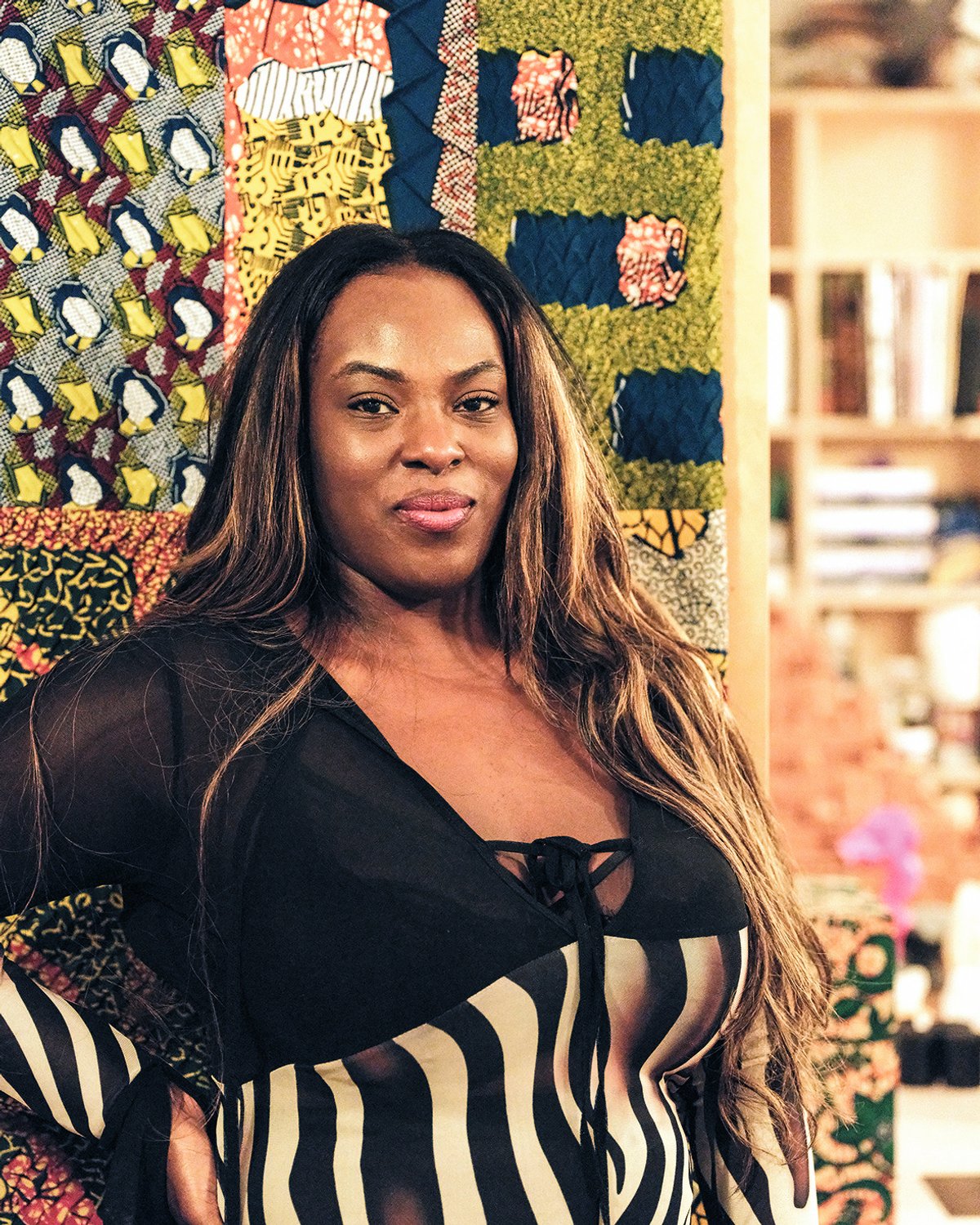
When Bolanle Tajudeen announced her gallery in 2023, she was not sure what that meant. “I’ve just always wanted one, so I announced it, and I didn’t really have a plan,” she says. The curator and arts educator, known for her online art school, Black Blossoms, hoped to support emerging and mid-career artists through curatorial projects, rather than simply establishing a conventional commercial space. Thus, Bolanle Contemporary was born, without a permanent home or an immediate roster of artists. Three years on, it has exhibited with Frieze’s No.9 Cork Street and Sadie Coles HQ, as well as at fairs in London and Miami Beach.
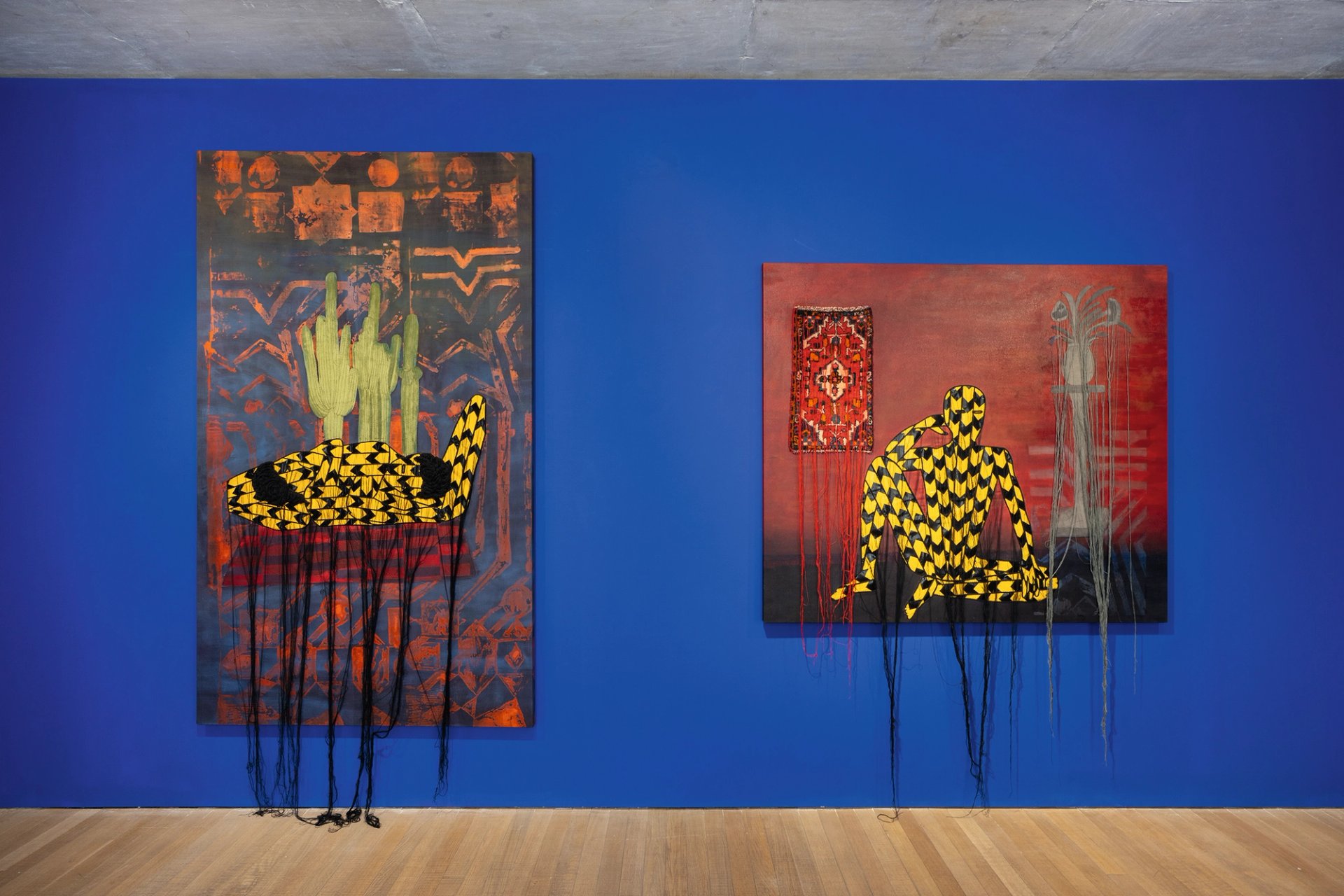
Bolanle Contemporary held a solo presentation by Osman Yousefzada at No. 9 Cork Street last April Damian Griffiths
This year, Bolanle Contemporary is the only nomadic gallery to show at Frieze London. This comes after the fair formally removed galleries needing to have a physical space from its requirements for its contemporary art fairs earlier this year, starting with Frieze Seoul.
“Some of the most exciting galleries working today are operating without permanent spaces, or through a combination of temporary exhibitions, collaborations and fairs,” says Kristell Chadé, the executive director of fairs at Frieze. “We want our eligibility criteria to recognise the quality of a gallery’s programme rather than prescribe a single way in which it must operate.”
Eva Langret, Frieze’s director of Europe, the Middle East and Africa, notes that, even before starting her gallery, Tajudeen had “been part of London’s art scene for many years, creating opportunities for artists and practices that might otherwise go unseen”. At the fair, Bolanle Contemporary is taking part in Artist-to-Artist, a curated programme that sees established international artists select emerging ones for solo presentations. The New York-based Dominican artist Firelei Báez chose the Dominican American Eilen Itzel do Espírito Santo, “which feels like a fitting reflection of that spirit”, Langret says. Do Espírito Santo graduated with an MFA in painting from the Slade School of Fine Art in 2024, and is showing abstract paintings, prints, drawings and sculptures.
Necessity over defiance
For Tajudeen, not having a physical space was never an act of defiance but one of necessity, she says, noting that it is “the biggest overheads [for a gallery] alongside participating in all of the international fairs”. She adds: “My goal is to have one eventually, but I don’t think the market right now is in a place where I can take that on.” Emerging and established galleries alike have felt this tension, with some of the industry’s biggest names having to close spaces in prime locations to stay afloat. Stephen Friedman Gallery, for example, closed its Tribeca space late last year before entering administration and closing its Cork Street flagship in February.
Yet for many gallerists this changing landscape presents an opportunity to reconsider what a gallery is and does. While forgoing a permanent physical space can mean missing out on organic connections generated by foot traffic, or relying on unconventional venues that might impose constraints on the artist’s work, on the other hand, it means that everything “does not always have to happen in the same building”, Chadé says, adding that she has noticed many galleries’ “willingness to think differently about how they support artists and create meaningful encounters with their work”.
In 2024 Artsy described the nomadic gallery model as part of a post-pandemic phenomenon driven by soaring real estate prices, a stronger relationship with technology globally and, sometimes, ethical reasons. But for some galleries, it is an integral part of their practice. One of these is Superposition Gallery, founded by the artist, curator and writer Storm Ascher in 2018, and primarily showing in temporary spaces in Los Angeles, New York and Miami. This includes exhibiting at Frieze Los Angeles over the past two years, making it one of the few nomadic galleries to have participated in Frieze’s contemporary art fairs before the criteria changed.

Superposition presented work by Helina Metaferia at this year’s Expo Chicago Courtesy of Superposition Gallery
Local angle
Ascher explains that while a gallery’s “credibility is often measured by square footage”, Superposition is prospering regardless, having exhibited February James and Greg Ito at Frieze Los Angeles; the Philadelphia Museum of Art acquired a piece by Helina Metaferia from its 2026 stand at Expo Chicago; and at this year’s Armory Show, its artist Zoë Pulley won the fair’s inaugural Bronx Museum Acquisition Prize. “Without a permanent space, the fair is where Superposition physically comes to life, so I treat every booth as its own exhibition,” Ascher says. “I design it around the artist’s world rather than a neutral backdrop, and the response from collectors and institutions has been remarkable.”
Superposition also involves the locals of a fair, giving opportunities to those who might not engage with art in this way. “When we brought Alex Anderson to the Seattle Art Fair, [taking place earlier this year] in his hometown, the presentation carried on outside the fair with dinners and gatherings for the community that raised him,” Ascher says. “That kind of connection is our foundation.” She references criticism of the 1893 Chicago World’s Fair, an international exposition showcasing a range of human achievement from technology to fine art, where the committee was accused of purposefully excluding African Americans, as inspiration for this aspect of her approach. “[Journalist and activist] Ida B. Wells and [the abolitionist] Frederick Douglass handed out a pamphlet protesting that Black Americans had been left out,” she says. “So we build trust by showing up fully.”
Tajudeen describes Bolanle Contemporary as operating with an “artist-first” approach. For Tajudeen, this means helping the artist secure institutional placements, press coverage and introductions to curators, as well as developing broader networks both nationally and internationally. It also allows Bolanle Contemporary to direct more resources to exhibitions. “I really care about curating installations that are memorable and museum-
worthy,” Tajudeen says, adding that she is particularly committed to solo and two-person shows. “Group shows are great marketing for the gallery, whereas solo shows are great marketing for the artists.”
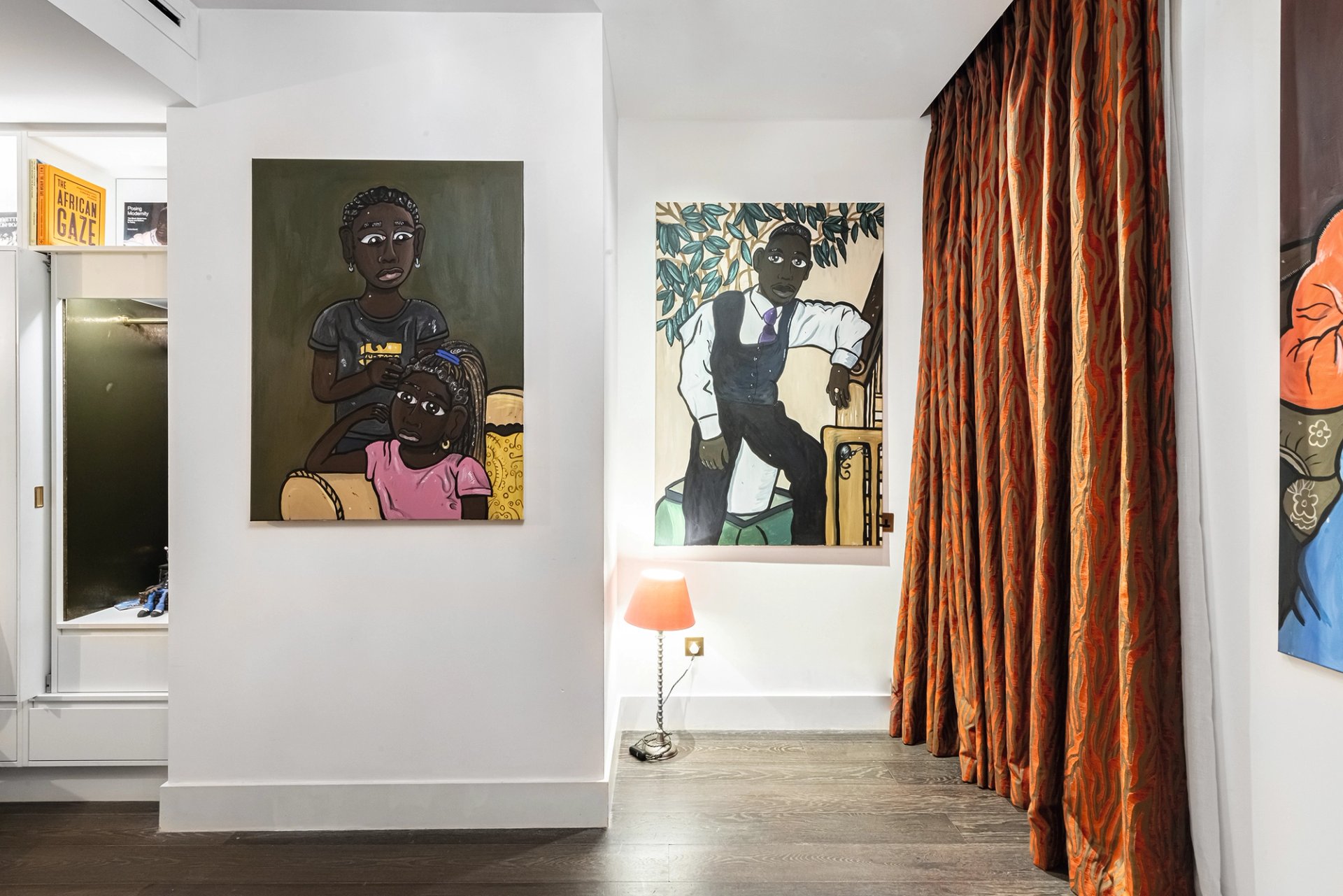
At the Minor Attractions fair in 2024, Bolanle Contemporary exhibited Djofray Makumbu Courtesy of the artist and Bolanle Contemporary
For the 2025 edition of the alternative art fair Minor Attractions (which for the past three years has offered luxury hotel rooms as gallery spaces), Bolanle Contemporary transformed its room at The Mandrake Hotel into a traditional Jamaican wake. The presentation by the artist Ramone K. Anderson took the form of a shrine-like memorial inspired by Jamaican Nine-Night (a community vigil that runs in the days leading up to a formal farewell) with a stereo, hanging clothes, shelves of collectables and CDs. It was awarded the WYN Exhibitor Prize for best domestic booth presentation.
Tajudeen also points out that her gallery’s show with the British-Congolese artist Djofray Makumbu at Minor Attractions the year before saw the re-creation of a classic Congolese living room, complete with a nostalgic 1970s television, alongside videos and music from the country. “We tried to create [unique experiential exhibitions]—which we developed with the artist—without it being too like set design or gimmicky,” she says.
Tajudeen emphasises her distaste for the term “nomadic”, explaining that it does not encapsulate all that her gallery does. “The art world is all about words, and I think nomadic is a really ugly one; it’s not sexy,” she says. Instead, she calls Bolanle Contemporary “a contemporary art gallery with an international exhibition programme”. She adds: “Words that feel a bit more sophisticated could help more people in the arts move to this new way of running galleries without a fixed location.”
A gallery can be wherever its people are, and the art world is richer for itBolanle Tajudeen, gallerist
But, regardless of semantics, Frieze’s decision to alter its rules suggests that perceptions of what constitutes a gallery are changing. For Ascher, removing the requirement for real estate “lowers the barrier for young dealers, makes room for artists who’ve been shut out, and draws in collectors who want a relationship with the work, not just an asset”, she says. “A gallery can be wherever its people are, and the art world is richer for it.”