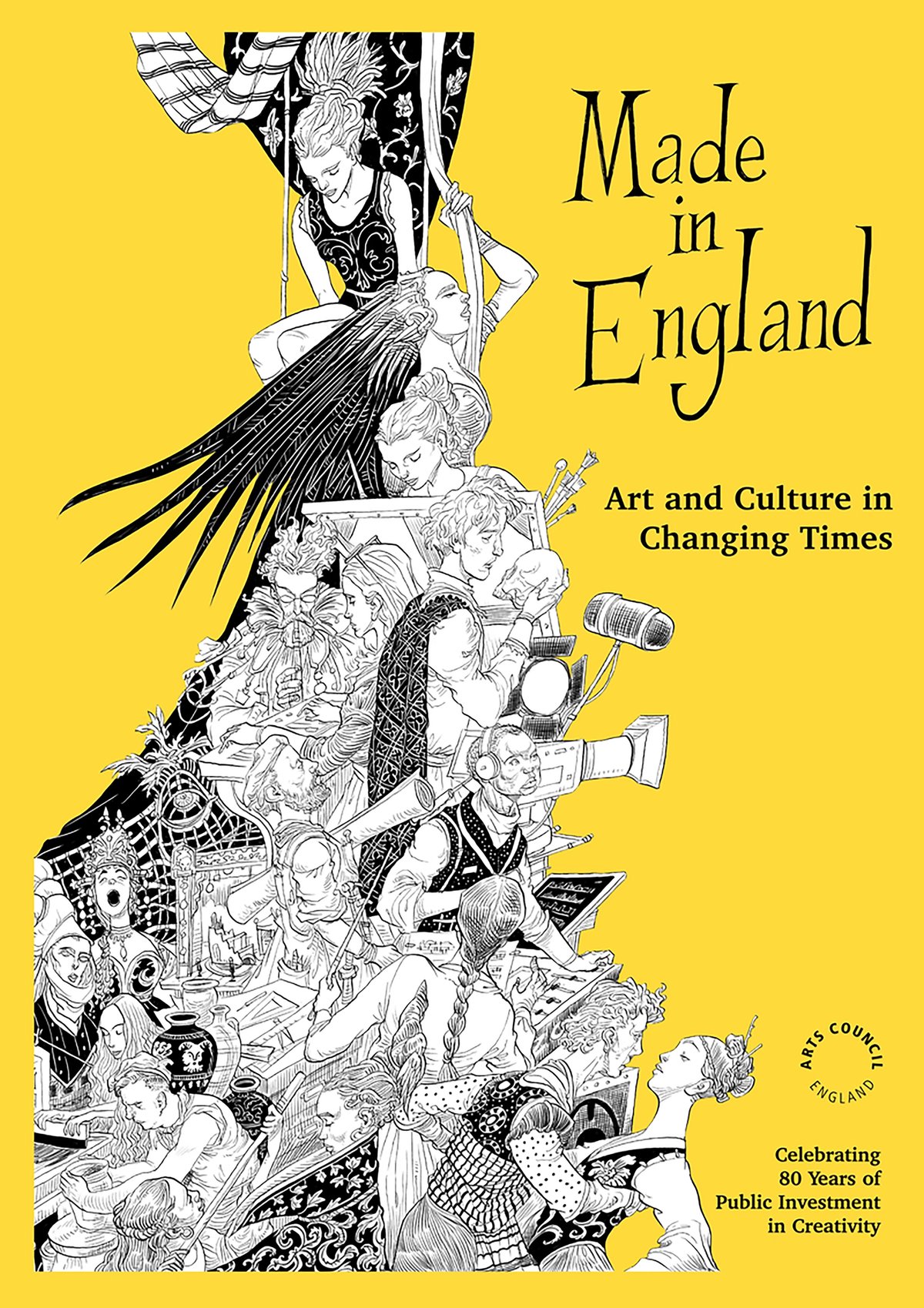
This is a book that nobody needs, and only a few arts bureaucrats want. It is presented as a celebration of “eighty years of public investment in creativity”. The 80 years belong to Arts Council England (ACE), established in 1946 as the Arts Council of Great Britain. The book also marks the departure of Nicholas Serota as chairman after nine difficult years, and he provides an introduction.
This is not a book about the real Arts Council. You will find nothing about the crises that led to the disappearance of the Regional Arts Boards. There is no discussion of the National Lottery, neither of its beneficial effects nor of the complete disappearance of “additionality” that once separated government grant-in-aid from lottery money. There is nothing addressing the crisis in the arts since 2010, when ACE lost a third of its funding. There is nothing about the loss of local authority funding. You will learn nothing of the activities of Tory arts minister Nadine Dorries. There is nothing about ACE’s decision to abandon a ten-year strategy, “Let’s Create”, in the wake of the 2025 report by Margaret Hodge. There is no simple, clear outline of what ACE thinks it is doing. And no hint that the arts might be about upsetting ideas and people, rather than adding a pleasing texture to public life.
Instead, we are presented with 16 essays by various hands, who for the most part have reason to see ACE as a “Good Thing”. The Arts Council is indeed a “Good Thing”, since it distributes roughly £1bn a year. That does not mean that it is well run.
As Serota admits, “our sector’s health depends on money”, and the actual, dire state of funding for the arts keeps breaking through. The UK is second only to Greece at the bottom of the European league for arts funding. Carlos Acosta, the director of Birmingham Royal Ballet, writes: “If you look at the core audience of the ballet world, it’s shrinking, and there is not a replacement”. According to Bobby Seagull, the ambassador for National Numeracy, our stewardship of libraries has “faltered”. A discussion of “massively undervalued” arts centres points out that the past 20 years has been spent “removing most of the space” they had. Jacqui O’Hanlon, the director of creative learning at the Royal Shakespeare Company, asks: “How is it that in 2026 we have still not found a universal system that ensures every child, regardless of background, can encounter the arts, and can fulfil their potential?”
Two contributors are more direct. In a rare break into history, the arts consultant Amanda Parker examines the late Naseem Khan’s 1976 The Arts That Britain Ignores, a report on “minority arts” that launched the Arts Council into the issue of “diversity” that has plagued it ever since. Parker argues that Khan’s emphasis on community arts, rather than the professional creative potential of ethnic minorities, unintentionally perpetuated a “patrician, paternalistic, quasi-colonial view” that lingers today. Though representation is better than it was, between 2010 and 2020 less than 3% of funding for regularly funded (National Portfolio) organisations went to Black, Asian or minority-led groups: “funding decisions are still largely made by individuals unfamiliar with the communities they are assessing”.
Explain excellence
The same can be said of disabled people, though Jo Verrent, the director of the disabled artists commissioning organisation Unlimited, points out that 25% of the British population has a disability of some kind: “the arts sector has systematically excluded disabled artists” and she is “exhausted”.
While Nigel Higgins, the chairman of Barclays, makes a coherent economic case of funding the arts, “leaving the poetry to others”, the essays conclude with ACE’s chief executive Darren Henley, in post since 2015, giving another account of his tours around the country. His title is “Excellence. For Everybody. Everywhere.” ACE’s new mantra. He uses the term regularly, but nowhere does he dare define what excellence is.
Sarah Crown, Martin Prendergast and Nicholas Serota (eds), Made in England: Art and Culture in Changing Times, Comma Publishing/Arts Council England, 222pp, 4 b/w illust., £12.99 (pb), published 7 July
• Robert Hewison is a cultural historian and commentator