


When the Hirshhorn Museum and Sculpture Garden opened in 1974 in Washington, DC, The New York Times called it “the capital’s newest cultural treasure”. Likening the Hirshhorn to a René Magritte picture, reporters drew out the “juxtaposition of man and nature with architecture”, the seamless melding of light and form, indoors and out, that sets apart its collection of Modern and contemporary art.
On 31 October, the Hirshhorn is scheduled to unveil a new cultural treasure: its $68m renovated sculpture garden. The project has been years in the making, designed by the Japanese artist Hiroshi Sugimoto—who also redesigned the museum’s lobby in 2018. The reorganised 1.3-acre space, with its 30,000 new plants and trees, draws on the architect Gordon Bunshaft’s original design. This is part of a broader transformation at the museum, including renovations to the plaza and building infrastructure.
Featuring 60 works—21 of them from the 1974 installation—the renovated garden includes five entrances, east and west overlooks and an underground passageway of stainless steel. Sugimoto describes its mirrored finish as “reflecting the garden and the people moving through it, an experience in itself—one that is continually transformed by the interplay of light, nature and the visitors”.
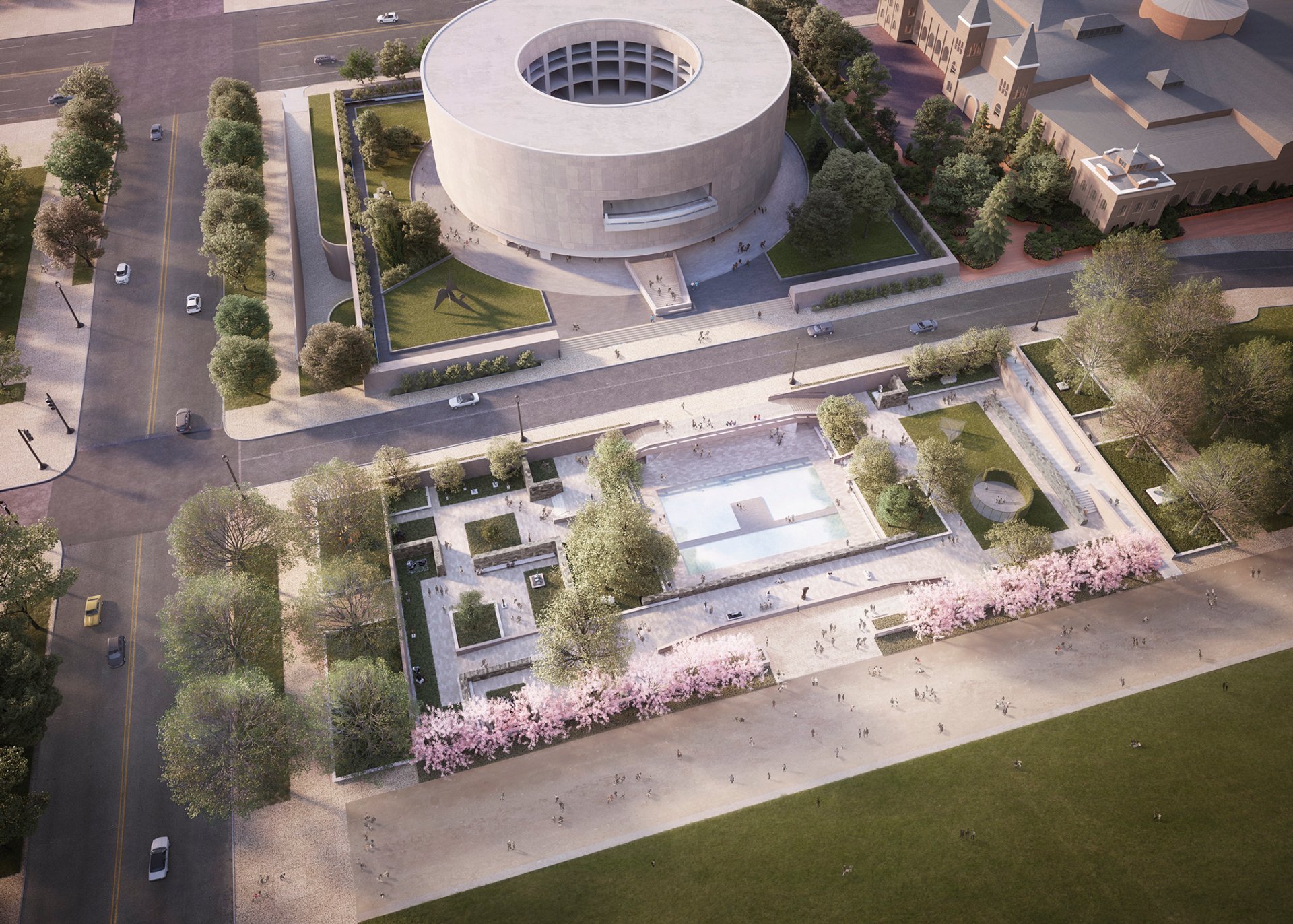
A rendering of the Hirshhorn’s revamped garden Hirshhorn Museum and Sculpture Garden
I decided a Japanese dry-stone wall would serve as a symbolic link between the ancient and the modernHiroshi Sugimoto
The walkways and alcoves are delineated using stacked-stone walls, each hand-selected and arranged by the artist. “Bunshaft was deeply influenced by the stone gardens of medieval Japan,” Sugimoto tells The Art Newspaper. “Inspired by this, I decided a Japanese dry-stone wall would serve as a symbolic link between the ancient and the modern, providing the perfect backdrop for the museum’s Modernist sculptures.”
The garden’s opening follows years of controversy. Sugimoto’s early vision for the space was met with criticism. In 2021, Charles A. Birnbaum (the president and chief executive of the Cultural Landscape Foundation) said that the stacked-stone plan “fundamentally disrupts” the garden’s Modernist design and the “artistic intent” of Bunshaft and the landscape architect Lester Collins.
Adjustments to Sugimoto’s initial design were made five years ago, according to the Hirshhorn, after a public consultation process as well as meetings with the National Capital Planning Commission and the Commission of Fine Arts. In 2022, the museum hosted a groundbreaking ceremony with Jill Biden. “I was amazed by the backlash,” Sugimoto said at the time.
Today, Birnbaum stresses that the Hirshhorn’s “landscape architecture is an art form” and urges the museum to “afford it the same curatorial oversight, care and respect as the rest of the material collection”.
A sense of calm
Sugimoto’s practice is meditative, rooted in a close study of the natural world. “There is an 11th-century Japanese garden manual, Sakuteiki, which tells us to ‘listen to the voices of the stones’,” he says. Each stone has its own character, weight and direction. He adds: “My task is not simply to place it, but to discover where it already wants to be; precision comes from listening carefully enough to find that inevitable position.”
This sense of balance is felt throughout the garden. With benches for quiet reflection and shaded, out-of-the-way recesses, the lawns encourage deep focus, an attentiveness to and a delight in the play of forms. “It’s not just about looking at art,” says Aaron Seeto, the Hirshhorn’s deputy director, “but about looking at it as the garden itself is changing.”
Sculpture in the space is arranged chronologically. The east garden includes a cast of Auguste Rodin’s poignant The Burghers of Calais (1884-89), its six figures weighed down and their necks bound in a darkened procession. Nearby is Henri Matisse’s The Backs I-IV (1909-31), a series of abstracted nudes in bronze relief, their angular silhouettes catching the light.
Henry Moore’s King and Queen (1952-53) is one of five works by the artist on view. It depicts a pair of seated figures, their faces abstracted, the curve of their shoulders liquid smooth. “Joseph Hirshhorn was one of Moore’s closest friends and one of the most significant collectors of his work,” says Godfrey Worsdale, the director of the Henry Moore Foundation. (Joseph Hirshhorn owned 55 sculptures by Moore, and Hirshhorn’s fourth marriage took place before a cast of the artist’s Upright Motive No. 1: Glenkiln Cross.) Worsdale applauds the renovated garden for offering “unfettered access to Moore’s work for new generations”.
In the west garden, home to new commissions, stands Yoshitomo Nara’s Sentinels of Stillness series (2025)—three monumental heads, fashioned from aluminium and coated in brilliant white paint. Following the Tōhoku earthquake and nuclear disaster in 2011, Nara found himself unable to paint and instead took to sculpting. The physicality of modelling clay served as a kind of healing for him.
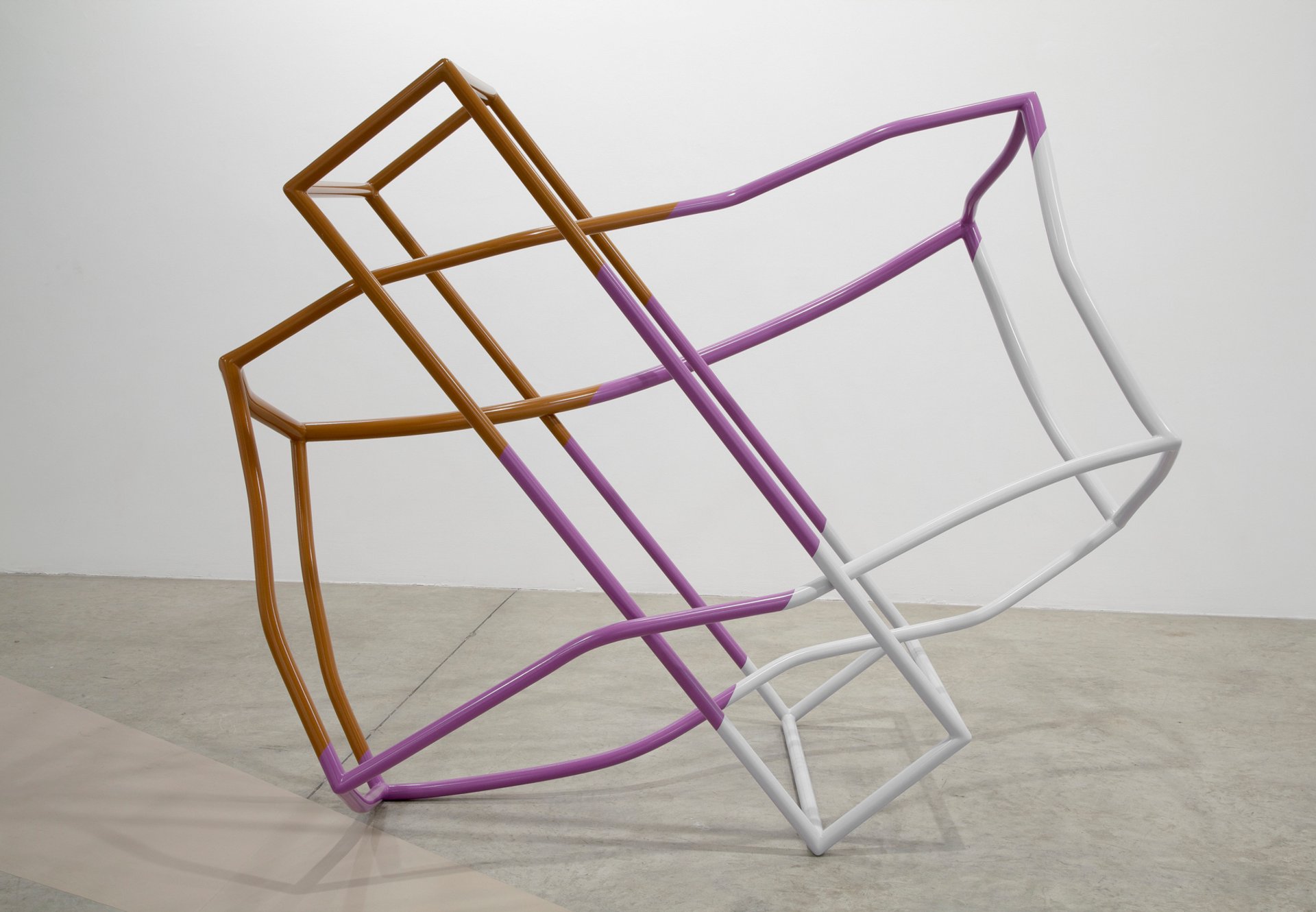
Liz Larner’s 6 (2010-11), now on show in the garden Photo: Jean Vong; Courtesy of Regen Projects
Liz Larner’s 6 (2010-11), meanwhile, is a cuboid of stainless steel in deep ochre, lavender and white—the tendril-like lines seeming to expand and contract as if suspended in air. The work is a kind of “variable in space”, says Larner, who is absorbed by the mathematical concept of x (the unknown). Following in the tradition of the Surrealist artist Meret Oppenheim, Larner explores the indefinable, “the variable of a variable, the changing perspectives that don’t ossify”.
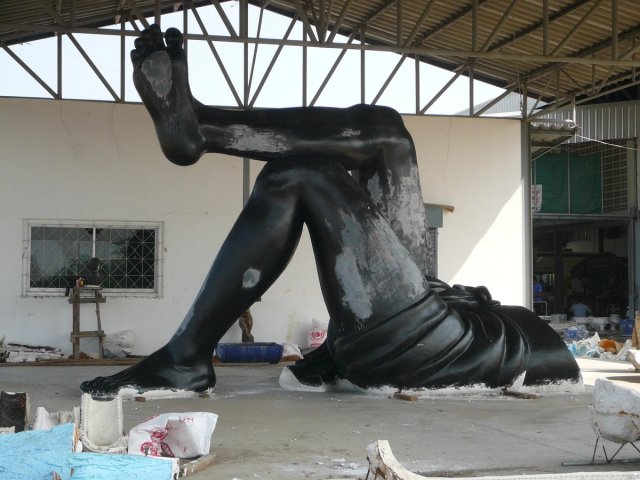
Comparably fluid is Raven Halfmoon’s Dancing at Dusk (2024), a neighbouring work of cream, coppery-red and slate-grey travertine. Halfmoon, a citizen of the Caddo Nation, gestures to violence and strength, pairing the themes in a work of banded-stone—her first in the medium—trimmed with a line of crosses. There is a kind of solemnity to the piece, the composite visage resolute, meeting the world as it is.
That pathos carries over to KAWS’s 14ft bronze SHELTER (2026), reminiscent of a mother and child—their eyes crossed out, their modelling soft, even tender. It is a warm embrace, the two encircled by an overhanging elm tree.
There is a stillness to the Hirshhorn’s new garden space, a sense of calm in the otherwise fast-moving capital city. “I hope people will experience a different sense of time in the garden,” Sugimoto says. “The sculptures, stones, trees, water and the changing light all exist on different clocks. The garden allows us to slow our own clock enough to become aware of these differences.”


