India’s art market rally has not yet slowed, judging by the fourth edition of Art Mumbai, held from 12-15 November. While several Indian dealers said that a clash with the Hindu festival Diwali had resulted in quieter VIP days than last year, this amounted to exhibitors rehanging around one-third of their stands, rather than 75%-100%.
The mushrooming wealth of India’s richest, who are shopping for big works to match bigger homes, appears more than capable of sustaining its small but growing domestic base of galleries and auction houses. The country’s secondary art market recorded its best year ever in 2025, at $272.1m, according to a recent report by the wealth managers 360One (a sponsor of the fair).
For India’s top galleries, success at Art Mumbai is now a foregone conclusion. “This fair is great for us, and right now I feel more inclined to invest my effort here than fairs abroad,” said Hena Kapadia, the founder of the dynamic local gallery Tarq, which sold the majority of its stand, including photographs by Ronny Sen, and rehung around 50% of it.
Notable sales in the fair’s contemporary section included a Subodh Gupta painting at the Delhi- and Mumbai-based Nature Morte, which placed to a new buyer of Indian-origin based in Europe, for €350,000. The gallery’s director Roma Patel noted that she met new collectors from south India, and diaspora collectors from Los Angeles, as well as existing clients, at the fair.
In the Modern tent, “some punchy prices” were noted by one auction executive. Works acquired at auction within the past 12 months were flipped for tidy profits, including M F Husain's 1991 Untitled (Horses & Ganesh) at Akar Prakar, bought from Bonhams in December 2025 for £179,000 (equivalent to $234,000) and resold for $600,000, although likely with a hefty discount.
Subtler gestures of confidence were also observed. Grosvenor Gallery, which counted among its sales a painting by the Sri Lankan Senaka Senanayake for a shade over $100,000, decided not to send PDFs prior to the fair. "We haven’t pre-sold anything for the past few fairs—a nice luxury afforded to us by the current market conditions, though it won’t last forever,” said the gallery’s director Charlie Moore.
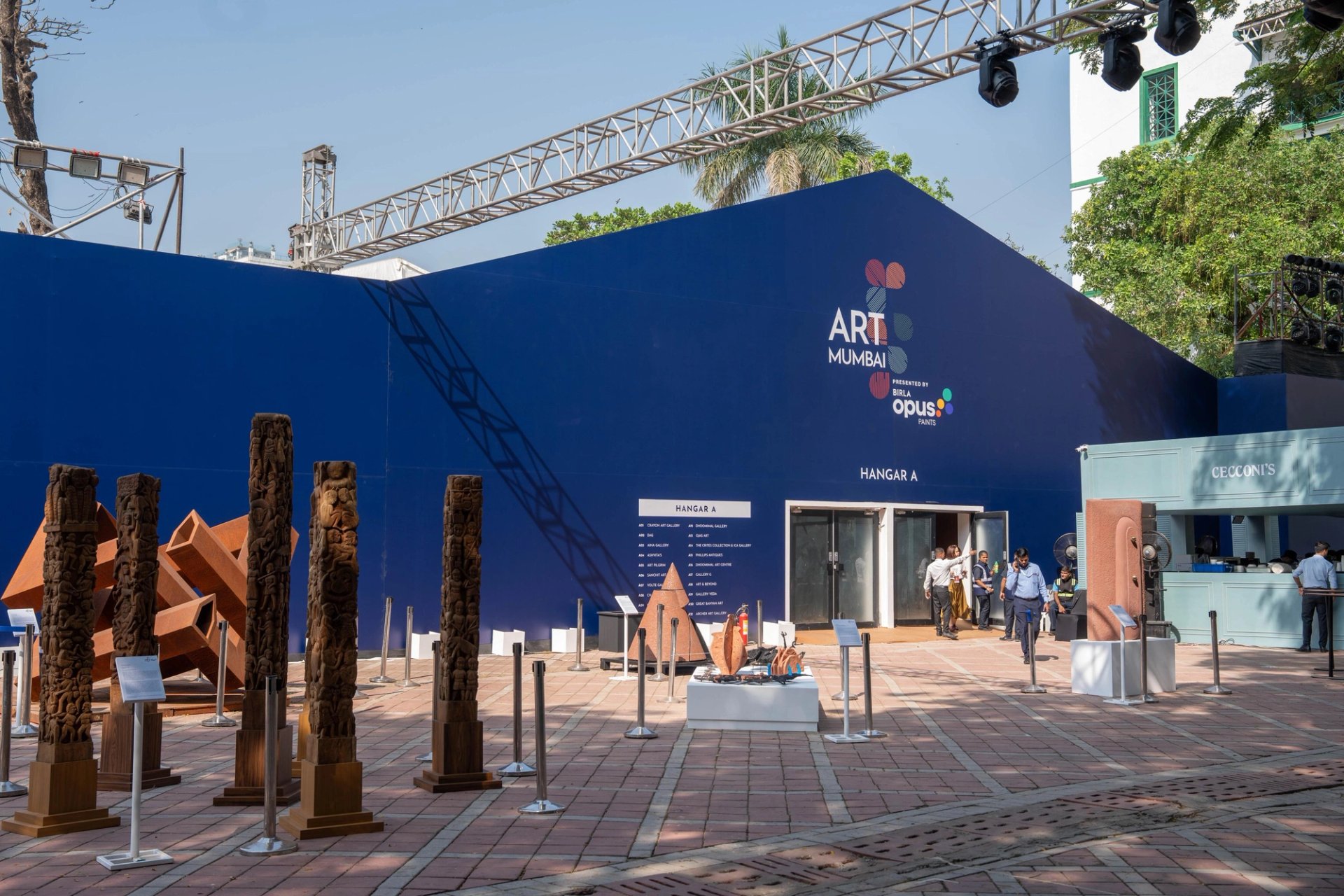
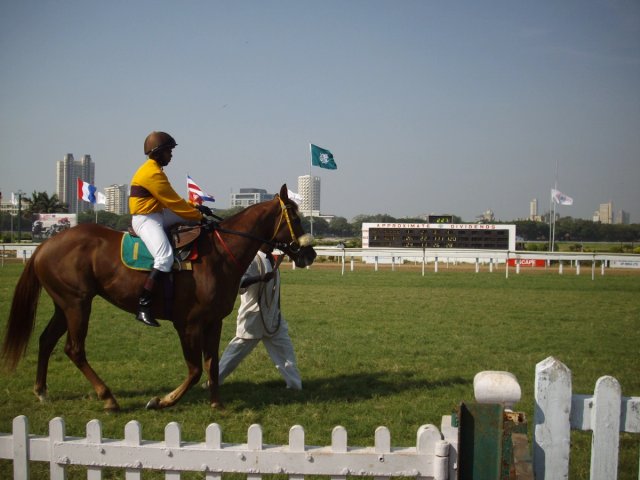
Art Mumbai takes places at the Mahalaxmi Racecourse
With India’s place on the global stage growing, and the predominant art markets of the US, Europe and China remaining relatively muted, international players are circling. Case in point, Frieze's chief executive Simon Fox, and Art Basel’s director of fairs Vincenzo de Bellis and head of VIP Carly Murphy, all attended Art Mumbai for the first time this year. Fox said this was his first India trip for work. Meanwhile, Art Basel’s India VIP representative Shaan Shahani noted that this visit marked the first India trip by Art Basel top brass in a decade.
Also testing these waters are the 12 international galleries that showed at Art Mumbai this year, up from seven last year. Newcomers included the global dealership Perrotin, Richard Saltoun and Niru Ratnam from London, and Rizq from Abu Dhabi, while Lisson, Continua, Ben Brown and Gallery Isabelle all returned from last year. Three international galleries that took part last year did not come back: Rossi & Rossi (Hong Kong); Leila Heller (New York and Dubai) and Saskia Fernando (Colombo).
Several of these large galleries continued to play it safe, bringing presentations to suit interior design-focused sensibilities and algorithmically informed taste—plenty of reflective surfaces, legible motifs and name brands, such as Ai Weiwei and Anish Kapoor. Lisson's sales topped out at £1.2m, and included two of Kapoor’s signature concave disc sculptures. Director Ellie Harrison-Read said that she had a "good fair but closing a few more sales could make it great”.
By and large, galleries that brought subtler or nicher works, struggled. Niru Ratnam did not place a work for the first two days, having pre-sold one painting by Amal Gosh to cover stand and shipping costs, though Ratnam noted that he made some sales towards the end of the week.
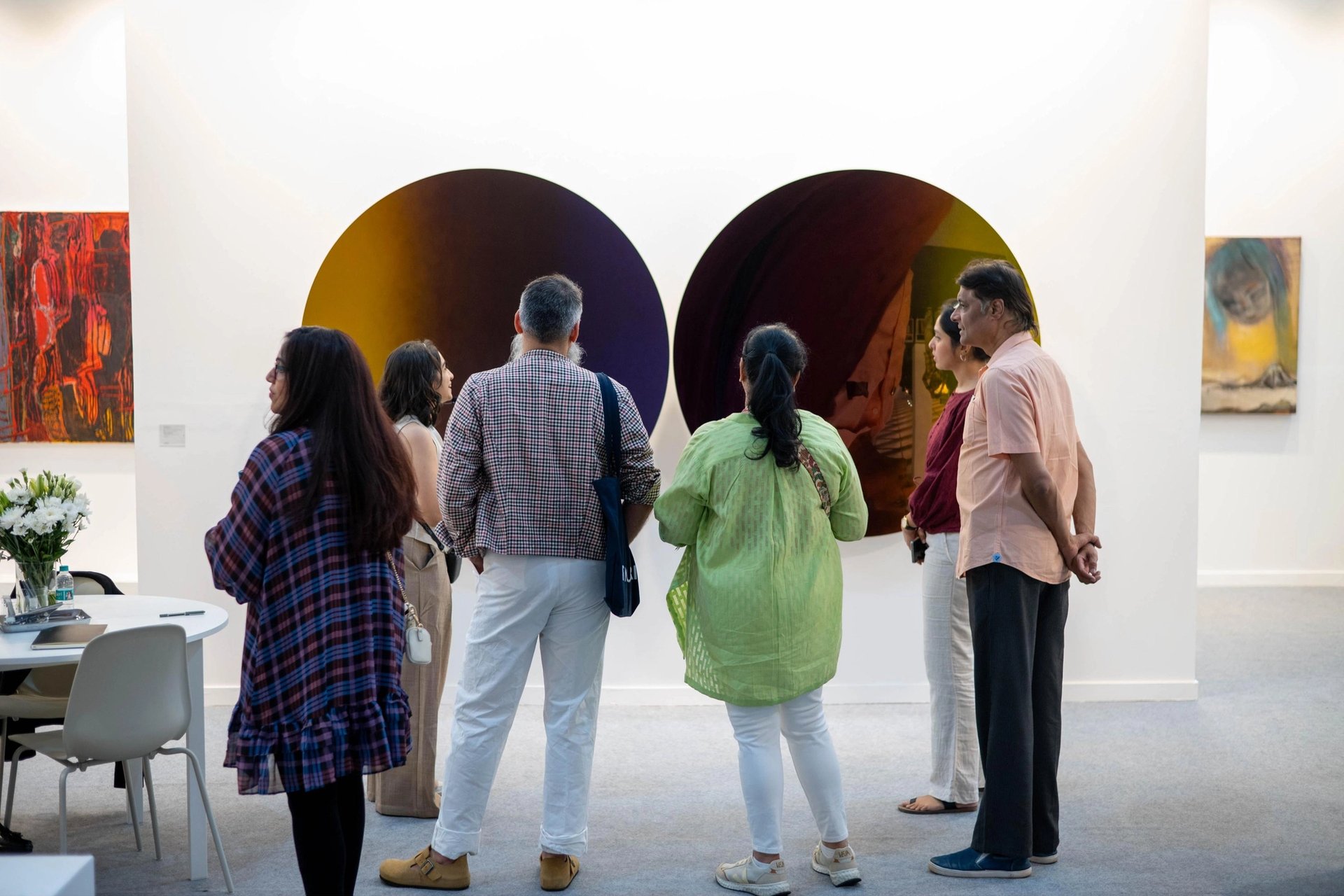
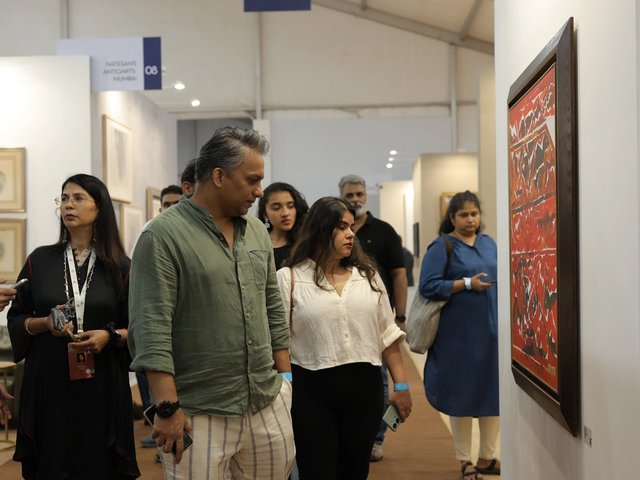
Visitors to Art Mumbai 2026
One of the clearer litmus tests for this market was a painting by Robert Nava, brought by the first-time exhibitor Night gallery from Los Angeles. Nava, who is co-represented by Pace, is a US-based market star whose naive figurative style sharply divides critics. The secondary-market painting, depicting a swimming cat, was tagged at $220,000, a hefty price for a buying pool unfamiliar with his work and where contemporary art by the most established artists rarely exceeds $400,000. It did not sell by the fair’s last day, but the gallery’s director Davida Nemeroff said she had engaged in several serious enquiries, including one local buyer who went home to measure their wall following a conversation on the stand. “We went in pretty blind, and didn’t know what to expect”, she said.
The gallery did however sell a $16,000 painting installation by Dhiya Mehra embossed with words from a speech by Surya Kant, India's former chief justice, that sparked the Cockroach Janata Party protests to the Kiran Nadar Museum of Art. “We’ve learned that if you don’t bring something vaguely South Asian, or a Picasso, it won’t sell," Nemeroff said.
Speaking of Picasso, one 1930s painting by the Spanish master was brought by Ben Brown, carrying a $4.5m price tag—the most expensive work brought to the fair in its four editions. Last year, the gallery brought a smaller painting by Picasso to Art Mumbai, which did not sell. Rather than being discouraged, this only convinced director Hugo Cobb to only double down. “Our feedback was that this market is now discerning enough for quality and it doesn’t want anything second rate,” he said.
As many international visitors and exhibitors will have observed, India now has no shortage of deep pocketed buyers, but its tastes are local and largely conservative. "Collecting in India is largely informed by pride in local culture, and familiarity," says the adviser Yamini Mehta. "The market here is still not ready for super conceptual stuff."
Further factors that keep India's art market more domestically focused than other Asian art market hubs include stifling bureaucracy and high taxes to ship works in and out of this country. As Richard Saltoun director Sakshi Mahajan said, "they don't make it easy or cheap to bring in work. Even when it's worth relatively small amounts".
Meanwhile, issues of black money circulating in the Indian art market persist. As one anonymous dealer noted, "many Indians might not want to send money abroad, for fear of those transactions being registered by the RBI (Reserve Bank of India)".
India's art market growth indeed appears to be domestic success story, in contrast to its last boom in the 2000s, which was fuelled by speculative buying, often from overseas collectors with no ties to the region.
While in buzzier Asian art markets like Seoul and Hong Kong, collectors covet international names at the expense of local talent, India protects and supports its own artists and its ecosystem—representatives from a growing number of new Indian biennials were spotted at the fair, including from the Bengal Biennial and the soon-to-launch Benares Biennial, both of whose artist lists are heavily weighted towards India and the wider South Asian region.
While India might not yet be ready for an international fair or an outpost of a mega gallery, it appears to be building something more valuable: an infrastructural network supporting homegrown talent, which will help to safeguard against another crash when the market eventually enters a soberer moment.