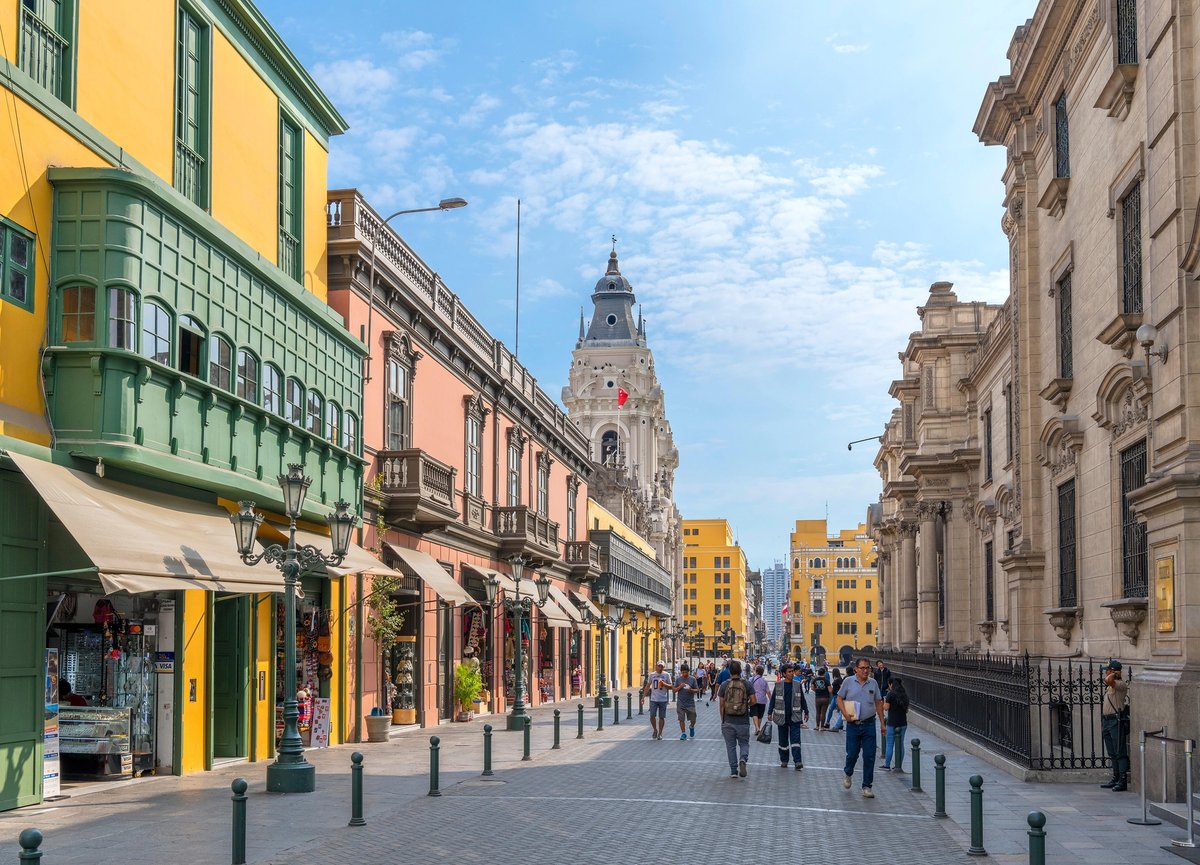
Unesco named Lima’s historic city centre a World Heritage Site in 1991. But like anything that is not properly cared for, its beauty is in danger of being lost.
As the city has continued to grow, wealth has fled to its outskirts, and buildings in the centre have been abandoned. This emptying out has created a disconnect between the city’s inhabitants and its long history. To mend the rupture, the Metropolitan Municipality of Lima is working to restore not only its architectural beauty but also its economic potential and identity through an ambitious revitalisation project called Lima 2035, due for completion in time to celebrate the historic city’s 500th birthday.
Founded on 18 January 1535, Lima initially served as the hub through which the Spanish crown’s decisions were passed on to its colonies in the Western Hemisphere. It was also a vibrant centre of trade, thanks to its strategic location on the shores of the Port of Callao. Lima served as the capital of the Viceroyalty of Peru, which extended well beyond Peru’s current borders. It was the wealthiest city in South America from the 16th to the early 19th centuries, due in large part to the highly profitable silver mines of Potosí (in modern-day Bolivia). In fact, the real de a ocho—the dominant international currency from the 16th to the 19th centuries—was made of silver and minted in Lima. In the prosperous city, religious structures, public squares and its characteristic balconies concealed many stately mansions.
The city has suffered frequent earthquakes, and reconstruction after each one was both traumatic and costly
Unlike the Peruvian cities of Cusco (built with stone from Incan quarries) or Arequipa (constructed using volcanic rock), Lima’s buildings were made using adobe and quincha—a wooden framework covered in mud and plaster. The city has suffered frequent earthquakes, and reconstruction after each one was both traumatic and costly. As a result, preference was given to quincha, a lighter and less expensive construction method than stone or volcanic rock that was also easier to build and less deadly in case of collapse.
Several years after Peru’s independence from the Spanish Empire in 1821, a change in architectural style began to emerge. During its Republican period, foreign trade led to the arrival of immigrants, who brought their own aesthetic to the city’s landscape. A European influence, particularly English and Italian, soon became noticeable.
Major changes to Lima, both aesthetic and practical, arrived during the second half of the 19th century. The city walls from viceregal days were demolished, large public buildings were erected, and boulevards were created—modelled on those championed by Georges-Eugène Haussmann in Paris.
Starting in the first half of the 20th century, Lima’s historic centre began to undergo not only major urban and architectural transformations, but social changes as well. Affluent families moved to more modern neighbourhoods that had cropped up along the city’s periphery. Meanwhile, the centre became home to increasingly poorer sectors of the population who lived in newly subdivided houses formerly inhabited by wealthy families. Among these converted houses was Casa Echenique, once home to the French writer Flora Tristan (whose father was Peruvian) and her grandson, the artist Paul Gauguin.
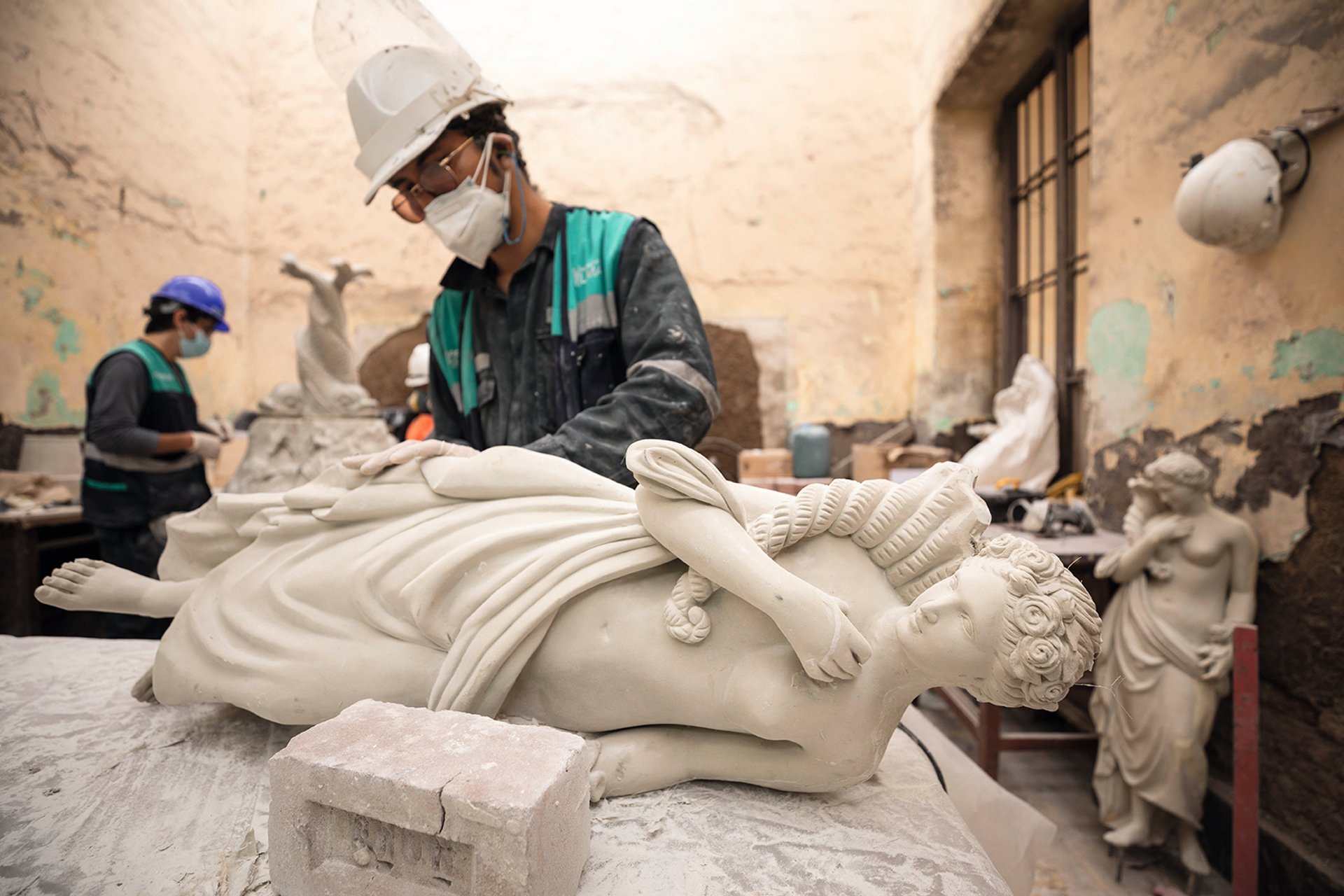
Replica work in the Lima Sculptors' Workshop on a nymph sculpture for the Plaza Italia fountain
Living for the city
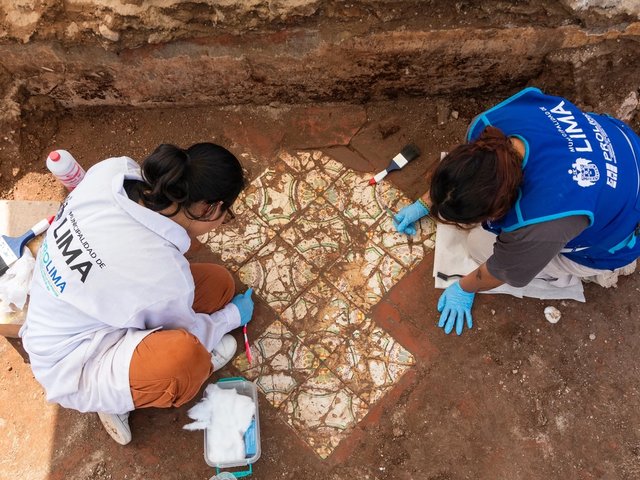
The vision and drive behind Lima 2035 largely derive from the Peruvian architect Luis Martín Bogdanovich Mendoza, the general manager of the Municipal Programme for the Recovery of the Historic Centre of Lima (Prolima). Lima 2035 has led to more than 500 professionals—architects, sociologists, historians, scholars, archaeologists, engineers and construction workers among them—working side by side since 2019 to rehabilitate the city’s unique historic centre, which Bogdanovich sees as having a uniquely Peruvian architectural style.
“A series of practical decisions were made when rebuilding after each earthquake, which makes Lima’s 16th-century architecture different from that of the 17th, 18th or 19th centuries,” Bogdanovich tells The Art Newspaper. “This was not only a question of changing tastes, but adaptation to the soil. While there may be a shared visual language with the Spanish Baroque, the architecture is not strictly Spanish; it is Hispanic and Peruvian.”
Under a new law, 3% of all taxes collected by the district go to the city’s restoration
Earlier this year, a law was passed creating a special funding arrangement for the revitalisation of Lima’s historic centre. Under the new law, 3% of all taxes collected by the district go to the city’s restoration, in accordance with a 4,000-page plan approved by Peru’s ministries of culture and housing and by Unesco. Thanks to this measure, the project for the recovery of Lima’s centre receives around $38m annually. (A similar strategy has been used successfully in Ecuador, where a recovery fund was created following the Quito earthquake of 1987.)
“Public spending can lay the foundations for this rebirth, but ultimately, it comes down to private investment. Every street that is pedestrianised fosters commercial development. Every church that is restored spurs economic growth in its surroundings,” Bogdanovich says. “I set out to restore everything—not just buildings, mansions and churches, but the spiritual, the intangible too. That’s what you see in Seville [in Spain], the way its inhabitants live for their city; they adore it. And you don’t just fall in love with the city, but with its people as well.”
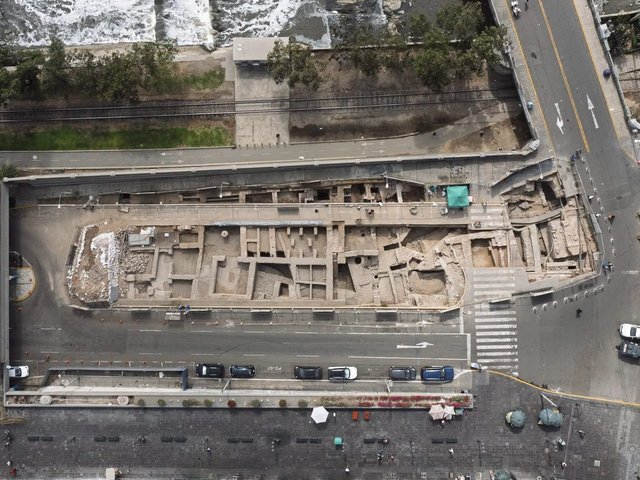
Bogdanovich’s project includes plans to restore 170 historic buildings. Prolima has already restored 12 churches, six squares, 41 blocks, 11 historic gardens, two theatres, two museums and a concert hall. The plan also includes two megaprojects: the recovery of the Rímac River and tunnelling beneath Avenida Abancay—a chaotic thoroughfare that runs through the historic areas of Barrios Altos and Damero de Pizarro (“Pizarro’s chequerboard”), once located within Lima’s historic walls. The plan is to reroute traffic underground, reuniting neighbourhoods that were cleaved in two by the avenue’s construction in 1940.
“Restoration comes with safer living conditions and a more harmonious coexistence,” Bogdanovich says. “Cartagena de Indias [in Colombia] and the historic centre of Panama City are both examples of this potential for rebirth.”
The goal of Lima 2035 is to achieve a newly glamorous and economically thriving city. So far, Bogdanovich has kept up the pace and remains optimistic. “The Meliá hotel chain, for example, already announced plans to open a location in central Lima, and a number of restaurants will open branches in the centre after decades away,” he says. “Trust is being regained.”