South Florida’s sunny skies proved an apt backdrop this week. Across Art Basel Miami Beach (ABMB), key industry figures are proclaiming the clouds hanging over the art market to have lifted. “The last two and a half years were really bad. But now we’ve moved onto the next 30-year cycle,” says Pace’s president Marc Glimcher. His gallery reported sales of almost $5m across the fair’s first two days, including a 2020 painting by Sam Gilliam for $1.1m.
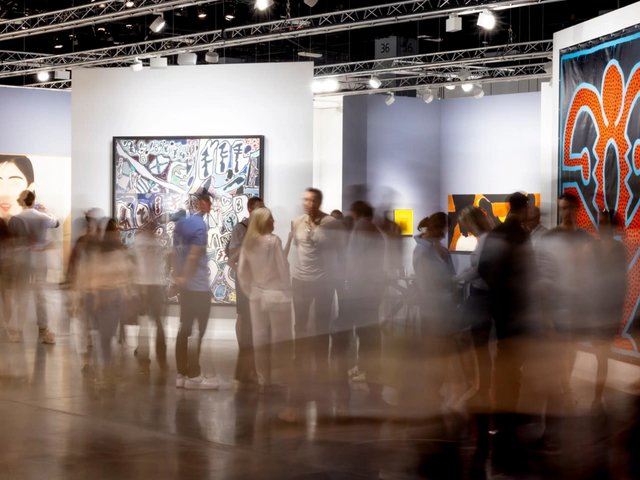
While the robust results of the autumn fairs and auctions have proved reassuring, many in the trade acknowledge that the business has fundamentally shifted. “My clients are still more cautious in their decision-making,” says the adviser Alex Glauber. “The indulgent, aggressive end-of-year consumption that once defined Miami feels like a thing of the past.” Meanwhile, numerous exhibitors noted a thinner opening day crowd, with one New York gallerist describing the emptiness as “a little spooky”.
“The new pace has been established. It’s slower and quieter, but that’s not a bad thing,” says Leopol Mones Cazon, whose Buenos Aires gallery Isla Flotante presented a joint stand with Galatea from São Paulo, selling $575,000 of art across ABMB’s first three days.
The changing of the guard is evident among both visitors and exhibitors. Around 20 galleries, several of which were mainstays of the fair, have not returned to ABMB this year: some did not apply, others withdrew and more than a handful have closed shop. Plugging the gap, the fair has welcomed a record 48 new exhibitors.
Dialled into digital art
Proving that necessity is the mother of invention, Art Basel has launched a new digital art section in Miami Beach, Zero 10. The buzzy corridor of stands saw brisk and buoyant sales: a Beeple installation of robotic dogs excreting NFTs (non-fungible tokens) sold out within five hours, with two editions of each robot going for $100,000 apiece ($1m in total). And nine works from a new generative art project, Quine by Larva Labs, offered as prints and corresponding digital NFTs, sold for prices between $25,000 and $45,000 each.
With traditional pools of buyers shrinking, Art Basel hopes that tech wealth and digital native collectors, who have long resisted the art world’s overtures, might take to this venture. “If Zero 10 resonates with tech-savvy audiences and brings new people into the full scope of our platform, that’s extremely welcome,” says Art Basel’s chief executive Noah Horowitz, though he maintains that “the core ambition is simply to meet artists and galleries where they already are. Digital tools and systems are now firmly established within contemporary practice, and it’s our duty to cultivate audiences and bring people into that conversation.”
Art Basel is following its own data: the latest Survey of Global Collecting found that 13% of high-net-worth individuals allocated money to digital art—compared to 3% last year—which is, surprisingly, the same amount that cohort spent on sculpture. However, this percentage seems to fluctuate dramatically year-on-year, partly due to a lack of authoritative structures to define this market. The new digital art section is a way to rectify this: “We absolutely see it as our duty to put our brand behind Zero 10 as a global initiative and firmly believe that its growth and success will be beneficial to the entire ecosystem,” Horowitz says. (The firm will roll out Zero 10 at its future fairs in other cities.)

Alexander Gray brought Statuesque (2025), a new work by the 93-year-old artist Joan Semmel, to its Art Basel Miami Beach stand this year
Liliana Mora
Historic positions hold firm
While Art Basel relies on new collectors and technologies to fill its halls, the historic turn in the art market endures, with galleries mining the past to meet the needs of their existing clients. While there are several factors at play, from shifting institutional appetites to demographic changes among collectors, according to Brett Gorvy, the co-founder of Lévy Gorvy Dayan, this “typical flight to quality in more sensitive markets” becomes “more emphatic when primary [material] is less dynamic”. The gallery has netted the fair’s highest-value reported sale as of this writing: an Andy Warhol screen painting of the boxer Muhammad Ali priced at $18m.
The softened primary market is the result of a turbulent past decade that is now being assessed with clearer eyes—and not everyone is happy with the results. “Price points for mid-career artists, which are framed off rising operating costs of galleries and studios, all of a sudden became on par with historical artists who have much greater provenance,” Glauber says. A London-based exhibitor, who wishes to remain anonymous, put it more bluntly: “People were buying like maniacs and now realise their collections are worth far less than they hoped.”
Such dynamics certainly benefit dedicated secondary galleries like Berry Campbell, which focuses on overlooked women artists of the 20th century. Its co-founder Christine Berry describes this year’s fair as “an embarrassment of riches”, with $1.7m in sales, including a Helen Frankenthaler painting for $175,000.
Alexander Gray, whose New York gallery returned to the fair after sitting it out for almost a decade, says that he has “definitely noticed heightened attention around the historical positions in our programme. The market’s growing interest has affirmed the trajectory we’ve been on for nearly two decades.” The gallery sold paintings by Joan Semmel and Jack Whitten from its stand, where two young collectors were overheard saying of a Whitten grid painting, “$225,000 is a great price”. A retrospective of the artist at New York’s Museum of Modern Art received glowing reviews earlier this year.
The shifting balance towards established names was the subject of cocktail banter this week thanks in part to Pace’s Glimcher, who, along with the dealer Emmanuel Di Donna and the former Sotheby’s private sales chief David Schrader, launched a new collaborative gallery, Pace Di Donna Schrader (PDS), which will exclusively focus on secondary market sales.
“There is a generational shift afoot thanks to the great wealth transfer that will bring forth amazing material. This needs to be better harnessed,” Glimcher says. He believes a key area of growth for the total market will be in the sale of existing works released from the estates of ageing collectors.
Glimcher, an optimist with vested interests, believes the market is about to get much bigger. A more pessimistic take might suggest that not enough new money will flow into this system to sustain the glut of the past and present. If Zero 10 is an indication that new audiences must be met by new tastes and media, a retreat to the secondary market suggests a wariness and conservatism among existing audiences. This leaves the artists who were elevated over the past two decades in a sticky spot.
“One of the issues that has existed for over a decade is that artists who find commercial success are obligated to overproduce.” Glauber says. “And if you are selling out booths to people who aren’t committed collectors and then they come on the secondary market and underperform, it exposes how fragile the system is.”