
It’s worth remembering that the presence of Homo sapiens is but a mere blip, a nanosecond in the four and a half billion year history of our planet. However, during this most brief of existences, our species has wreaked destructive havoc on a scale only previously achieved by volcanoes and asteroids. But whether seismic eruptions, extraterrestrial bombardments or the more recent spate of human-caused upheavals, each event forms part of the earth’s great continuum; and whatever the cause, all come accompanied by a proliferation of chemical reactions that deposit a wealth of revealing mineral evidence in their wake.
These buried alternative histories and the traces they leave within the fabric of our planet form the substance, both physical and conceptual, of Yasmin Smith’s thought-provoking sculptural installations. Elemental Life, her current solo exhibition at the Museum of Contemporary Art Australia (MCA) in Sydney (until 8 June), reveals how this Australian-born artist uses ceramics and glaze technologies to decipher and interrogate deep and often highly vexed interconnections between human and environmental histories. Drawing on plant and mineral materials gathered from a wide range of locations ranging from remote parts of Australia to urban France, Southern Italy and Sichuan Province in China, she’s developed an archive of site-specific glazes which also function as chemical records of place and time, offering what she defines as an “alternative knowledge system”, that throw new light on the history, ecology and geology of these different terrains.
Smith has been described as an "archaeological ceramicist" and whether she’s making salt-glazed vessels using salt and sandstone from Sydney Harbour and filling a gallery with a 19m procession of ceramic coal lumps glazed in ash from 11 coal fired power stations across Eastern Australia, or working with a Chinese sanitary ware factory to create stoneware bamboo replicas glazed using the ash from burning the original plants, each of her installations emerges out of extensive field research often involving widespread collaborations with communities, scientists, archaeologists and social historians.

Yasmin Smith's Seine River Basin (2019) at the Museum of Contemporary Art Australia Image courtesy and © the artist, photograph: Hamish McIntosh
The current MCA Australia show focuses on the multifarious histories and geologies of rivers and waterways; and to make the dramatic wall-based Seine River Basin (2019), commissioned by the Centre Pompidou in 2019 and now part of MCA Australia’s permanent collection, Smith worked with an ecologist, an arborist and a local environmental organisation to delve into the chemical and social history of the River Seine and its tributaries. Having first created replicas in Limoges stoneware of tree branches growing alongside the river and floating in the network of waterways in and around Paris, she then glazed these ceramic facsimiles using ash derived from burning the original specimens. The resulting installation is arranged to evoke a line of trees mirrored in water, while the glazed surfaces reflect the unique chemical makeup of their environment, acting as a visual register of the substances—both nutrients and pollutants—that had been absorbed by the original specimen and become lodged like mineral memories in its cellular structure. As Smith says, “glazed ceramics have this alchemical ability to transmute one thing into another, and in the process show us something that we might not have been able to see with our own eyes”.
Like a mass extinction event, for example. Chicxulub (2025) presents ceramic glazes and forms derived from samples taken from the Chicxulub crater beneath Mexico’s Yucatan Peninsula, the ground zero impact zone of the asteroid that caused the Cretaceous-Paleogene (K-Pg) extinction event. This occurred approximately 66 million years ago and wiped out 75% of all plant and animal species on Earth. Working with Professor Kliti Grice from Curtin University in Western Australia, Smith obtained 15 samples from a core drilling 1.3km down below the crater floor. She then cast ceramic replicas from 3D prints of each sample, and glazed them with various ceramic recipes derived from the mineral analysis of each sample.
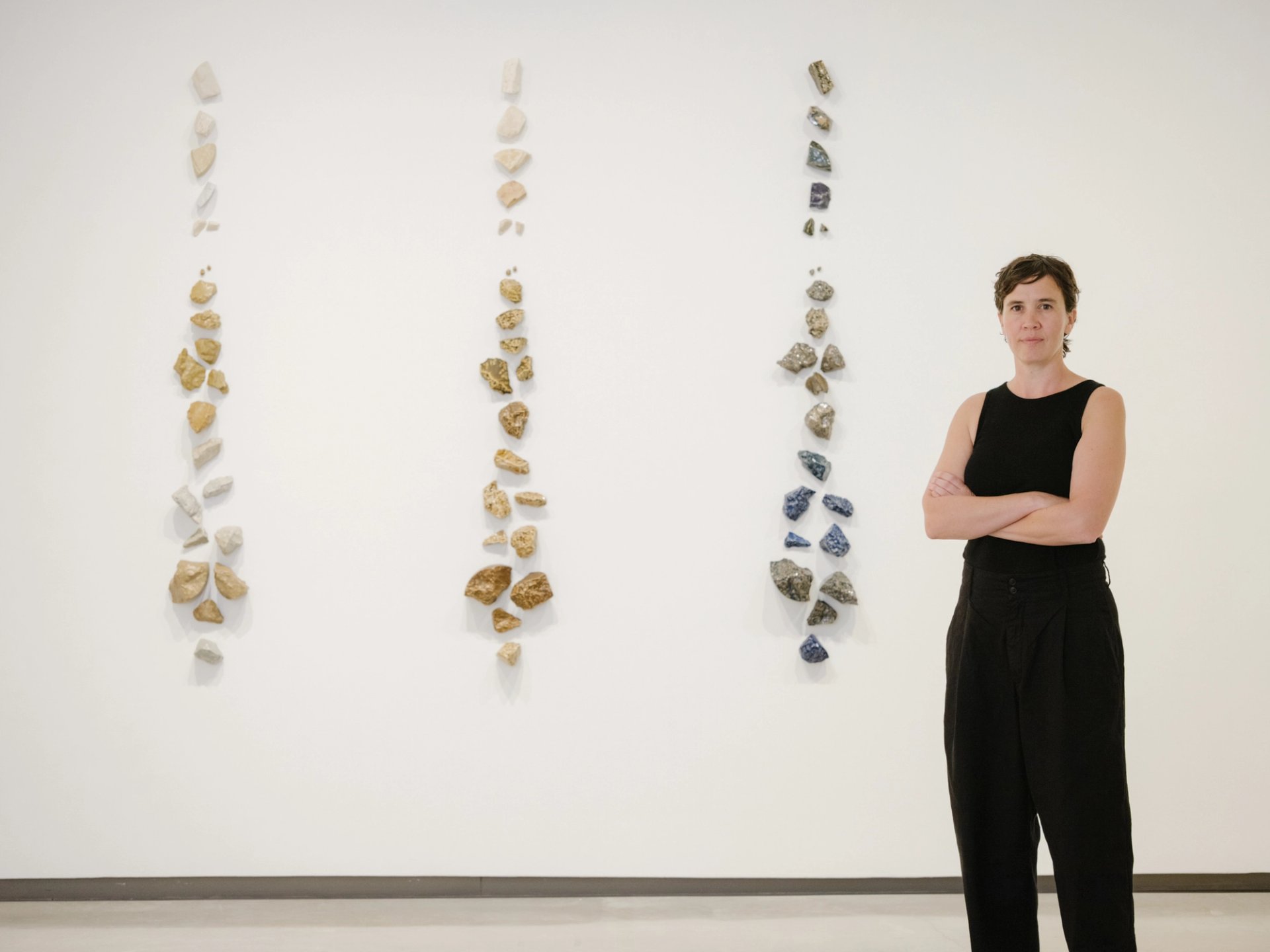
Yasmin Smith with Chicxulub (2025) at the Museum of Contemporary Art Australia Courtesy the artist and The Commercial, Sydney © the artist, photograph: Hamish McIntosh
Arranged in three vertical lines descending in order of age, with a gap to indicate the extinction line at 620m, we see the chemical effect of K-Pg in the rock forms and glazed colours ranging from russet elements from the unique suevite breccia melt-rock created at the point of impact, to a palette of minerals manifesting themselves in shades ranging from an intense cobalt blue to pale greens, dove greys, creamy yellows and caramel browns. It is strangely chilling to realise that the five innocuous looking rocks arising above the extinction line are composed from charred forests and debris created moments after the impact and carried by tsunamis into the crater, and then, over time, combined with the bodies of millions of dead sea creatures. But Smith is adamant that she wants all her work to offer new perspectives, provoke thought and engage the eye as well as highlighting geochemical events. “I don’t want it to be a science display,” she says. “I want it to be a speculative tracing of all these many and often marginalised histories using aesthetics as well as a different source of information.”
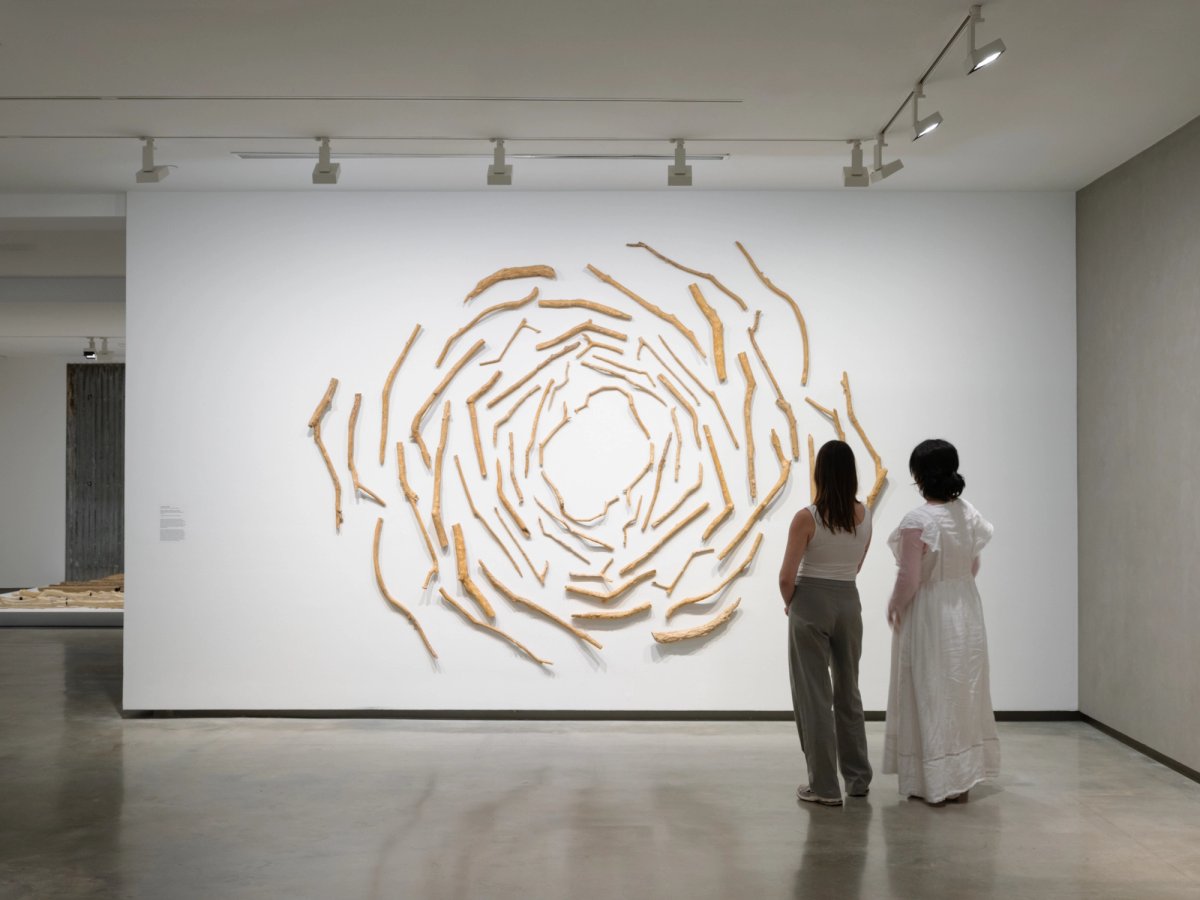
In tracing the chemistry of extinction events Smith puts our current environmental crisis into perspective, and highlights the social and economic as well as the ecological legacies of industrialisation. Manchester Driftwood (2025) consists of another wall full of ceramic sculptures, this time arranged in concentric circles and cast in clay from floating driftwood collected from the Manchester Ship Canal in the north of England. Completed in the 19th century, the engineering feat of this canal helped landlocked Manchester become a major port and the world’s first industrialised city, nicknamed ‘Cottonopolis’ due to its dominance of the global cotton trade, supplied by US slave plantations. Here the textures and glazes of Manchester Driftwood reflect the elements absorbed by the trees to reveal the chemical legacy of the Industrial Revolution, an event Smith describes as “a ground zero for the earth’s current environmental crisis and sixth mass extinction.”
They also point to the wider social, economic and political consequences of Manchester’s reliance on slavery abroad and an exploited workforce at home. And as Smith’s driftwood samples indicate, the contamination continues apace, with the coal ash, textile dyes and heavy metals from the 18th and 19th centuries now joined by modern industrial effluent, agricultural chemicals and urban runoff. The enduring human cost also continues to reverberate.
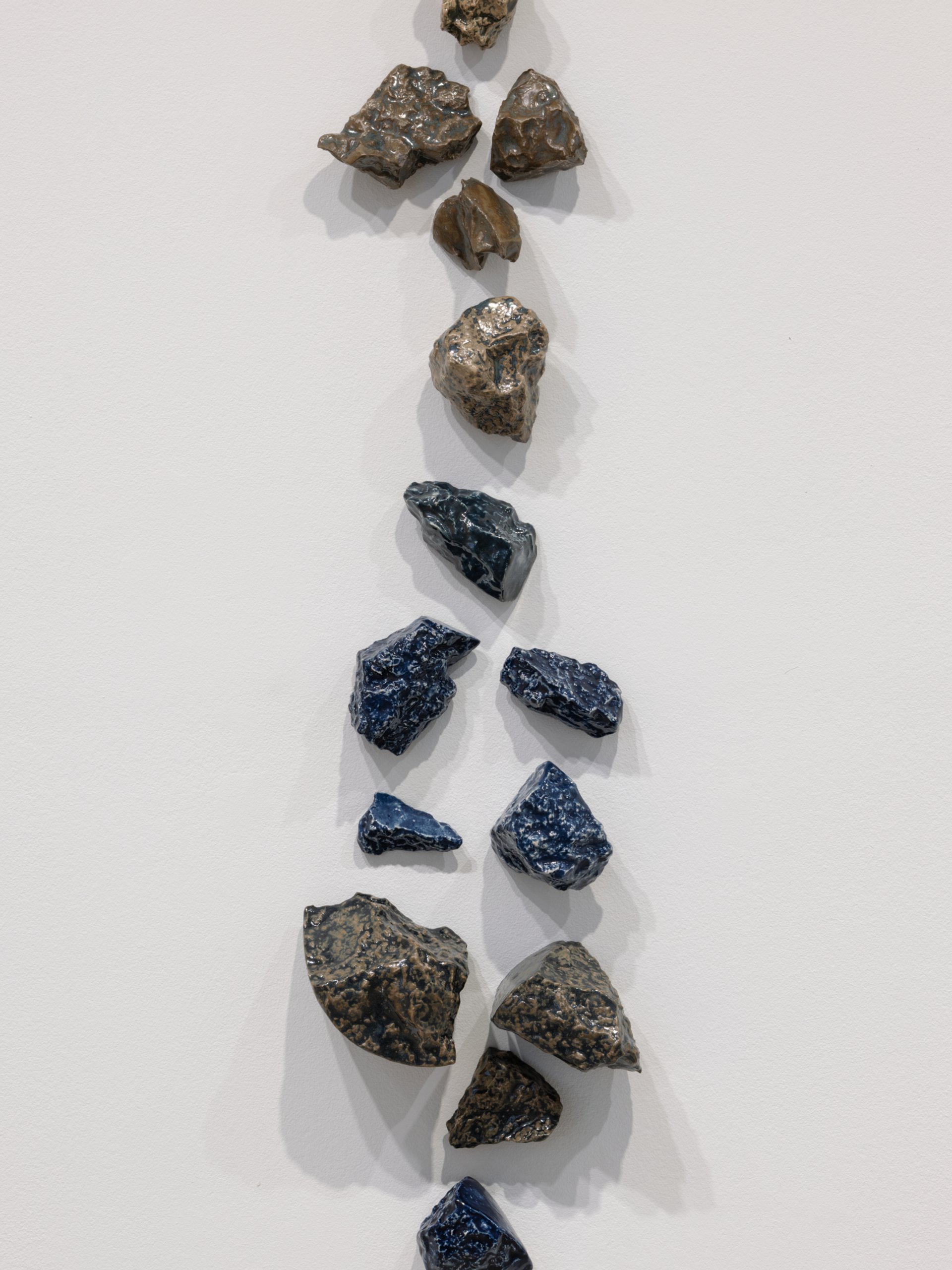
A detail from Yasmin Smith's Chicxulub (2025) Courtesy the artist and The Commercial, Sydney © the artist, photograph: Hamish McIntosh
Smith made Manchester Driftwood during her recent time studying on the Art and Ecology MA at London's Goldsmiths’ College, an exemplary 15-month studio based programme that enables artists to engage with pressing ecological concerns and to which I will be devoting an entire column in the new year. It was whilst walking by the Thames at Deptford, near Goldsmiths' south London Campus, that she was inspired to make Flint (2025), a film and performance work spanning a period of 560 million years and tying together human and pre-human histories from across the globe to demonstrate the ability of a single artwork to encompass and encapsulate myriad complexities of culture, time and place.
Noticing a proliferation of flints on the foreshore near the historical Deptford shipyards, she learned that this knobbly South English rock—itself formed from the silica skeletons of Cretaceous sea creatures—was used in the 18th and 19th centuries as ballast to weigh down and stabilise the hulls of wooden slave ships, along with those sailing the imperial trade routes between Europe, Africa, Asia and the Americas. More research revealed that the hulls of the First Fleet, the 11 ships that sailed to so-called Australia in 1787-88 carrying British convicts and settler colonialists, had been stabilised with thousands of bricks and nodules of this same flint.
Then 230 years later, in 2016, an excavation on the lands of the Bidjigal and Gadigal people in Sydney unearthed flint stone tools carved by local indigenous people. Flint is not part of Sydney’s local geology and forensic tests confirmed a chemical match with the London flint that arrived in the boats of these early invaders. Stones that had originally come from the sea, then crossed many oceans to enable two centuries of colonial slaughter, subjugation and land theft to unfold. But flint also provided the means for making useful tools, whether the spears and blades fashioned by the early communities of Northern Europe, or those carved two centuries ago by these individuals around Sydney harbour under the shadow of the Union Jack. Again, it takes the power of art to knit together such rich and various stories of evolution, invasion, interconnected cultural narratives, extractive economies and the entanglement of geology with colonial histories. I will never look at a piece of flint in the same way again.
• Yasmin Smith: Elemental Life, MCA Australia, Sydney, until 8 June 2026