What can a deep reading of a specific work of art reveal? In the right hands, one specific book, painting or film can unfold and display multitudes, giving readers an expert sense of what went into making this work of art while also drawing unexpected connections between seemingly disparate threads of history and philosophy.
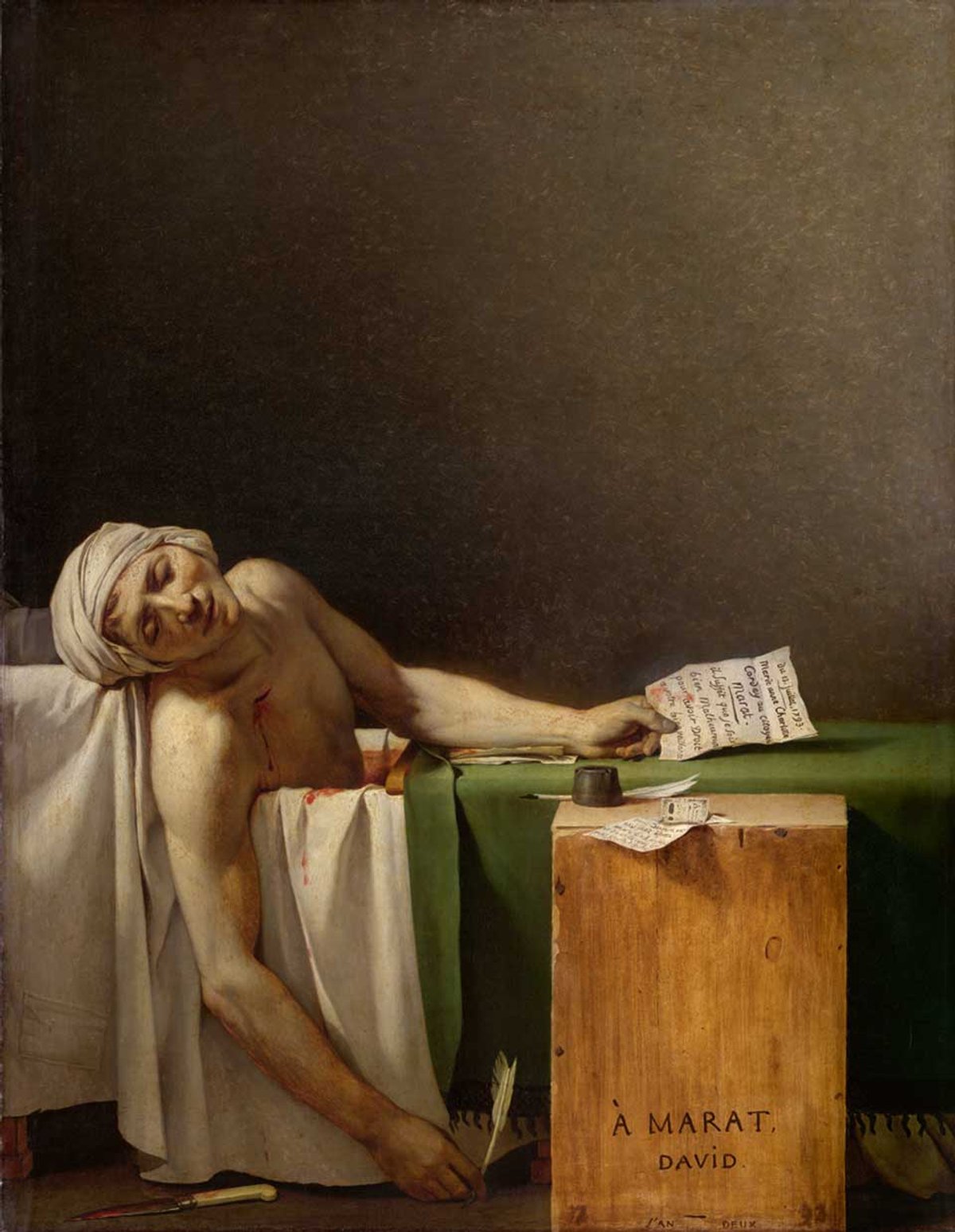
Apparently, we are living through a bumper crop of such artistic and intellectual inquiries. Tom McCarthy’s The Threshold and the Ledger (published September 2025) puts an Ingeborg Bachmann poem under the microscope to reveal numerous insights into literature, translation and the concept of home. Not to be outdone, Thomas Crow’s latest book, Murder in the Rue Marat: A Case of Art in Revolution, zeroes in on Jacques-Louis David’s The Death of Marat (1793, in the Royal Museum of Fine Arts of Belgium, Brussels), examining and remixing the painting from all angles while also acting as a chronicle of Crow’s lifelong fascination with this work: who knew that the psychedelic rock band Moby Grape could lead a budding intellectual on a decades-long odyssey into history and aesthetics?
Crow’s first encounter with David’s painting came via a flyer for a 1968 Moby Grape concert
The budding intellectual referenced above is, as you might surmise, Crow himself. As the author explains in chapter one, aptly titled Scene-Setting Prologue, his first encounter with David’s painting of the French revolutionary figure dead in his bath came via a Robert Wilson-drawn flyer for a 1968 Moby Grape concert. “Any connection between David’s martyr portrait and the accomplished but somewhat generic music of the advertised band is elusive,” Crow writes. And yet, a lifelong interest emerged as a direct result of this version of the painting.
“As best as I can reconstruct, my first imagined project to secure professional credentials as an art historian ultimately rested on the memory of that revelatory moment,” Crow notes. He goes on to cite Honoré de Balzac’s Sarrasine (1830) and the French literary theorist Roland Barthes’s “code”-based analysis of it in S/Z (published in 1970) as influential on the development of his own project, declaring his aim “to reverse Barthes’s procedure and find a way to render sequentially the non-linear, atemporal painting”.
The version of Crow who wrote this book has the advantage of having more resources than his younger self. He is currently a professor of Modern art at New York University’s Institute of Fine Arts (IFA), and credits the assistance of IFA student Dominika Ivanickà, whose manipulations of David’s original work can be seen throughout the book. There is also another work of art that allows him to deconstruct David’s painting even further: Yue Minjun’s 2002 The Death of Marat, which reproduces the original painting but removes Marat’s body from the scene.
Crow’s exploration of David’s painting includes plenty of consideration of the history of the French Revolution, and of both David and Marat’s roles in it. Crow also deftly explains that David’s work, which soon followed the events it depicts, has a larger political role than simply showing the aftermath of a murder: “Every one of the material items in David’s painting functions as implicit testimony bearing on the crime and its perpetrator, high points marked in blood for investigators to follow.” Crow goes on to discuss the way that “uncommon weight rests on the rendering of script illegible to viewers even a short distance away”, connecting David’s accumulation of such details to his concurrent presenting of evidence before the Committee of General Security.
Striking juxtapositions
Elsewhere in Murder in the Rue Marat, Crow makes further connections between David’s painting and other art-historical traditions. In one especially striking use of image manipulation, he and Ivanickà juxtapose elements of The Death of Marat with those of an earlier painting, the Pietà by David’s student, Anne-Louis Girodet (1790, in the Church of Montesquieu-Volvestre, Haute-Garonne, France). The way that the figures of Marat in David’s painting and Mary in Girodet’s line-up is uncanny, placing an image of a recent incident into a much older tradition: “Out of all the dispersed analogies between the two paintings, it was this formal device that David expressly retained from his pupil’s dramatic revision of the Christian devotional formula, as if what he required could be condensed into one abstract line,” Crow observes.
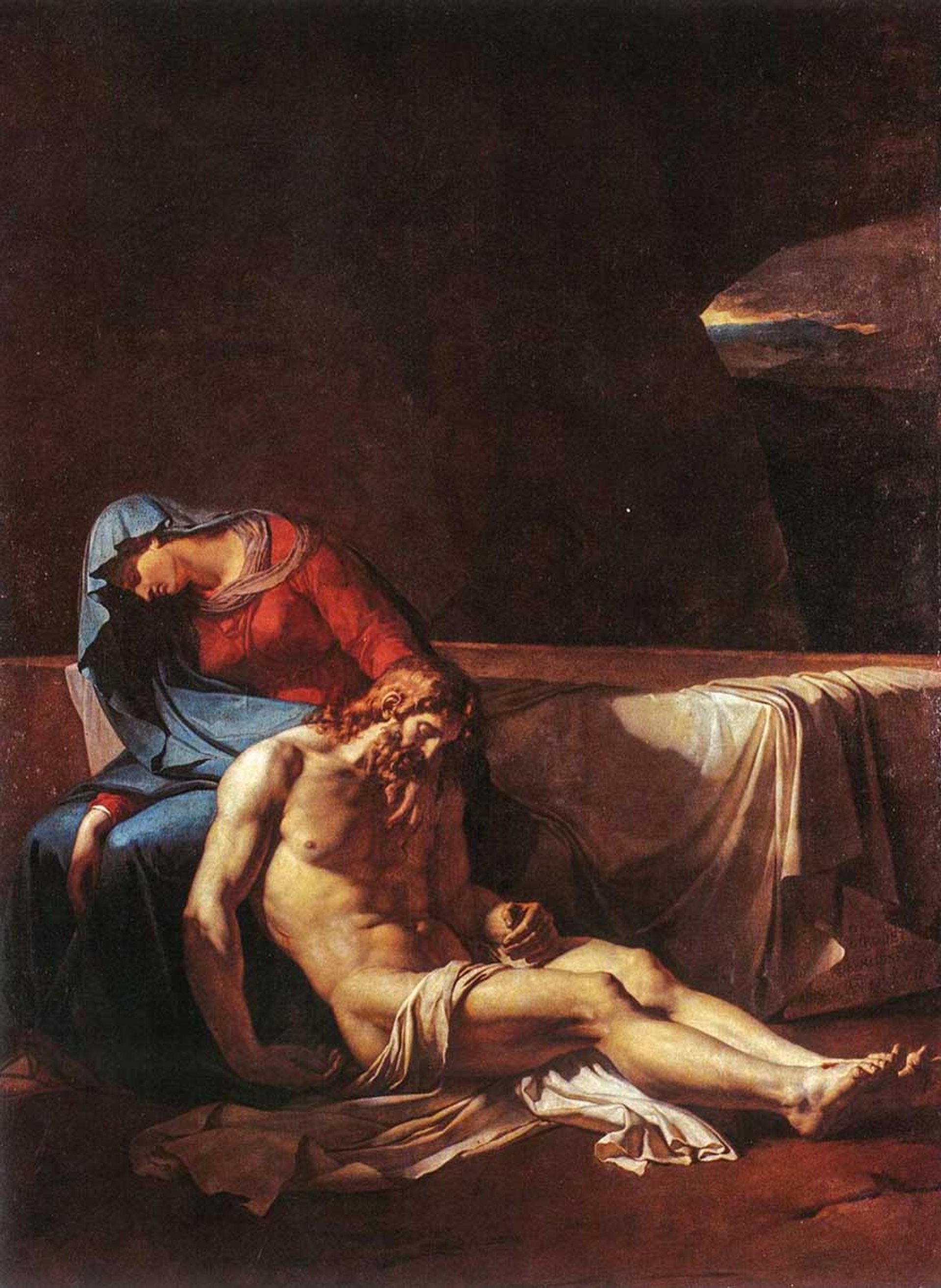
The author draws connections with works such as Anne-Louis Girodet’s Pietà of 1790
Courtesy Church of Montesquieu-Volvestre
In tracing his own artistic pursuits over the decades, Crow gives the reader an enduring sense of his own personality and intellectual connections. (An early reference to “light conjurer Jim Turrell”, the American artist, gives a sense of some of Crow’s interpersonal connections.) An echo of this can be seen in the way that Crow empathically describes David’s chronic health issues—“David’s tumorous growth on one cheek, which distorted his face and slurred his speech”—and speculates that it may have been one reason for David and Marat, who suffered from a severe skin condition, to bond.
Evocative prose
It does not hurt that Crow’s prose is frequently evocative, turning his analysis of David’s paintings into compelling work in its own right: “Marat’s face and torso testify to one level of truth; the rest of the painting to another. Blood in the former, retained in subcutaneous capillaries, speaks to the fullness and continuity of life, cruelly breached and on the verge of disintegration, but for the moment maintaining its integrity. The truth to which blood attests elsewhere belongs to a different order of knowledge.”
Murder in the Rue Marat does not only consider David’s painting and the deconstructions of it mentioned above; over the course of the intellectual journey mapped out here, Crow also invokes works by the likes of Honoré Daumier and Eugène Delacroix, as well as (unsurprisingly) Peter Weiss’s 1964 play The Persecution and Assassination of Jean-Paul Marat as Performed by the Inmates of the Asylum of Charenton Under the Direction of the Marquis de Sade.
By the time Crow’s book reaches its conclusion, he has demonstrated the power of great works of art: that they can transform the scope of a worldview. Murder in the Rue Marat is about Jacques-Louis David’s The Death of Marat and Thomas Crow’s decades-long fascination with it; it is also about, well, everything. (Laird Hunt’s 2006 novel The Exquisite pulls off a similar feat with respect to Rembrandt’s The Anatomy Lesson of Dr. Nicolaes Tulp of 1632.) Not all decades-long obsessions pay dividends the way that this one does. In Crow’s hands, David’s painting and its legacy crystallise into something truly revelatory.
• Thomas E. Crow, Murder in the Rue Marat: A Case of Art in Revolution, Princeton University Press, 176pp, 37 colour illustrations, $30/£25 (hb), published 4 November 2025
• Tobias Carroll is the author of five books, including Political Sign (2020) and the novel In the Sight (2024)