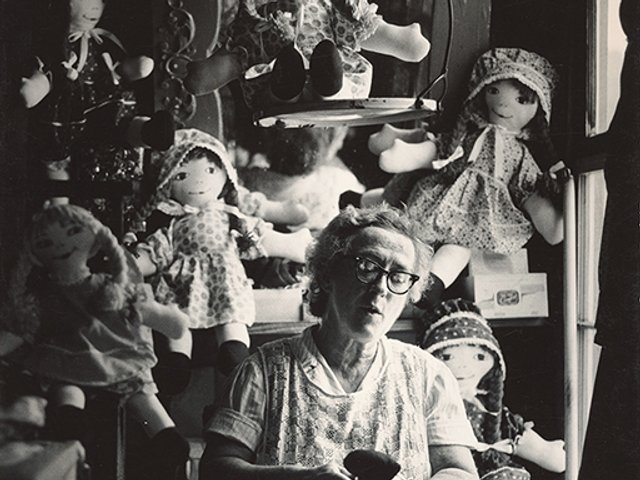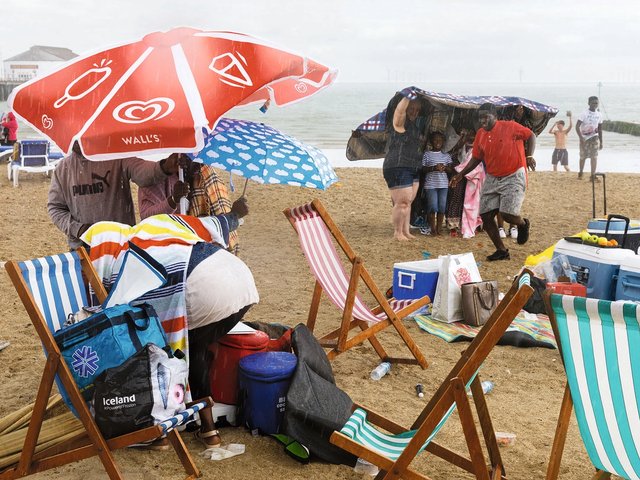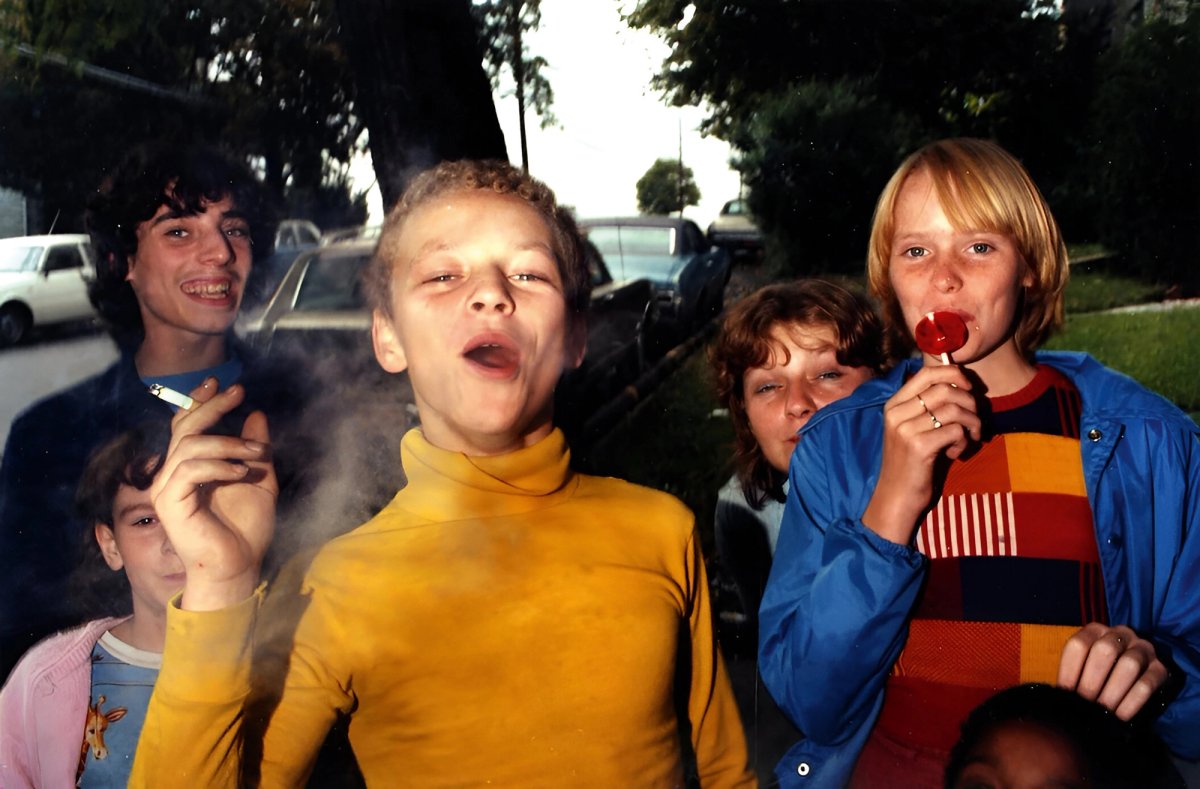
“A street photographer is a photographer who works on Fifth Avenue in New York,” states Mark Cohen (born 1943) in Trespass, with more than a hint of suspicion: “I’m like an alley photographer. I go everywhere to take pictures.” In one sense, this is borne out in Cohen’s unique, if strangely dislocated, work: abrupt and close-cropped colour shots of people, places and found objects taken—even stolen—at close quarters, a catalogue of “ordinary people in ordinary situations”, writes Phillip Prodger, the former head of photographs at London’s National Portrait Gallery.
At the same time, the idea that Cohen’s pictures take him “everywhere” is misleading. While he has photographed in Mexico and Europe and, in 1973, produced a striking series of black-and-white images of New York City street scenes—published for the first time in 2025 by GOST Books—the lion’s share of Cohen’s photographs take place in Wilkes-Barre, Pennsylvania, where he lived and worked for 70 years before relocating to Philadelphia in 2014. As a generous selection of Cohen’s Wilkes-Barre photographs, mostly taken in the 1970s and 1980s, Trespass offers an exciting introduction to the work of one of America’s most groundbreaking and rule-breaking photographers, one whose work, to borrow a line from the poet John Ashbery, showcases “the richness of life and time as they happen to us”.
Space invader
Beginning his career as a local studio photographer, Cohen soon developed a distinctive visual vocabulary. Experimenting with flash and early colour film speeds, he began to photograph around Wilkes-Barre using a controversial method, bringing his camera uncomfortably close to his subjects, invading their personal space with neither warning nor consent. For the most part “Cohen worked so fast that he was often able to make pictures before the subject even knew they were being photographed”, writes Prodger, recalling the surreptitious Subway Portraits by Walker Evans (1903-75), taken with a camera hidden underneath his coat.
Cohen’s methodology did not go unchallenged. “Did your subjects ever complain?” asks Prodger in an interview included here. “Oh yeah, lots of times. I had all kinds of altercations,” admits Cohen. “Sometimes it would get physical.” And yet, Cohen sees a certain irony in this complaint. After all, “you can’t walk down the street without being photographed… There are cameras everywhere you look.”
Blur and focus
Whatever one concludes of Cohen’s guerilla tactics, the results speak for themselves. Simultaneously haunting and brimming with life, the photographs are characterised by extreme blurriness and points of hyperfocus. There is a molten quality to Cohen’s pictures, as though the world that they depict has yet to fully solidify, yet where sudden details, arrested by the camera flash, are frozen into sharp moments of clarity—a bright red fingernail, the glint of a ring, the buttons on a winter coat.
The competing blur and focus of the work evoke the haziness of memory, resembling the fuzzy, grainy footage of VHS movies paused during playback. The photographs invite us to imagine their unfolding narratives, as though there is more of the story to come. In the words of Gene Thornton, reviewing an exhibition of Cohen’s work in 1973, “Time and again I had the impression that… Cohen is showing us only a fraction of what he has seen.” Indeed, one of the emerging themes of Trespass is that of partiality, a quality of incompleteness that accompanies each picture. This is not so much an example of Henri Cartier-Bresson’s “decisive moment” as it is a reminder that experience is made up of an endless chain of arbitrary ones; a sense that “all things flow and change”, to quote D.H. Lawrence, “and even change is not absolute.”
Off-guard
Due to the speed of Cohen’s practice, his photographs often appear at awkward angles, heads and limbs cropped oddly from the frame, figures often “slack-jawed or mid-blink”, writes Prodger, seeming somehow more real than if they had had an opportunity to pose—that is, compose themselves—for the camera. As such, Cohen’s accidental portraits are especially poignant, revealing figures lost in thought or caught slightly off-guard. While his “sitters” (as Prodger terms them) are strangers, Cohen’s pictures achieve surprisingly intimate results, particularly his photographs of children, who appear less wary, regarding him with curiosity or amusement, like the girl with twig-like limbs wielding a baseball bat—a strange extension of her body—or the young boy with a toy revolver, shooting the photographer right back.
“Cohen’s photographs can have a transgressive, even at times erotic, quality,” writes Prodger. Indeed, it is striking to find that several photographs include the word “flashed” in their titles, a term with connotations that extend beyond photography. The transgressive nature of their creation notwithstanding, the subtlety and pathos of Cohen’s work is undeniable, whether his photograph of bare feet resting on a plastic porch—a masterclass in art’s relationship with texture—or the blue boy offering a single, perfect blackberry, his cautious fingers lightly stained.
• Mark Cohen: Trespass, by Phillip Prodger. Published 7 October 2025 by Prestel, 188pp, 120 colour illustrations, £40/$55 (hb)