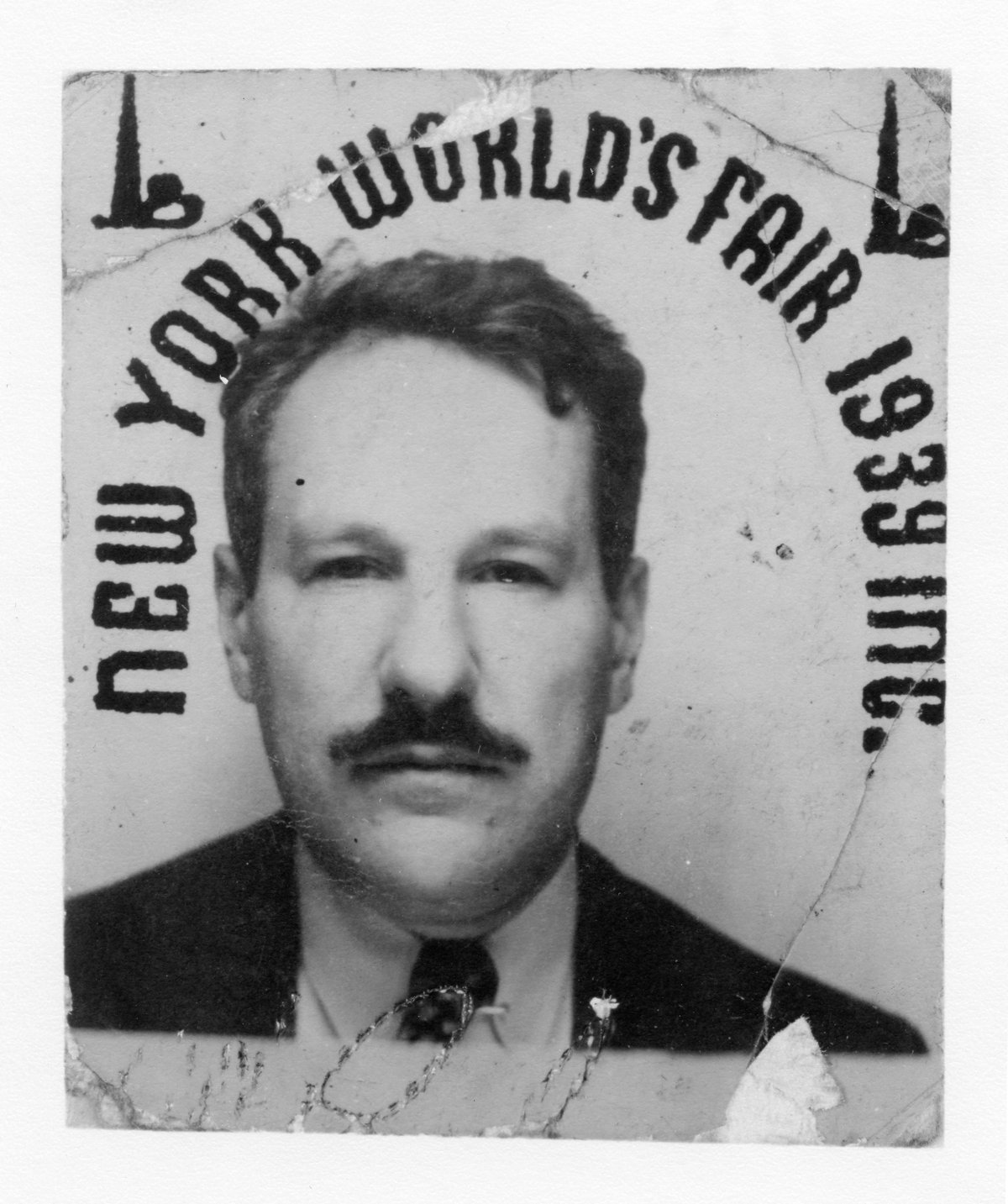
Barnett Newman (1905-70), known as “Barney”, fought the “bastards” all his life. First, it was the Communists and the New York Tammany (Democrat) political machine, both of whom he loathed more than they abhorred each other. Aged only 28 and yet to produce a painting, he ran for the mayoralty of his beloved hometown in 1933 under the self-declared banner of “the Need for Political Action by Men of Culture”, and a platform proposing: “A Clean Air Department”; “extensive Waterfront parks”; “free music and art schools in every district, a municipal opera house”; “closed right-of-way on certain streets for the use of street cafés”; “Public Works connected with City Planning, to clear slums and beautify city”. (Eat your heart out, Zohran).
It was the most contested mayoral campaign in New York history. In the year that inaugurated President Roosevelt’s New Deal—which Barney acknowledged was “very important for everyone” except him, as a “philosophical Anarchist”—American politics was balanced on a knife edge. “It is humanity’s tragedy that today its leaders are either sullen materialists or maniacs who express the psycho-pathology of the mob mind,” Barney told the New York World-Telegram, before losing the election to Fiorello La Guardia.
High-minded ideals
Barney is one of the last remaining figures of the “first generation” Abstract Expressionists to be honoured with a major biography. As Amy Newman (no relation) asks in Barnett Newman: Here, her impressive and extensive character study, what “caused Barney to mount a quixotic, if not entirely prankish, mayoral campaign, moreover one with a pie-in-the-sky cultural platform?” Arrogance, mostly, and an unfaltering disposition for grand gestures and high-minded ideals pitched against certain failure. The experience was prescient of his life to come as he became one of the most self-regarding, combative and, to be sure, remarkable American artists of the 20th century. For Amy Newman, it would be her subject’s “reflexive instinct for passion, the gamesmanship, of Jewish-style disputation [which] would forever be one of Barney’s most marked traits”.
Barney was the son of Jewish immigrants from Poland: Abraham, a haberdasher and passionate political Zionist, and Anna, who fostered a home life where “artistic ambition was a cult”, so much so that she would trade an heirloom diamond ring in and out of pawnshops as she hired private instructors in art, elocution and drama for her four children. Barney grew up on the impoverished Belmont Avenue in the Bronx. A truant and troublemaker at the DeWitt Clinton High School, then in Manhattan, he went on to study philosophy at the City College of New York and worked as a garmento for his father’s ailing business before reinventing himself as a painter. It was a vocation, he said, which was “extremely true to my way of thinking”, offering him a “heightened feeling” and a sense of “vividness”. He fell in with the downtown crowd of Adolph Gottlieb, Arshile Gorky and Mark Rothko, and started experimenting with abstraction.
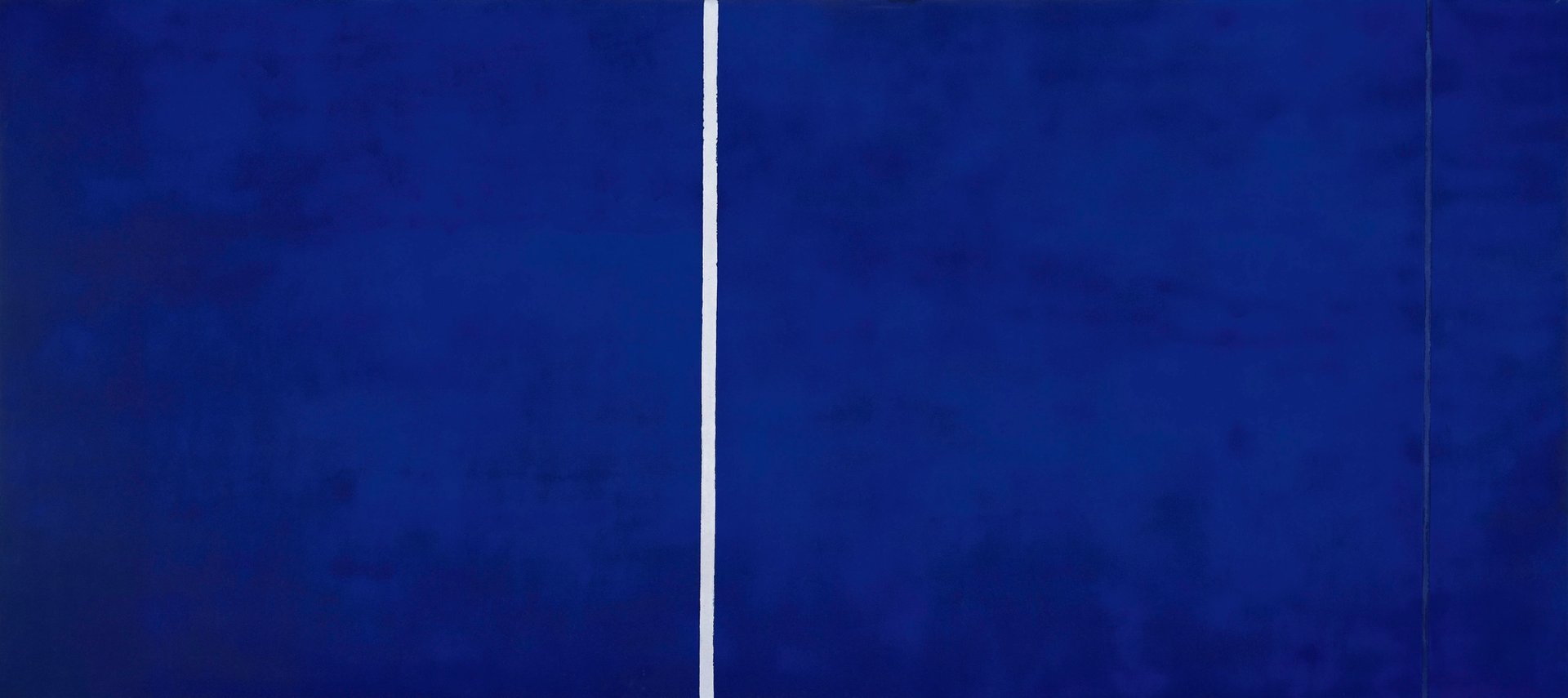
Zip it: Barnett Newman’s Cathedra (1951), which critics at documenta II in 1959 likened to a misplaced table-tennis table Courtesy the Barnett Newman Foundation
The first ‘zip’ painting
Barney’s self-mythologising tale of “the beginning of my present life” arrived with him painting a single line on a canvas on his 43rd birthday, leaving it there for eight or nine months before realising he had made a masterpiece. Onement I would become his first great “zip” painting, one of the earliest colour-field works and the first of his signature style. Its gestation is treated with mild suspicion by Amy Newman, who describes the artist’s Hemingwayesque sense of creative self-invention as he realised such a simple gesture “made the thing [the canvas] come to life”. Whatever the timing or the circumstances, Barney had finally found his subject and never looked back, but he was continually frustrated by those who misunderstood his singular contributions to American painting—often deliberately, or so he thought.
Two years later, Rothko displayed his friend’s Horizon Light vertically (as many of the works were orientated) rather than horizontally (as implied by the title) at Betty Parsons Gallery and received the full extent of his friend’s ire. At the 1959 documenta II held in Kassel, then in West Germany, Cathedra (1951), a monumental blue canvas with two “zips” representing the “seat or throne” of God, was badly damaged in transit, adding to the comedy of errors of its unfortunate display.
Critics likened Cathedra to a misplaced table-tennis table, as the baffled West German visitors tried to comprehend what the artwork in front of them had to do with the artist’s boldly stated sensibilities. Amy Newman treads a perfect line that acknowledges the brilliance of Barney’s “zips”—and they really were a singular contribution to American Modernism—while necessarily embedding them within the social world of their making and the sphere of their reception: thus never allowing them to ascend into the universalising narratives that the artist was so keen to construct around them.
He embodied several contradictions, all beautifully sketched out in this book
Throughout the book, Amy Newman stresses the lifelong importance of Jewish culture to an artist whose two most celebrated works might be Abraham (1949), an elegy for his own father and a homage to the Old Testament patriarch who nearly sacrificed his son to God, and Adam (1951, 1952), a red and brown “zip” that refers to the first man, whose name derives from the Hebrew word adamah (earth).
In 1963, at the first night of Towards a New Abstraction at New York’s Jewish Museum, he met Richard Meier, a young architect who was seeking to curate an exhibition on recent synagogue architecture. “Oh, I’ve designed a synagogue,” Barney told Meier, before admitting that it “was on the back of a napkin somewhere”. Meier agreed to present Barney’s synagogue designs, which he developed over months and modelled on a baseball field, with men seated privately in “dugouts” awaiting their turn at the “mound” to read the Torah.
Barney believed the plan would finally settle his long-standing debate with the painter Lee Krasner over Judaism’s patriarchal rituals, claiming she would approve of the women’s placement. When he told her women would sit at the altar, she replied that she only wanted an empty seat in the next vacant pew. Why did Krasner refuse to allow him to win the argument? “When I think of Barney,” Krasner said after his death, “St. Thomas More’s quote, ‘Finally it is not a matter of reason; finally it is a matter of love’, expresses my feelings best.”
Despite his conservative sartorial eccentricities—in later life consisting of immaculately tailored tweeds and hound’s-tooth checks, silk bow ties, brushed fedoras, brigadier’s moustaches and a démodé monocle—Barney remained a radical all his life. While he brushed off most if not all his early aggressively leftist tendencies and became a mystic Jewish Modernist as much as a macho Abstract Expressionist, he embodied several contradictions, all beautifully sketched out in Here. He was, as Amy Newman sets out in her conclusion, “not only artist, justice- and enlightenment- and truth-seeker, but also writer, civil servant, anarchist, agitator, theorist, ornithologist, philosophist, theologist, New York-ologist, son, brother, husband, and friend”, and it was through these complexities that “Barney would outlive the ‘bastards’, whoever he thought the ‘bastards’ were”.
Amy Newman, Barnett Newman: Here, Princeton University Press, 728pp, 20 col. & 61 b/w illus., $39.95/£35 (hb), published 28 Oct 2025 (US) and 6 January 2026 (UK)
• Matthew Holman is a writer, academic and author of Frank O’Hara and MoMA: New York Poet, Global Curator (Bloomsbury 2025)