Since the early 1980s, when he first attracted attention with evocative sculptures drenched in drifts of powdered coloured pigment, Anish Kapoor has been concerned with challenging sculptural conventions to explore and interrogate what he describes as “the space of the object”.
Over the decades, these objects—and sometimes non-objects—have come in myriad shapes, sizes and materials, including velvety pigment voids carved into stone or opening up into floors and walls; immense PVC skins stretched throughout entire buildings; and, in the case of the giant stainless steel Cloud Gate (2006), a 110-ton public sculpture that entirely reflects its surroundings in Chicago’s Millennium Park.
When Kapoor represented Great Britain at the 1990 Venice Biennale, the pavilion’s floors had to be reinforced to accommodate the weight of Void Field, consisting of 16 chunks of rough-hewn sandstone with holes containing powdered pigment. For his solo show at the Royal Academy of Arts in 2009 he devised a giant cannon that at regular intervals fired huge balls of crimson wax into a corner. As well as intervening in architecture, Kapoor has also created some of his own, most notably the ArcelorMittal Orbit tower for the Queen Elizabeth Olympic Park in London; the Monte Sant’Angelo underground station in Naples; and the world’s first inflatable concert hall, designed in collaboration with Arata Isozaki in 2013.
Kapoor won the Turner Prize in 1991, was elected a Royal Academician in 1999 and was knighted in 2013. Now, the artist has a retrospective at the Hayward Gallery in London, which was also the first institution in the UK to host a major survey of his work in 1998.
The Art Newspaper: Your show at the Hayward Gallery opens with All of Nothing (2026), a massive inflatable piece that almost entirely fills the 6m-high first gallery, leaving very little space for the viewer. It is a challenging first encounter.
Anish Kapoor: I’m deeply interested in the body being the central thematic of sculpture—of art, perhaps—and here the bodily confrontation with this object doesn’t quite push you into the corner, but almost. It’s very round and full, and you can’t see the whole work at once. Only when you go back up and round into the so-called mezzanine space can you see the other part of the inflatable, which is pushing very strongly up against the architecture. Again and again, I come back to this question of the object not just being a discrete entity, but an attached, connected part of the architecture. The body’s encounter, the body being pushed into a particular relationship between the architecture and the object, that’s very important.
You are well known for making works around a void and have also talked a lot about the material and the immaterial, saying that you do not want to make sculpture about form but about “belief, about passion, experience, and all that’s outside of material concern”. Yet at the same time you are also an artist very involved with material qualities: rugged or polished rock, shiny reflective metal, powdery pigment, stretchy PVC, and so on.
I think they’re both important, of course.
So, is it a tension between opposites?
Indeed. With All of Nothing, I chose the title very particularly because, of course, it is a big huge thing, but it’s also nothing. It’s a stupid balloon at one level. So, there is that kind of contradictory space and place occurring in my work all the time.
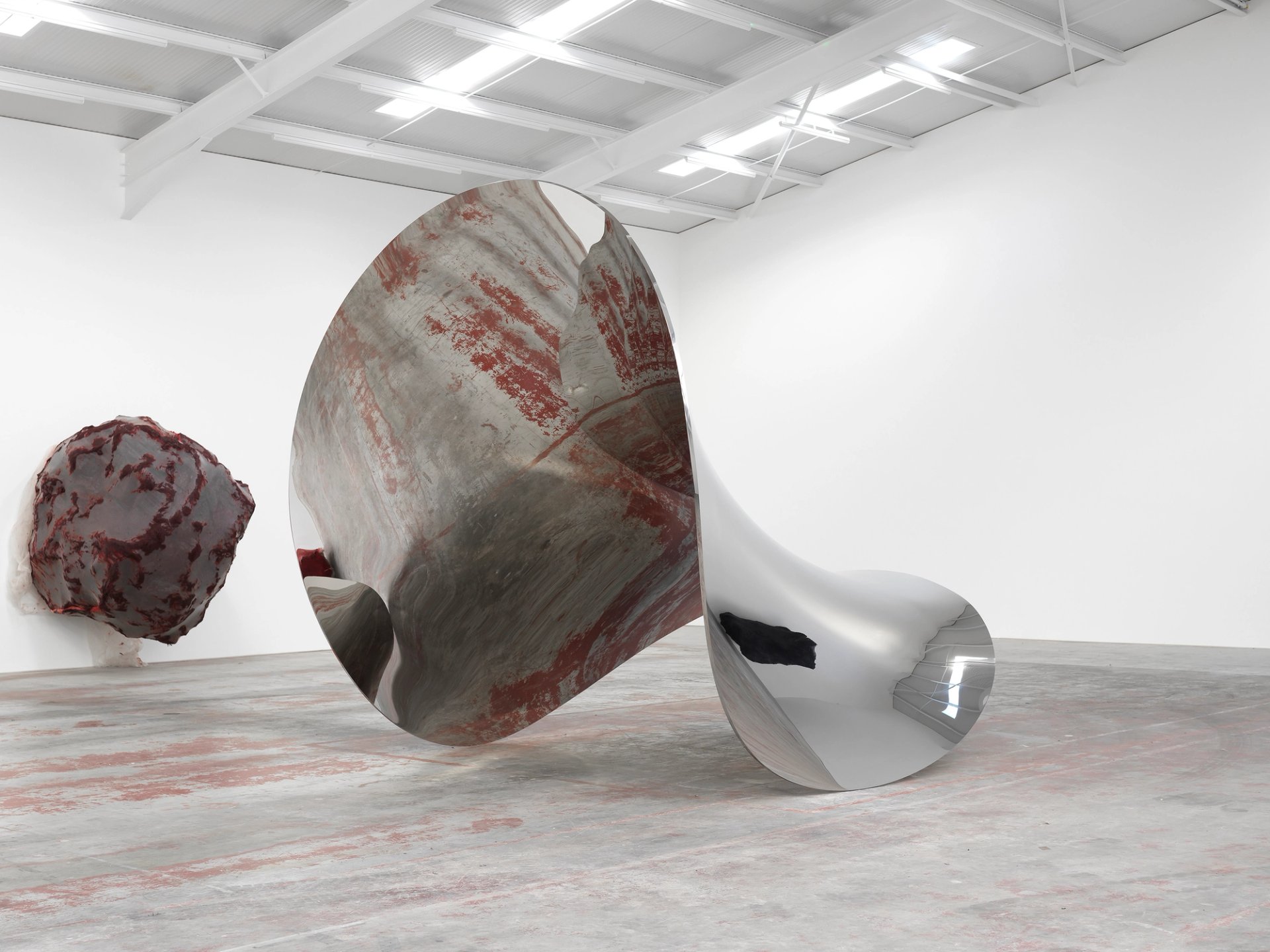
Anish Kapoor, Tsunami (2018)
Photo: Dave Morgan © Anish Kapoor. DACS, 2026
Even your emphatically material works often dematerialise, whether pigment voids in hefty chunks of rock or large polished steel sculptures, such as Cloud Gate in Chicago or Tsunami on the Hayward’s terrace. They may be huge pieces of metal but they completely reflect their surroundings. Again, there is the contradiction: they are pristine, discrete, static forms but simultaneously amorphous carriers of change, flux and movement.
What you’ve just said about the way that bigness and the ephemeral—in other words, bigness and smallness—come together, is most important. Scale, to quote Barnett Newman, isn’t a matter of size; it’s a matter of meaning. And it is a genuine, if somewhat difficult, tool for the sculptor, in the sense that just because a thing is big, it doesn’t mean it’s of any interest or even good. And how, then, does one play with work and turn into poetry this difficult question of the size of a thing? I try to take that full on, so let’s see.
Overall, it seems that you have dramatically ramped up the scale of your architectural interventions, and this is especially evident throughout the Hayward show.
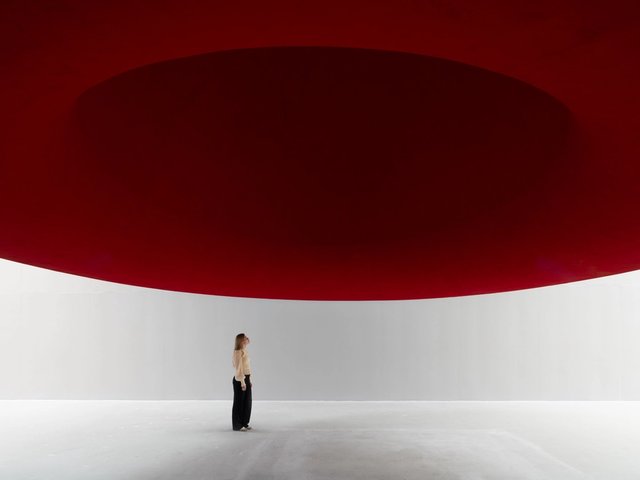
I don’t see it as a grand scale; I see it as necessary. Upstairs in this show there is a new work, which I’ve called Ha Makom. It means “the place” in Hebrew. But of course, in Kabbalistic tradition, place and deity are the same thing—or at least associated with each other in Kabbalistic language. It’s a very big pigment piece and it is a very emphatic, insistent red made of bits that all sit in relation to each other and fill most of that room upstairs. So, what am I after? I’m after red, of course, in a very particular mood, but also otherness, the sense of this being, if you like, somewhere else, something else.
Another development in recent years is the way in which your work has become messier, fleshier and more amorphous in appearance. There are a number of these visceral bodily works at the Hayward, most notably the Ritual Expiation (2025-26) series of floor-based sculptures with what looks like piles of viscera in trays, and new paintings with voids of gold leaf surrounded by fleshy frames.
In a way, the whole ritual practice, the ritual event, has been a big part of what I’ve worked with over many, many years. I feel it’s essential. I keep returning to it.
Your early pigment sculptures had votive, ritualistic connotations, with their coatings of powdered colour. And gazing into your many void pieces can feel akin to an act of devotion. But what you are conjuring up in these works is a very different kind of ritual—this is sacrificial carnage.
It’s carnage but, you know, they’re also performed in these trays. The trays have spouts. It’s very particular. It’s descriptive more of a moment of flaying all the insides. And none of them are real, of course. They’re made of silicone. There’s no actual bodily anything, except that at the same time it’s all very bodily, it’s all stuff.
Is this meant to make us aware of our own internal stuff?
Indeed. That’s exactly what I was going to say. That is the whole point of why I keep returning to various forms and ways of looking at the interior. The void is one, and this is another. It’s not incidental that it’s red, of course. Red is another interior, even if we don’t always recognise that to be the case; when you look at something red, it’s still there. And that conversation about the interior remains absolutely central for me.
These latest works refer to the flesh within us all but, like so much of your work, they seem more “yoni” (female) than “lingam” (male) in both form and association. What draws you to this essentially feminine imagery?
I keep returning to it. When I was a young artist, the first time anyone ever wrote about me, they wrote about me as if I was a woman. And I loved it! I’m heterosexual, I’m male, and yet this part of me is always there. Some women artists find it difficult, but it’s who I am, that’s the way it is! Whatever it is might also be cultural inheritance at some level. I don’t know any other Indian artists, or artists of Indian origin, who are drawn to, or trapped by this. But for me it’s a very important thing. Always has been, always will be.
You grew up in India in the shadow of the Himalayas with a Hindu Indian father and an Iraqi Jewish mother, and spent time on a kibbutz in Israel, before coming to art school and settling in England in the early 1970s. Here, you immersed yourself in the most radical art of the time. Do you think this diverse background has instilled an outsider spirit—and maybe a greater sense of freedom?
And to add to that, I’m now married to a Muslim! On one level, yes. But perhaps it also brings a perennial sense of homelessness. I remain homeless in my head. And, perhaps at some level, a gender homelessness is also part of this curious thing—though I don’t strictly see it in those terms. I am who I am, male and whatever else. But I’m deeply drawn to the feminine. The radical anthropologist Chris Knight talks of the first acts of culture being formed by women whose primal act was to cover their bodies with red ochre; he claims the first cultural acts were red ochre dancing. That moment of original creative formation is totally believable to me. Then, in Catholic art, we see the Madonna clothed in red, but then she becomes blue, as she’s taken from the earth and put in the sky.
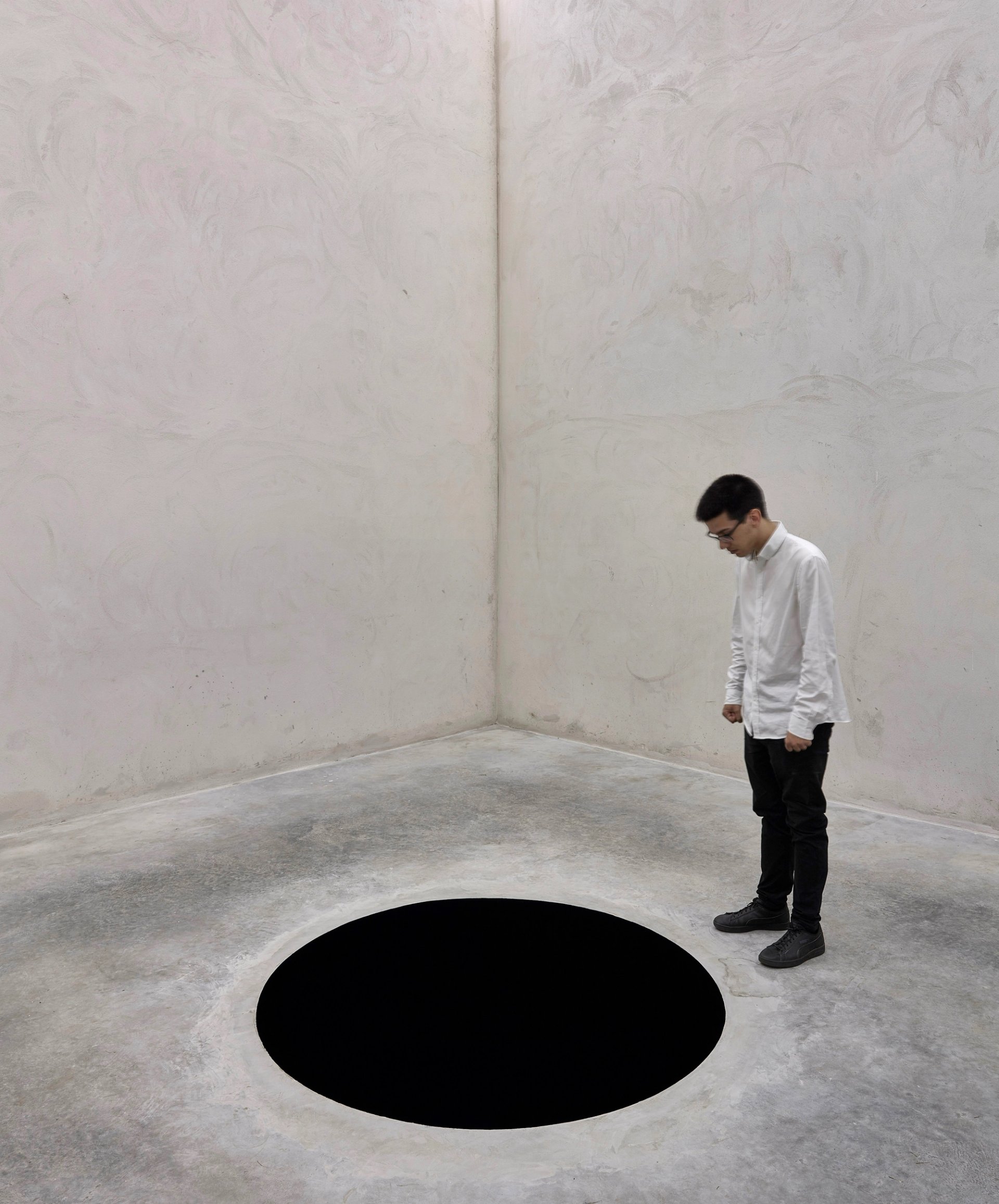
Anish Kapoor, Descent into Limbo (1992) Photo: Filipe Braga © Anish Kapoor. All rights reserved, DACS, 2026
The other colour you have become especially associated with in recent years is black. In 2016 you gained the exclusive artistic licence for Vantablack, developed by Surrey NanoSystems to be the darkest manmade substance in existence, absorbing more than 99% of visible light. Your use of this material has resulted in what you call “non-object” works, which from certain angles seem to vanish altogether—literally into a black hole.
I’ve worked with this wonderful team for many years now and I should say it is a technology, not a paint. A surface is put down on a material and then it goes into a reactor. It’s highly technical, dangerous and difficult. And the particles, the nano tubes, stand up rather like a velvet, and light gets trapped between the particles and can’t escape, which makes it all super-black. I’m deeply interested in [Kazimir] Malevich, and the radical proposition of his Black Square as a four-dimensional object and the notion that fiction and reality mix with each other. A four-dimensional object is only four dimensional if you believe it. So, this poetic object sits in a wonderful place between the fictional and the real, between being and non-being.
• Anish Kapoor, Hayward Gallery, London, until 18 October