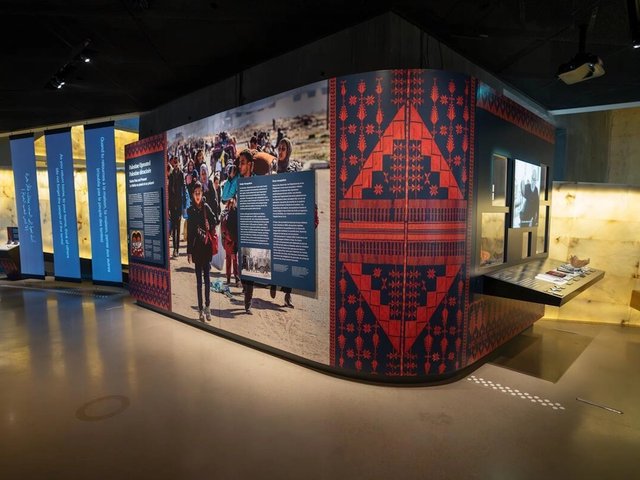
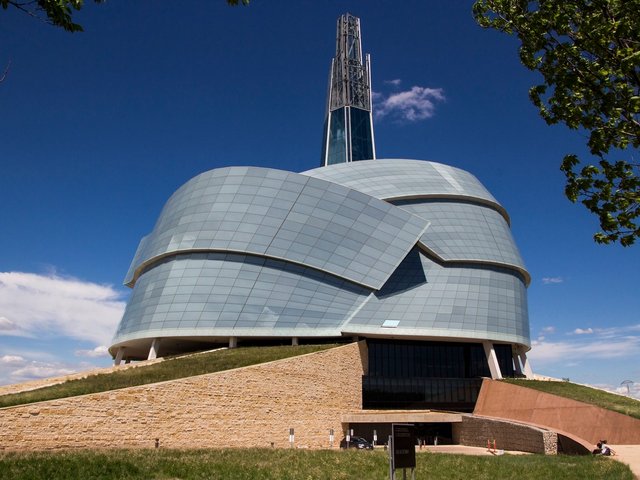
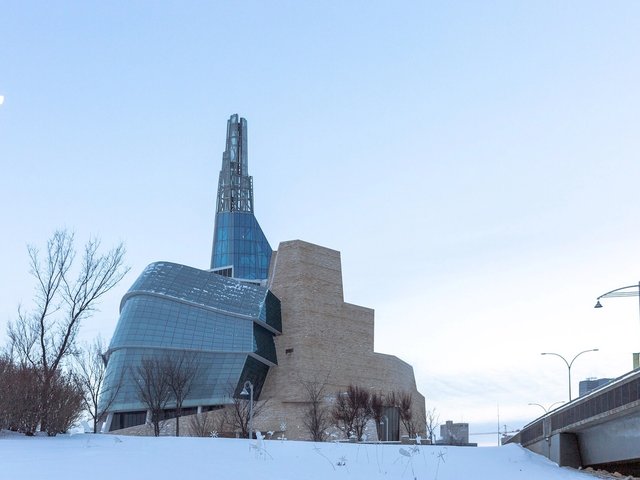
Gail Asper, whose father Izzy Asper was instrumental in conceiving and financing the Canadian Museum for Human Rights (CMHR) in Winnipeg, has stated that her family will no longer fund the public institution due to concerns about its exhibition Palestine Uprooted: Nakba Past and Present (until 30 November 2028).
In a CBC Radio interview aired in Winnipeg on Monday (27 July), Asper, who is a trustee of the Asper Foundation and was instrumental in realising her father’s vision, told a reporter that she now had “complicated emotions” towards the CMHCR. She complained of a “lack of context” in the exhibition about the forced displacement of Palestinians during the creation of Israel, such as the omission of information about the Palestinian rejection of a state that was offered in the United Nations’ 1947 partition plan and about Jews displaced in Arab lands.
Although Asper said that she had no issue with the inclusion of testimonies from Palestinian Canadian survivors of the Nakba, she said that “not mentioning the hostages Hamas took [on 7 October 2023]” and not saying that Hamas wants to eradicate Israel “brings the curatorship into disrepute”. She added that she “feels betrayed by the curators and the leadership” at the museum her family helped create.
While the displacement of Jews in 1948 from Arab lands and the Arab rejection of the UN partition plan are acknowledged elsewhere in the museum, Asper said she fears the lack of explicit context within Palestine Uprooted could contribute to growing antisemitism in Canada.
According to Asper, her family's foundation donated over C$23m ($16.3m) toward the museum’s construction, while she personally gave another C$1.4m ($1m) to the museum’s fundraising efforts and exhibit development. She added that the Asper Foundation stopped funding the museum’s annual gala after 2023 because of “concerns about its programming”. Asper, who did not respond to The Art Newspaper’s request for comment, told CBC Radio that she has indefinitely paused a C$50,000 ($35,500) donation to support the expansion of an existing Holocaust exhibit at the museum.
A CMHR spokesperson tells The Art Newspaper that the “Dimensions in Testimony” section of the museum’s existing Holocaust exhibit requires special facilitation and staffing. “The C$50,000 [from Asper] was to expand how often we run this programming. It will continue and be offered,” the spokesperson says. The withdrawal of Asper’s funds “will not impact our exhibits or current programming”.
The spokesperson confirms that CMHR has not received funding from the Asper Foundation since 2023. She adds that since Palestine Uprooted opened, the museum had received an influx of support from new donors.
“Our mandate is to foster thoughtful reflection and dialogue about human rights,” the CMHR spokesperson says. “Building an understanding of the personal stories and experiences of Palestinian Canadians is squarely within that mandate. Their stories have a place in this museum.”
That mandate, the spokesperson continues, “also includes combatting antisemitism and the devastating impact it has, and its alarming growth in recent years. In recent years, we have expanded our Holocaust and antisemitism education and programming, and we will continue to expand that work to promote respect and dignity for all. “
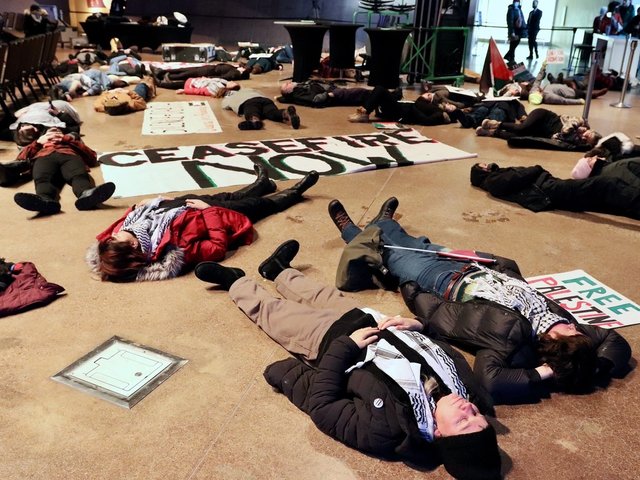
A union representing CMHR workers issued a statement on 29 July objecting to the campaign against the Nakba display. “The intensity of the pressure to silence Palestinian Canadian voices and discredit this exhibit says a great deal about exactly why the exhibit is necessary in the first place,” Béla Gyarmati, the chief shop steward for Union of National Employees Local 50773, said in a statement.
On 22 July, 114 human rights, labour, faith and civil society organisations issued a statement defending the CMHR’s curatorial independence. A petition objecting to Canadian Heritage Minister Marc Miller’s perceived attempt at political interference in Palestine Uprooted has gathered more than 12,000 signatures.
Nir Hagigi, a spokesperson for Independent Jewish Voices Canada (one of the more than a dozen Jewish organisations that signed last week’s statement), tells The Art Newspaper: “Private donors are entitled to withdraw their money. However, no donor, regardless of their historical relationship with any particular institution, should be able to determine which communities are permitted to tell their histories or what political conditions must be attached to their recognition.”
Hagigi adds: “It is particularly disturbing to characterise an exhibition about Palestinian displacement as contributing to antisemitism simply because it centres Palestinian voices.”
Ramsey Zeid, the president of the Canadian Palestinian Association of Manitoba and the son of Nakba survivors who was part of the community consultation on the exhibition, claims the Asper family’s actions are a continuation of a long history of “erasure” of the Nakba’s history and legacy. He says funding has been weaponised to control the narrative on Palestine “not just at the museum but also in terms of political contributions to the Liberal Party of Canada”.
Zeid adds: “I hope the museum and the government stand firm and refuse to bow to their pressure. This is a story that needs to be told.”