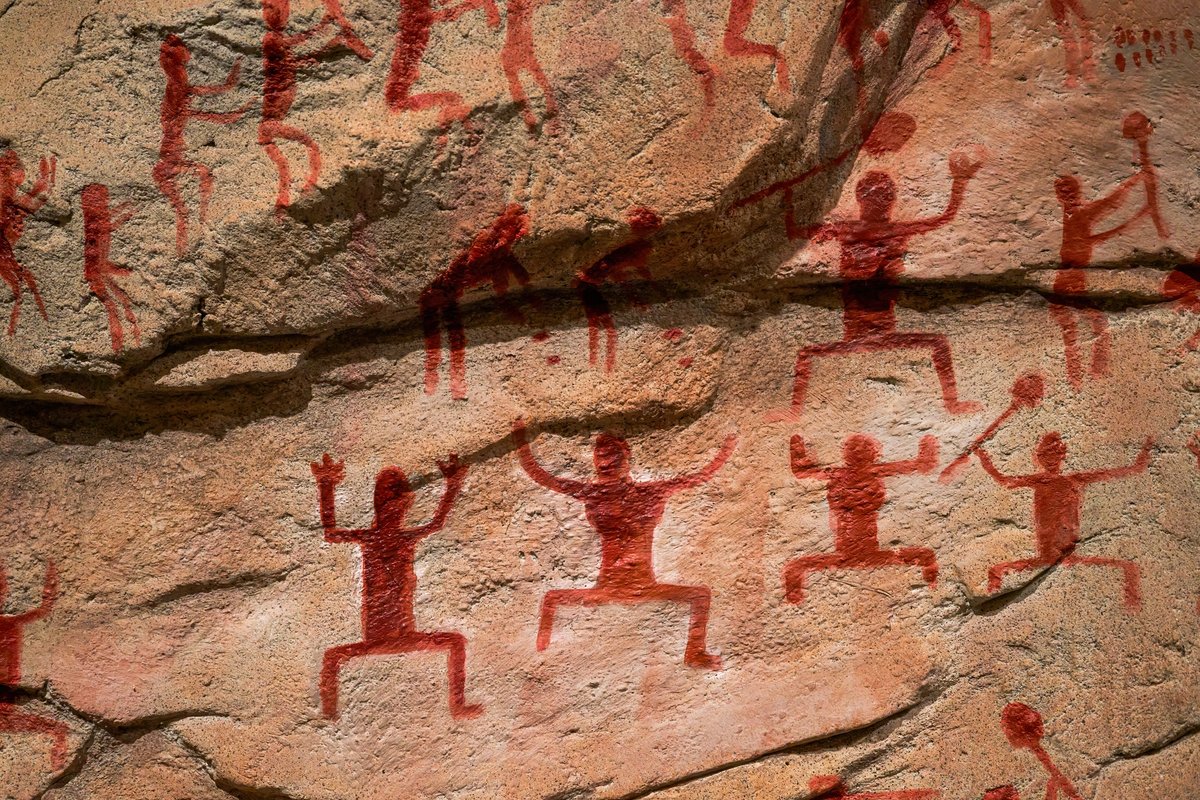
New research suggests that the reason that the ancient images found in the bright red murals of China’s Zuojiang River Valley are so well preserved is due to a special ingredient in the pigment: blood.
A team at the International Research Laboratory of Environmental and Social Archaeology in Shandong University, led by Meng Wu, say that the still-vivid figures—some naked, wearing feather headpieces and playing drums and bells in what might be an ancient fertility rite—were created from paint made with a small amount of blood, including animal blood and possibly blood from human childbirth. The research is due to be published in next month’s issue of the Journal of Archaeological Science.
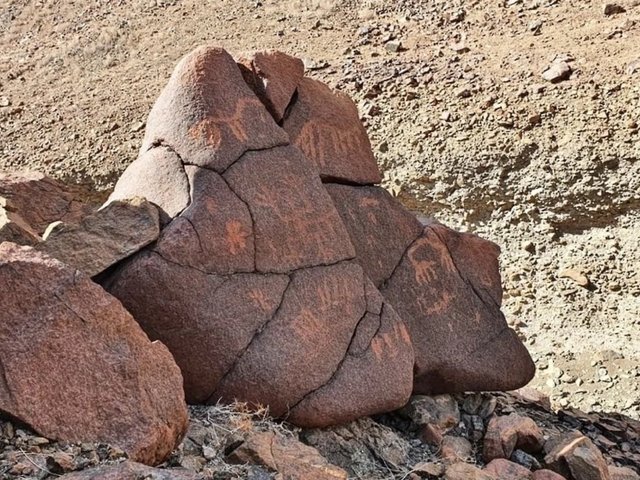
Located in Guangxi, southern China, the Huashan rock art dates back to around the fifth century BC to the second century AD and was inscribed on the Unesco World Heritage List as the Zuojiang Huashan Rock Art Cultural Landscape in 2016. Painted onto karst limestone cliffs in a extremely hot and humid subtropical monsoon zone, it has long been a mystery as to how the images have survived weathering for over two millennia.
The Shandong University team looked at rock art fragments from three of the more than 80 sites in the Huashan rock art belt (only 38 are inscribed by Unesco) using infrared and x-ray technologies and proteomics (analysing sets of proteins produced or modified by an organism, tissue or cell) to determine the murals' structure and mineral and organic composition.
“Our study indicates that red clay rich in nano-hematite was used as the pigment, and a composite mortar made from lime and blood served as the binder in the rock art. Biomineralised calcium carbonate induced by blood proteins tightly encapsulates nano-hematite and strongly bonds to the limestone,” the researchers write. This stable organic-inorganic composite bonding system, they claim, reveals the complex technological processes used by the creators and explains why the Huashan rock art has survived so well in such challenging conditions.
“Many ethnographic studies around the world have mentioned that blood was used in prehistoric rock art painting. This may be related to the fact that most rock art painters were hunter-gatherers,” Wu tells The Art Newspaper. “This study helps us better understand the level of chemical technology in early human societies—specifically hunter-gatherer societies.”
The research also suggests that the use of blood from childbirth “could be linked to the worship of female fertility of the creators' community, a matriarchal fisher-hunter-gatherer society.”
These findings, the researchers note, show that pre-historic rock art “was a technically intensive project rather than a labour-intensive one”.
The archaeologist Jose-Miguel Perez Gomez, an expert in ancient rock art from the same period in South America, tells The Art Newspaper that the suggestion that some human blood may have come from women during childbirth or the postpartum period, based on proteins associated with pregnancy and lactation, is the the weakest but potentially most interesting part of the research. “Those proteins are not exclusive to childbirth,” he notes, adding that “no ancient DNA was recovered, and only three sites in a rock-art complex of more than 80 were sampled”.
What is missing in the research, he says, is a stronger archaeological bridge between chemistry and meaning. “If childbirth blood was intentionally selected, we should ask whether images associated with reproduction cluster where human blood is detected; whether pigment recipes vary according to motif; and whether the spatial setting itself formed part of the ritual,” he says.