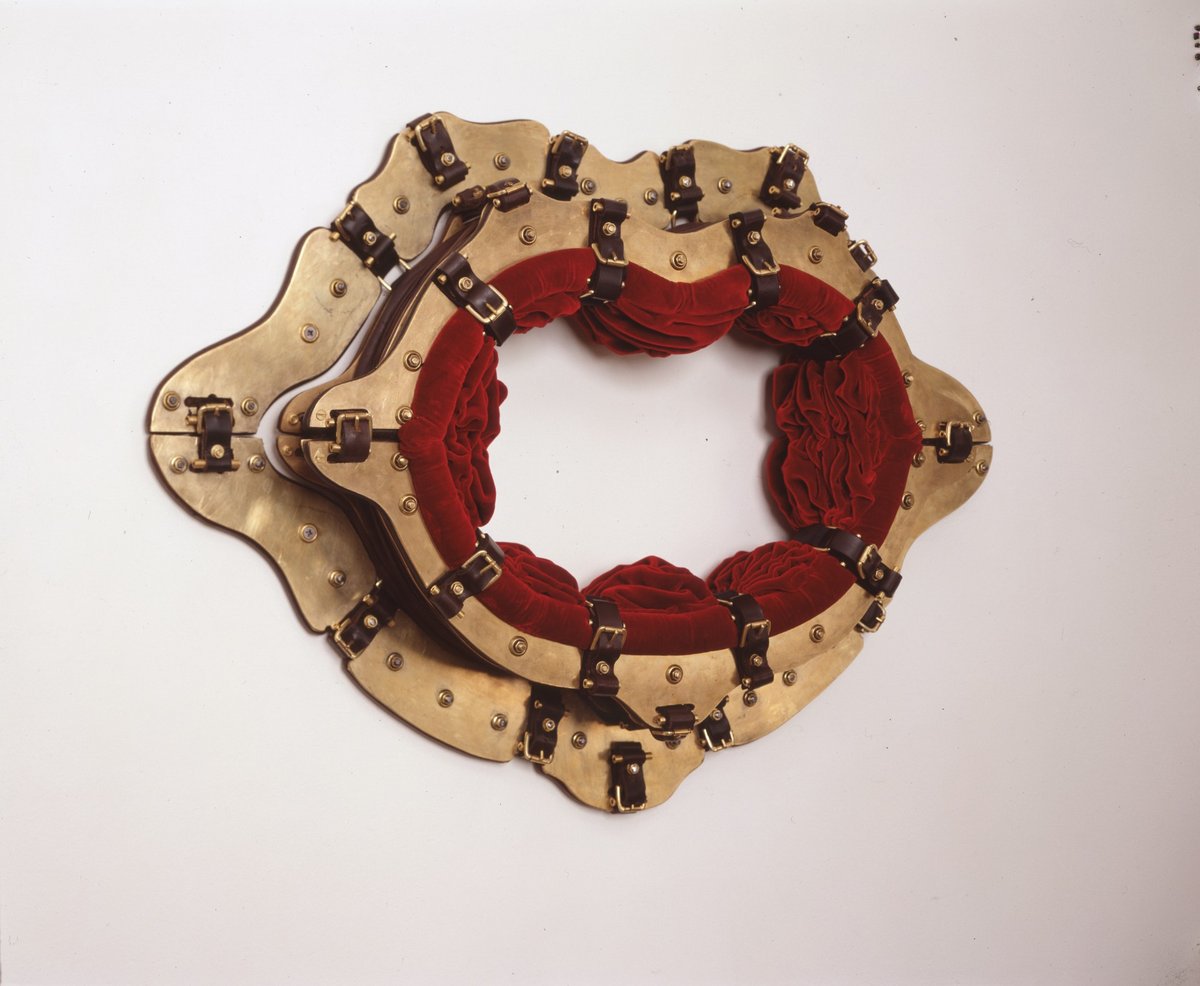
Cathy de Monchaux’s erotic, intricately wrought sculpture confirmed her as one of the most original and distinctive artists of the 1990s. I remember her show at Chisenhale Gallery in 1993 with its elaborate wall pieces bristling with baroque spikes and curlicues, threaded with ribbons and seeping slivers of red velvet and folds of leather from between bolted metal plates.
A Goldsmith’s graduate, De Monchaux had a very different aesthetic to her YBA contemporaries, but just as much attitude. Once Upon a Fuck was her title for a palm-sized, heart-shaped piece, baring velvety innards and shiny brass spine like a sprung trap: this was work that spat on stereotypes and defied any easy readings.
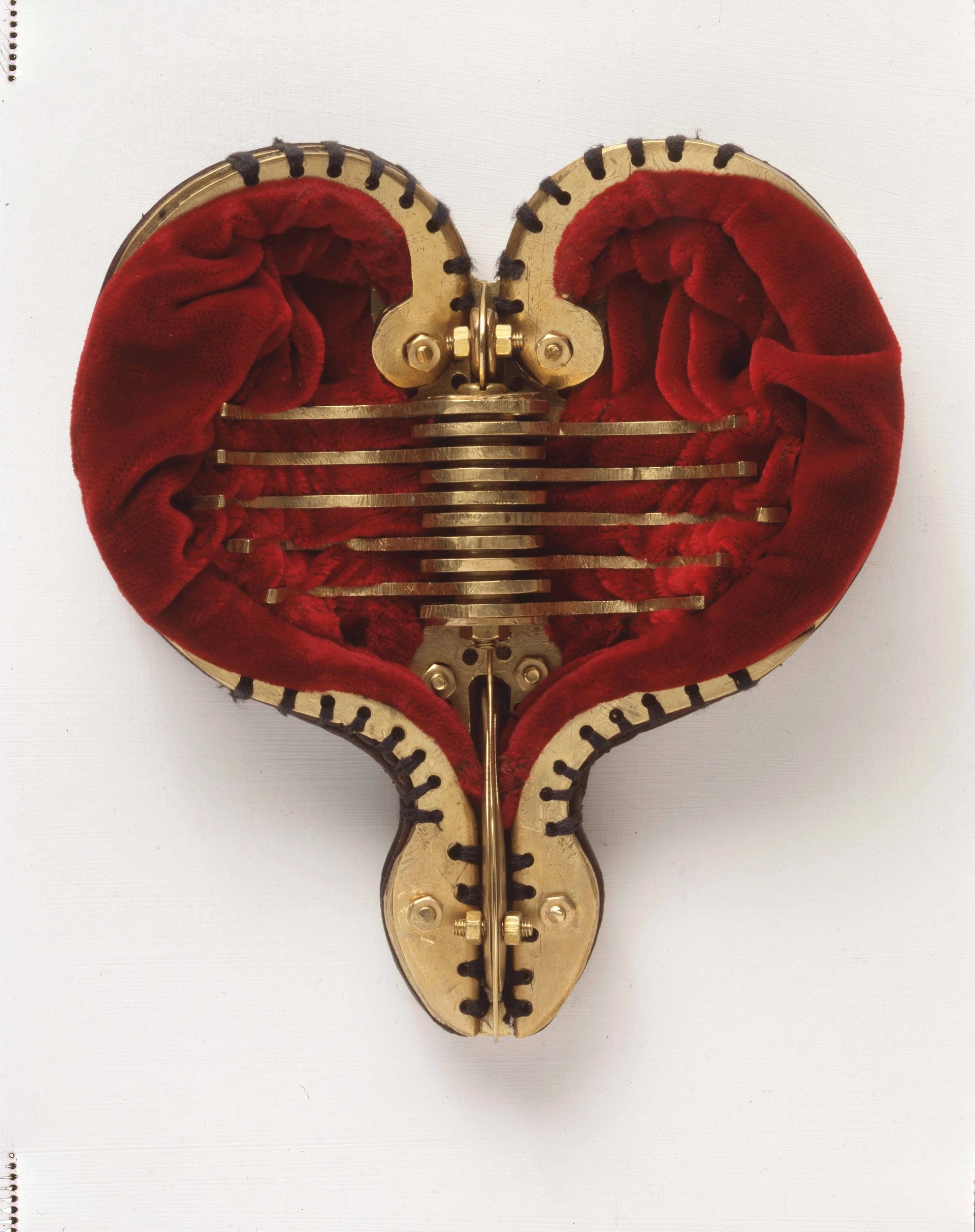
Heart felt: Cathy de Monchaux’s Once Upon a Fuck (1992) © Adagp, Paris, 2026
Success was rapid. She was nominated for the Turner Prize in 1998, and her Turner exhibition featured two large works that had already been bought by the Tate. More institutional acquisitions also accompanied critically acclaimed US shows in 2000.
It’s therefore astonishing that De Monchaux is only now regaining recognition. Studio Wounds and Battles: Desire is the Reiteration of Hope, her major survey at the Palais de Tokyo in Paris, is her first significant exhibition for more than quarter of a century. “The phone just stopped ringing,” she tells me, as we walk through the museum’s cavernous spaces, adding, “Putting myself out is not one of my skill sets.” The eye of the art world may have turned away but De Monchaux, alongside raising her son as a single mother and supported by a handful of loyal collectors, never stopped making work. “I’m so lucky that I’ve been able to keep up the intensity through thick and thin, and because nobody was pressurising me—I’ve been able to investigate new things at my own pace,” she says.
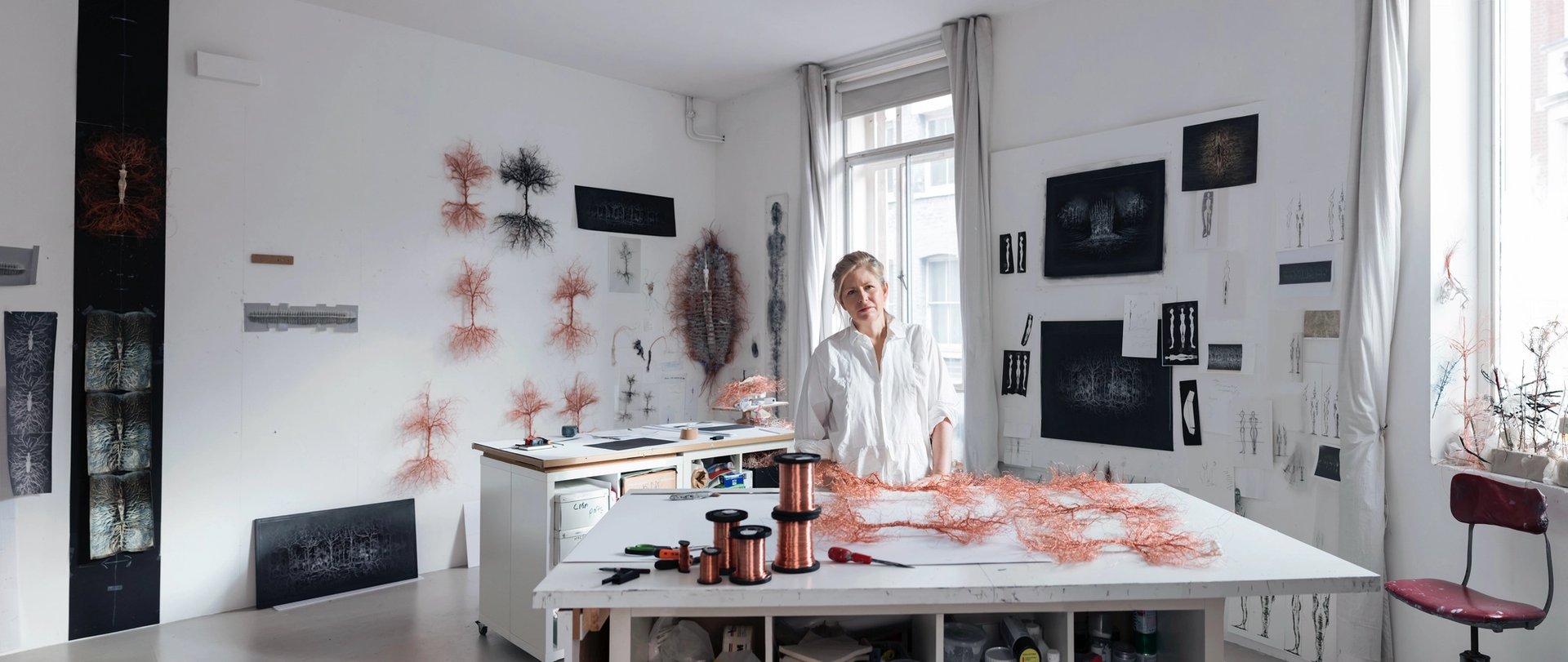
Portrait of Cathy de Monchaux Photo: Anthony Lycett, 2018
The Palais de Tokyo show is testament to this intense experimentation. Avoiding a chronological approach, it mixes works spanning decades: a life-sized unicorn made from cane and tissue paper when De Monchaux was a student presides over recent works, some completed in situ in an improvised studio upstairs at Palais de Tokyo. These comprise dramatic wall-mounted chalky white tableaux of faceless pregnant women emerging from papery fissures, perched on tumbling staircases or becoming part of forests, their wiry hair whipped aloft like branches, feet growing webs of arterial roots. All are testament to an enduring fantasy world fuelled by childhood memories of roaming throughout the Victoria and Albert and British Museums in London. De Monchaux remembers absorbing everything from Elizabethan ruffs to musical instruments and Egyptian funeral figures. “We’d run wild, it was a mental escape, looking at all these objects and trying to make sense of them”.
A pan-cultural cathedral
At the Palais de Tokyo the effect is that of a profane, pan-cultural cathedral where earlier abstract works inhabit the lofty architecture like ornate gargoyles or votive reliquaries. They are accompanied by multifarious works including prominently genitaled cast silver frogs; framed monochrome forest scenes that feature more unicorns; and miniature battles raging in glades fashioned from wire, paint and sticking plaster. Then there are the massed ranks of pregnant female figures that have become a motif in recent years. “They are clearly mothers; in my work it is always about the back and forth between the personal and the political,” she says.
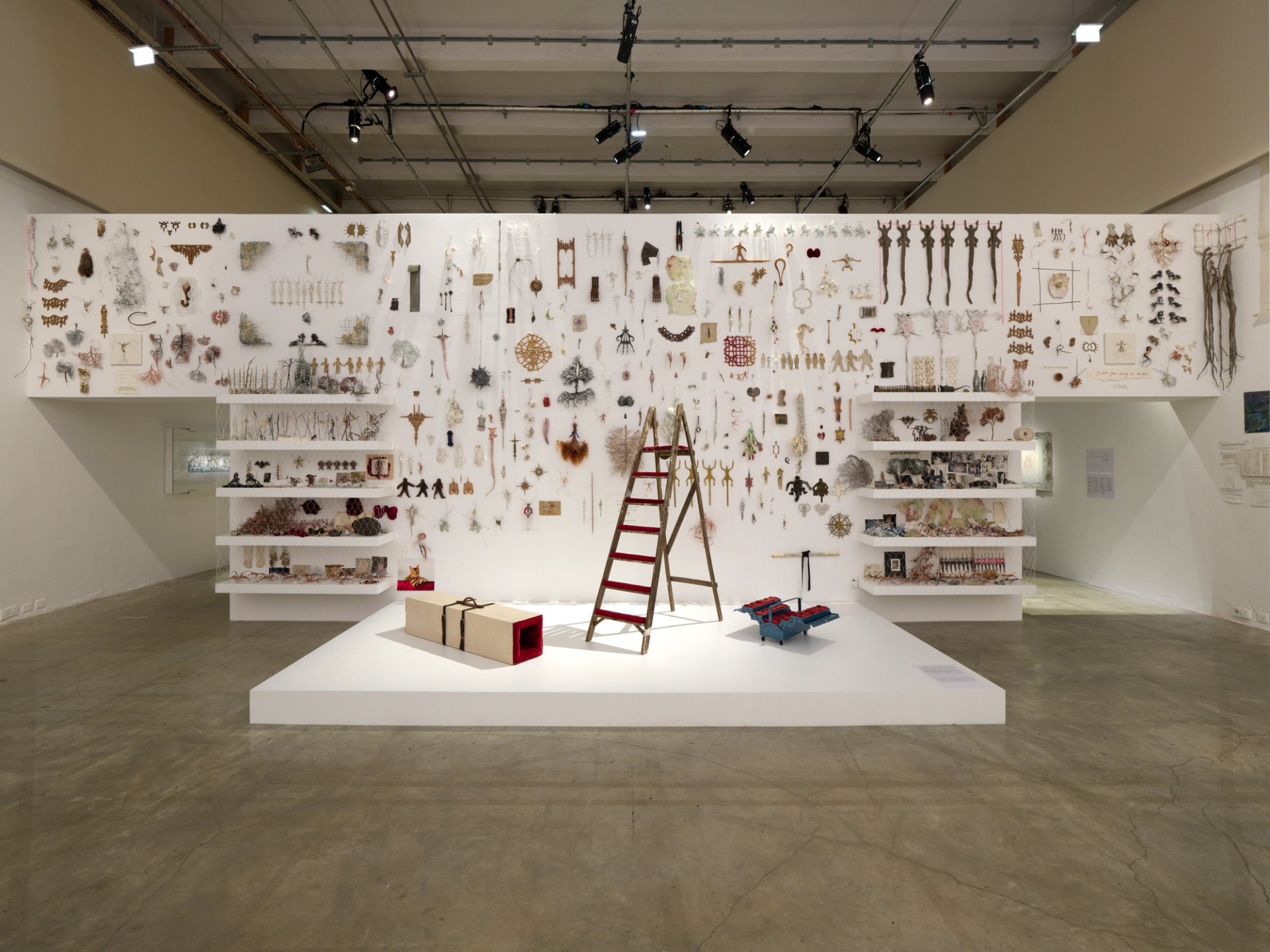
Installation view of Studio, Wounds and Battles, Desire is the Reiteration of Hope Courtesy of the artist and the Galerie Jennifer Flay; © Adagp; Paris; 2026
The language of her work may have changed, but De Monchaux’s preoccuption with meticulous fabrication remains. “I’ve always wanted to hand-make my work,” she says, laughing at the “insanity” of her obsessive creative process which frequently results in her working through the night and up to the last minute, including for this show. This inventive devotion to facture has resulted in a near- alchemical mastery of materials: such are De Monchaux’s transformative skills that it’s often hard to know what her work is actually made from, as surfaces are rubbed, distressed and covered with dust, plaster or encrusted with paint. “Materials are evocative of my mood,” she remarks.
As the title of the Grand Palais exhibition implies, De Monchaux’s London studio lies at the centre of all these endeavours, functioning as a creative crucible of strife and struggle as well as refuge and solace. One of the show’s most striking features is the laborious recreation of this studio space, a magical treasure trove of ephemera, offcuts and magical objects—from a mummified bat to strangely-shaped stones, scraps of fur and twists of metal, wire and paper—which she describes as “my tool shelves of ideas and spells.” Along with these massed talismans, walls lined with open sketchbooks and papered with layered intricate drawings offer a total and sometimes disconcerting immersion into a unique imagination which at last is getting the recognition it so richly deserves.
• Cathy de Monchaux: Studio, Wounds and Battles, Desire is the Reiteration of Hope, Palais de Tokyo, Paris, until 13 September