“It’s the very high and the very low stuff that is selling the best, it’s still a strange time,” reflected the adviser Judith Greve at the opening VIP day of Frieze London (until 17 October). Offerings from blue-chip galleries remain largely conservative, while the most striking and daring works come courtesy of smaller dealers operating at lower price points and with lower overheads.
In the back of the tent, where the biggest dealerships are placed, solo stands of painting dominate. At Gagosian, all six recent Albert Oehlen oil paintings were sold (price undisclosed but The Art Newspaper understands them to be over $1m each), while Lisson has sold two paintings by Dalton Paula for £50,000 each, with a further four on reserve (for £50,000-£150,000). In the front of the tent, Modern Art gallery has brought a solo presentation of gently layered abstracts by Francesca Mollett.
For some, quality remains an issue in the upper end of the primary market. Philip Hoffman, the founder of The Fine Art Group advisory, notes that “plenty of works had sold when I enquired, but there was no material that was fantastic. The galleries seem to be trying to pay their bills and are not making much more money—costs are hefty and fairs like Frieze are not cheap dates.”
Pace has devoted its stand to five large, monochromatic canvases by Marina Perez Simão, nearly all of which it says sold for $250,000 each by the end of preview day. The gallery’s president Marc Glimcher frames the compact stand as fitting for Frieze London, “a fair suited for solo presentations”, while “Paris is a more buoyant selling opportunity”. Hoffman notes “the serious money is going to Paris, we are sending our whole team there with few on the ground in London”.
Naturally, many stakeholders are keen to stress that London and Paris operate in collaboration, not competition. Nonetheless it is undeniable that Frieze’s proximity to Art Basel Paris (23-25 October) is causing dealers to adjust to a shifting pace of sales and VIP attendance in London, with important collectors from overseas increasingly visiting and buying both on its opening day and over the weekend, en route to Paris.
A case in point: Frieze has this year added VIP hours between 10am and 11am on Saturday, the first time it is accommodating VIPs on the weekend. “We are seeing an increase in VIP guests attending the fair at the weekend, and the Saturday VIP hour creates the context that facilitates in-depth conversations and relationship building,” says Frieze’s executive director of fairs, Kristell Chadé.
“More clients visiting over the weekend is certainly something we are factoring in,” says Zoe Sperling, a partner at Hauser & Wirth, confirming more senior directors were now required at the fair during the weekend. The gallery registered several sales across Frieze London and Masters, including the highest priced work reported on day one: a still life by Jan Brueghel the Elder, which sold “in the region of £5m” at Frieze Masters.
Several commentators stress that while the deepest pockets—particularly those from the US—may not be in London this week, the city plays host to a wide range of cultures and diasporas. The adviser Diane Abela says: “You see such a diversity of audience at this fair that you don’t get elsewhere.” Indeed, notable collectors from growth regions such as the Arabian Gulf and India, which have closer cultural ties to the UK than they do to France, were spotted snapping up works. Sheikh Zayed bin Sultan bin Khalifa Al Nahyan bought three works, including a wood-framed print by Joanna Piotrowska for €24,000 from Phillida Reid and a large painting by Anna Ruth from Grimm Gallery for £20,000. “Frieze London feels more measured this year, fewer risqué gestures, more established practices,” he says. “Perhaps works that speak to the weight people are carrying, given the economic and political situation around the world.”
Buyers taking more time
Several galleries operating in the mid-tier reported solid sales, although dealers did say that collectors are continuing to take more time to make a decision than before the market downturn.
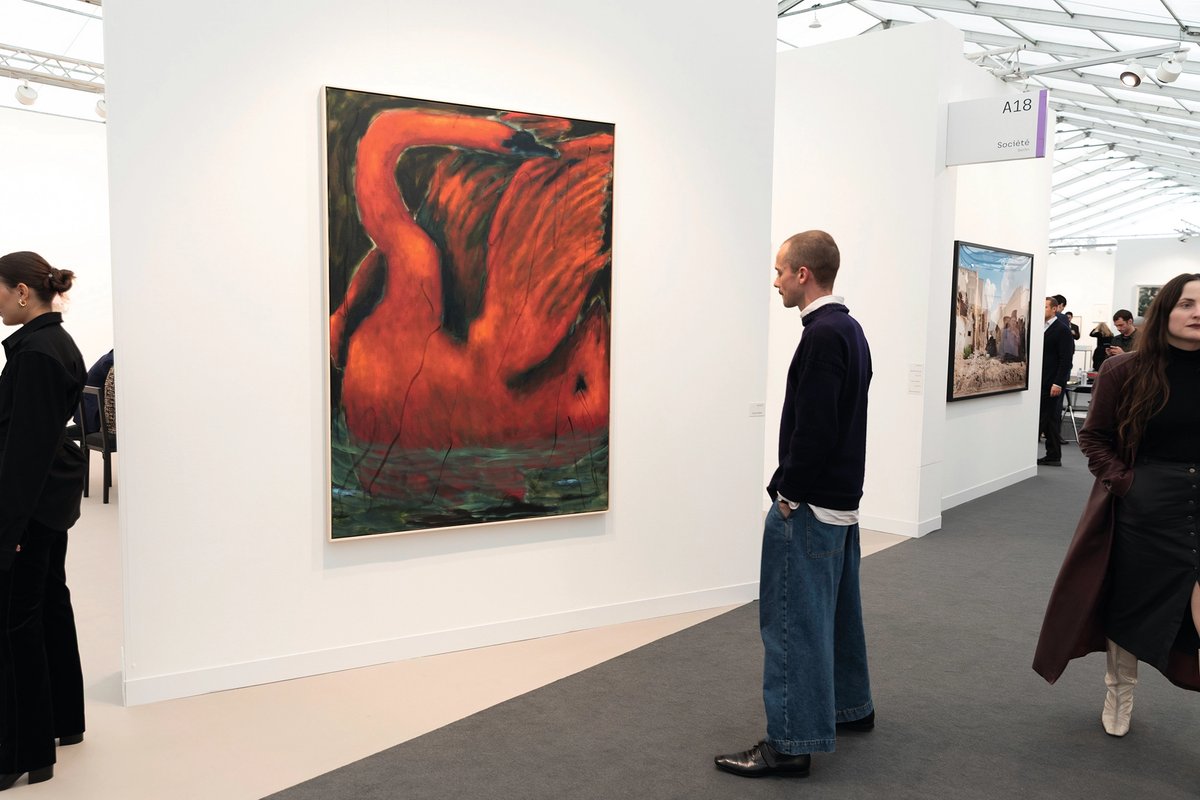
Proyectos Ultravioleta, the Guatemala City gallery, reported both institutional and private interest in a number of minute, beautifully detailed paintings by the late Maya Kaqchikel artist Rosa Elena Curruchich, which sold for £10,000 apiece. Three works by the Silät collective, a group of women weavers in northern Argentina, also sold, with one going to The Whitworth via the Contemporary Art Society’s Collections Fund. Société, the Berlin-based gallery, placed works across age and price ranges in its painting-led stand, with a Conny Maier painting going in the €90,000-€100,000 range; a Jeanette Mundt painting going within the first hour; and two paintings by Tu Hongtao for $30,000 each.
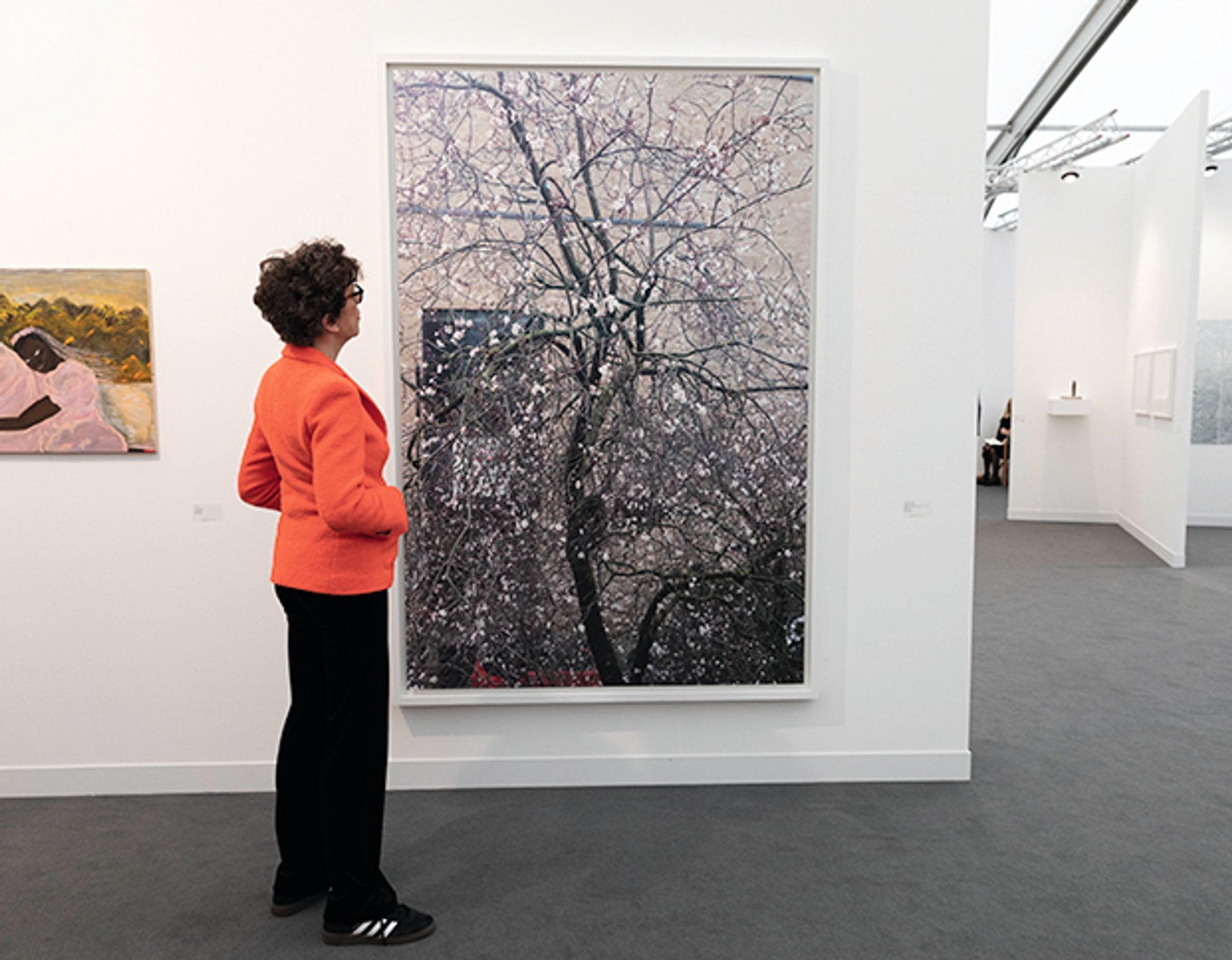
Wolfgang Tillmans’s First Days of Spring (2026) at Maureen Paley gallery’s stand David Owens
Maureen Paley likewise reported energetic buying, with a striking Wolfgang Tillmans photograph sold for $120,000; a painting by the British artist Mary Stephenson, a recent graduate from the Royal Academy, going for £29,000; a large watercolour by the Nigerian-American artist Chioma Ebinama going for $18,000; and a melancholic landscape in wood by the Scottish artist Merlin James for £33,000. James will have a solo show next January at the Camden Art Centre. Maureen Paley gallery also said that it had conducted several sales at the fair for Rebecca Warren, whom it is showing at its London main space
Among the emerging galleries, experimental and daring works offered at reasonable prices are finding a receptive and curious audience. Indeed, as large portions of the contemporary art market are proving to be unreliable stores of value, several dealers remark that greater interest is returning to challenging works whose purchase presents a lesser financial risk.
The north London gallery Harlesden High Street is offering text-based prints and works resembling street signs by Marcus Jefferson, which refer to the “social and economic gaps between the Frieze tent and its nearby areas”, and are priced at £2,000-£8,000. The gallery’s founder Jonny Tanna notes that from last year he has ceased to sell paintings and now focuses exclusively on conceptual art. “No shade to people who only show painting,” he says, glancing to several canvas-heavy stands around him, “but we want to do something more challenging”. It is paying off, Tanna notes, with the gallery having sold the entire stand by the end of VIP Day.
These sentiments are echoed by Lucien Tso, the founder of Shanghai’s Gallery Vacancy, which is offering small sculptures by Anna Gonzalez Noguchi, ranging from $2,500 to $12,000, two of which have sold, one to a London foundation and another to a private collector. Tso explains that at a certain price point people are still willing to be challenged. “That is where a new market can be formed. Looking around it is clear that even in a downturn, some galleries are still willing to take risks. You constantly have to test to find out what works.”