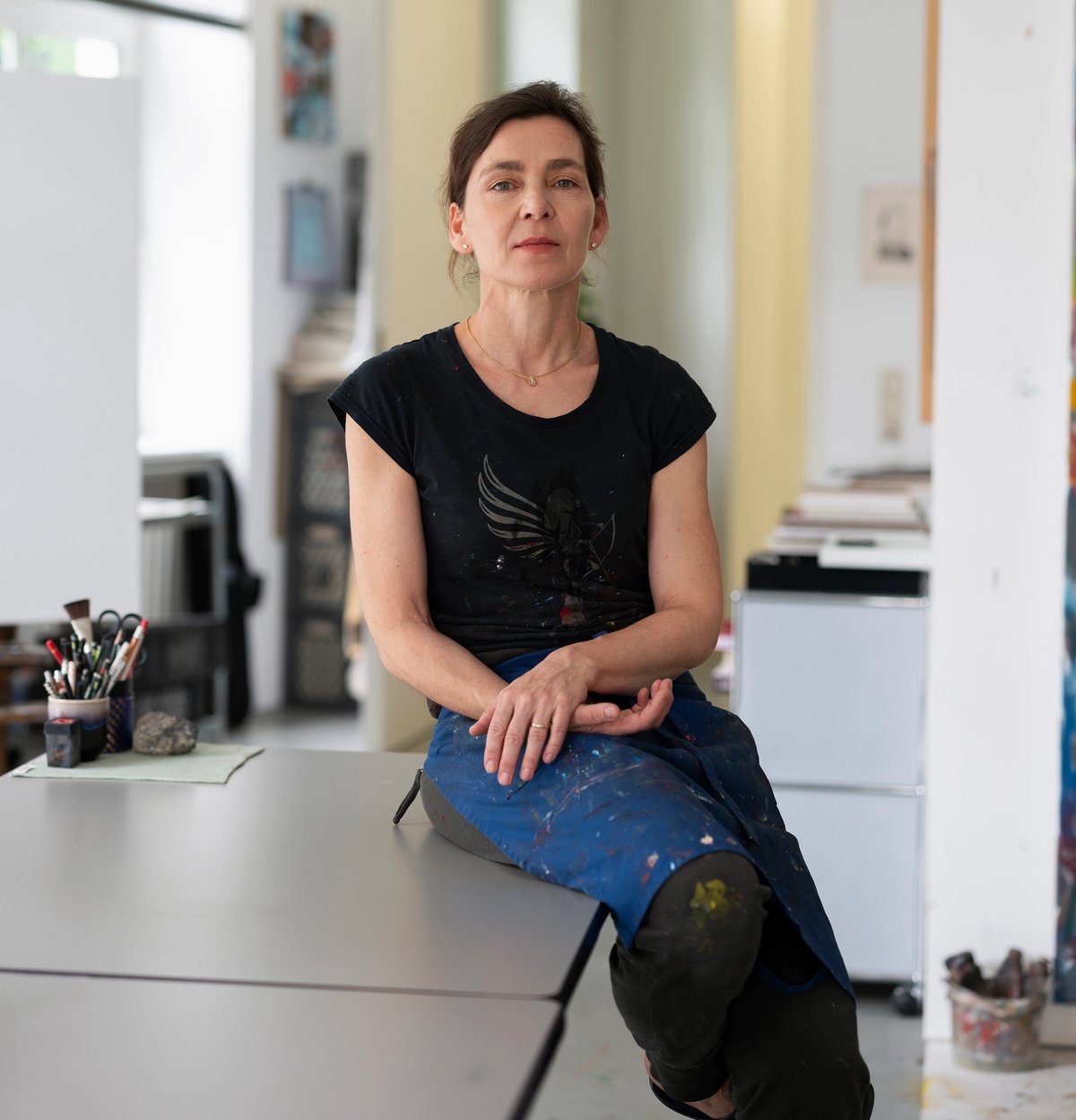
The German painter Sabine Moritz has long worked in ways that frustrate easy categorisation. When an interviewer in 2023 asked her about a new body of gestural paintings being somewhere between abstraction and figuration, she described the act of painting itself as a landscape of sorts. “It’s like there are two banks,” she said. “Figuration on one side and abstraction on the other, and a river between. The river is obstinate. It takes time to cross.” This imagery draws out a golden thread that weaves through all her work, where ever-present attention is paid to the natural world.
As Moritz was preparing to open Lie Down in Green Pastures at the Garden Museum in London—her first large-scale museum show in the UK—she spoke about her early works, based on memories of her childhood, that brought her to the world’s attention and how her new work is not about understanding the past but how to live in the present.
The Art Newspaper: This is your first UK museum exhibition. How does that make you feel?
Sabine Moritz: I’m so proud and so happy to be doing this show, particularly in the Garden Museum, which has made clear all kinds of connections that I wasn’t really aware of until now. When the curator Emma House and I first discussed what to include, I sent over images and gave her free rein. She immediately knew she wanted the two big Institute paintings: Institute I and Institute II. I wasn’t sure. I had never shown them before because I was just never happy with them. I made them a long time ago back in 1993, while studying at the Academy of Art in Düsseldorf, and I knew exactly what I was trying to achieve with them then. But somehow I always felt I could have done better. I was essentially trying to teach myself how to paint with oils.
I made the botanical drawings around the same time, which I’ve also never shown. I kind of only recently rediscovered them. What has been amazing is seeing anew the works Emma chose—it makes me think there is a quality there that I hadn’t seen myself. Perhaps the sense of urgency or intensity I felt when making them and wanted to instil in them is discernible—even if, to my mind, they aren’t entirely successful in formal terms.
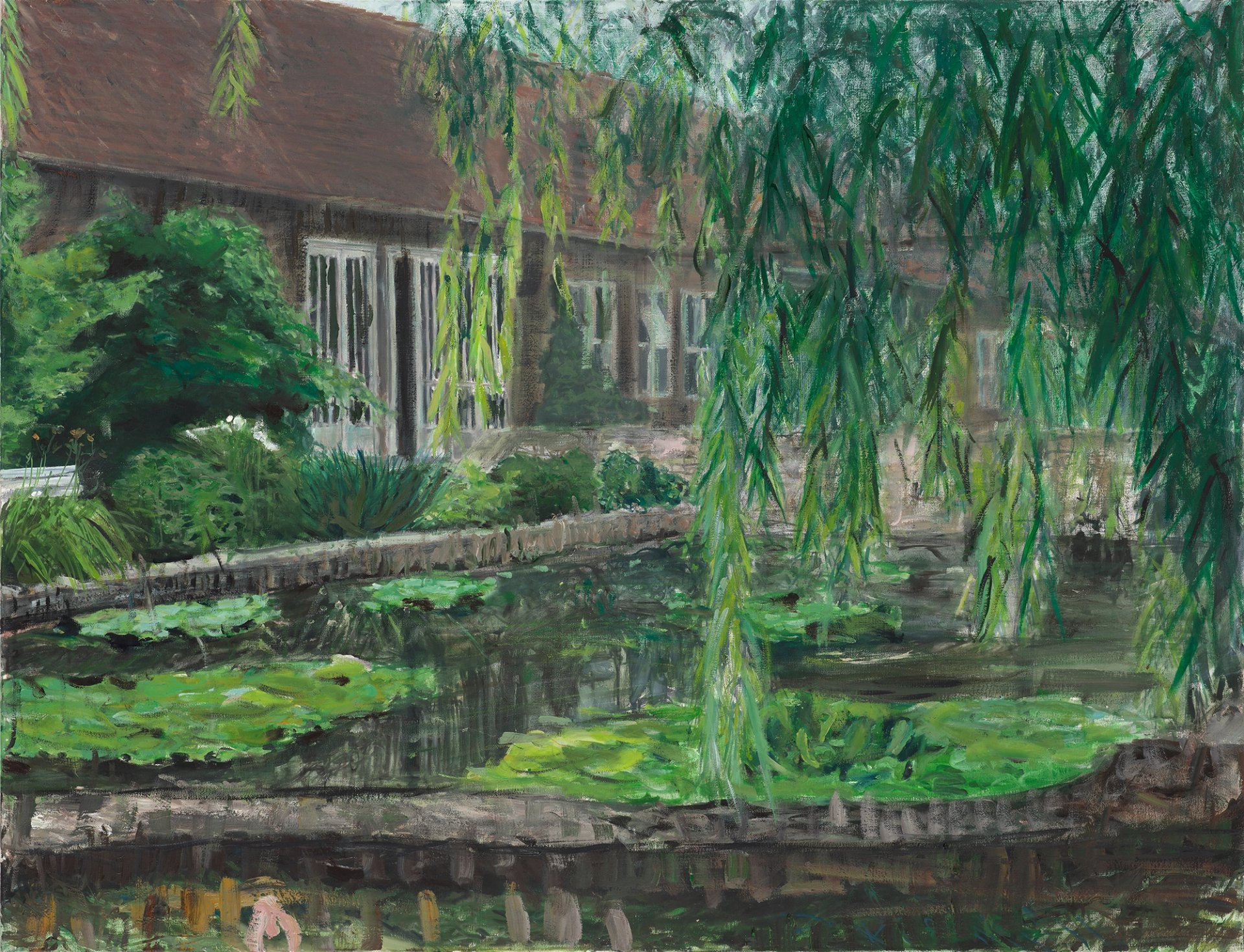
Moritz’s Institute I (1993). “I love the subversive nature of plants, the way they will always grow back, no matter how much you fight against them,” the artist says Photo: Georgios Michaloudis; © Sabine Moritz; courtesy of the artist and Pilar Corrias, London
Does the show give a thorough overview of 30 years of your practice? What are the throughlines you have picked out?
The exhibition does cover 30 years, but there are, of course, gaps. For a while I was working a lot on the idea of war—helicopters and airplanes are among the motifs I explored—none of which is included in the show.
But towards the end of that period, I came across these photos Robert Capa took while travelling through Ukraine, then a Soviet republic, in 1947 with John Steinbeck. He captured people in the fields during the harvest. I was so fascinated. Because it’s both really beautiful, seeing people at work in nature, but you also know how hard these years were. There was famine; so many men didn’t come back from the war. Among the figures was that photograph of a child, which I painted again and again. When I’m fascinated or busy with something, I tend to do many variations on it.
It is only later that I realised that that child is like an alter ego, or a second me—a figure that reminds me so much of my own childhood, or perhaps of something that all of us experienced as children. Being left to our own devices, running around outside making noise, in a state of Selbstvergessenheit—I don’t think there is a satisfactory English equivalent of this word. Literally it translates as “self-forgetfulness”, but it isn’t about forgetfulness. Rather, it is being so at one with nature and your surroundings that nothing else matters and you are able to let go, to be at peace. It is a very happy experience you can have outdoors, in nature, but also when working.
Building a garden in a landscape is kind of what art is too. I’m never dogmatic—I’ll see something growing and just look at it and consider whether to prune it, let it keep growing or suppress it. And that’s what happens often in work too.
In interviews you have often spoken about looking out the window, and in your studio now you have a huge window looking out over treetops. Is it particularly poignant for your this show to take place in a museum focused on our relationship to the natural world?
I’m not sure why looking outside is so beautiful. I find it always so calming. Whenever I’ve gone through periods of not knowing what to do in my work, I’ve simply drawn what I could see through the window. It’s also about a search for beauty. German cities are often so ugly, because of the war and of how much was destroyed and then rebuilt with a lack of funds or a misguided idea of what modern is; also, tastes have changed.
Your Institute paintings relate to the wider body of work you did early on around Neulobeda, in East Germany—a new town built in the 1960s and 70s full of concrete-slab residential blocks, where your family lived after your father’s death. He had worked as a chemist at the Central Institute of Genetic and Cultivated Plant Research in Gatersleben. How has your approach to working with memory changed?
When I was working on the Institute paintings, I had such a strong impulse to work with memory, and to go back in time—to live in that past, which of course isn’t possible, but that’s what art is for.
My main works at the time were my Lobeda line drawings. People often say they look naive or childlike; they were done purely from memory. As a counterpart, I wanted to integrate something living in this world. As a child I was always outdoors, digging in the ground, making things with plants, creating tiny worlds for tiny animals. Nowadays people talk about there not being any weeds—that all plants are beautiful. As a child I was aware of how beautiful even an ugly thistle was. I love the subversive nature of plants, the way they will always grow back, no matter how much you fight against them. They have such an energy about them. So that’s where the botanical drawings came from.
What I had never made a connection with is the fact that the institute where my father worked was for genetic plant research. There were huge gardens there. It still exists—they have one of the world’s biggest seed banks.
I still work in an associative way, but memory no longer plays such a great role in my work. I’m actually trying more to understand the present. It might be because I’m in my late 50s and there’s so much, so many images, in my mind.
Artists are always trying to make the world a better place and it never works
Is the title of the show, Lie Down in Green Pastures, a biblical reference?
Yes absolutely. I find Psalm 23 so beautiful, and so becalming. And I thought it fitted so well, this sense of trusting in God and the idea that we are being led. In German, not in the Catholic Bible but in the Lutheran Bible, which is much more beautifully worded and poetic, the verse is “er weidet mich auf einer grünen Aue”: “he grazes me on a green pasture”. Of course, humans don’t graze, animals do. But there is, to my mind, a certain humility in that, the idea that we are a part of creation. And a sense of trust, or hope. But of course, today, often desperation too—my god, the heat this summer. I was in London recently and walked through Hyde Park with my son. Everything looked dead, the trees were suffering. We need to all think so much more about how we want to live in this world. Artists are always trying to make the world a better place and it never works.
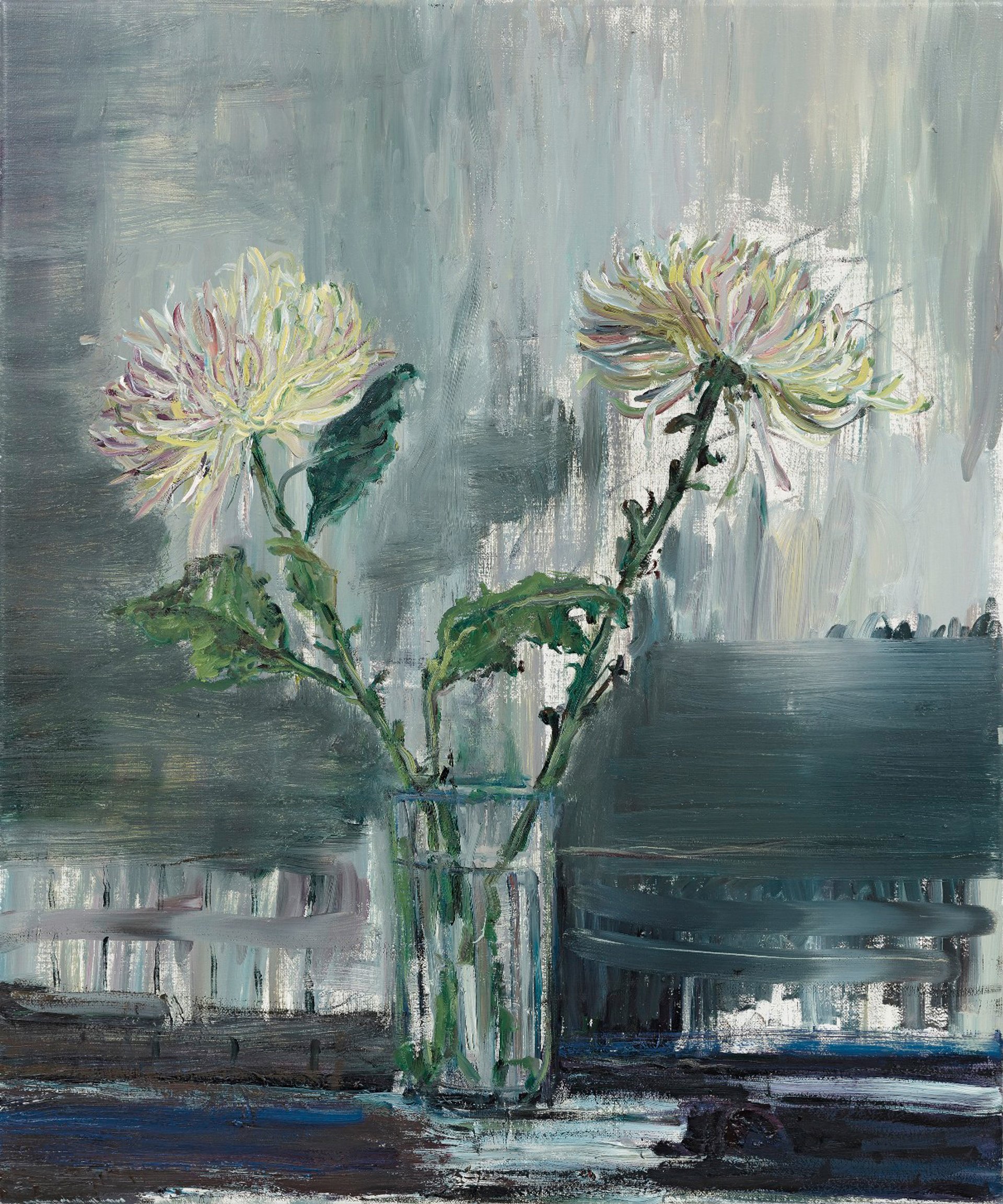
Moritz’s Two Chrysanthemums (2014), part of an ongoing series of floral still-life paintings Photo: © Simon Vogel; © Sabine Moritz; Courtesy the artist and Pilar Corrias, London
How does the new work in the show, Melancholy of the Wind, relate to these earlier works? What connections and conversations have surprised you, when putting it all together?
For the past ten years, I’ve been making these purely abstract paintings, more recently including female figures within them. Sometimes I feel they don’t go with the older works at all, so I’m actually excited to see how it all comes together. In Melancholy of the Wind, I’ve included four female figures, and they’re in the state of Selbstvergessenheit that I mentioned, of thoughtfulness or contemplation. They’re naked in nature, but it isn’t a realistic nature, the colours are not those you would normally associate with the landscape. It is a place with a dreamlike quality, where you might relax and lose yourself, effortlessly thinking about what comes next.
• Sabine Moritz: Lie Down in Green Pastures, Garden Museum, London, until 20 December