Much has been written about the current period of restraint facing the cultural sector. Public funding is under pressure, operating costs continue to rise and many cultural organisations are navigating an increasingly complex political environment, while being asked to do more with fewer resources. One consequence of this moment is that institutional programming can be shaped by financial constraints and fundraising imperatives, narrowing the space for experimental projects that require significant investments. Another is that the financial burden can be transferred onto artists themselves, who are asked to absorb production costs that institutions once carried. It is becoming more common for artists to subsidise aspects of their own projects simply to ensure that an exhibition or work can move forward. If this trajectory continues, the cultural ecosystem itself will become less able to sustain the kinds of work that challenge and expand public discourse.
This moment calls for new models of support to reinforce the ecosystem and allow artists and institutions to remain ambitious, even in periods of constraint. The question is not simply where additional funding might come from, but how support might be structured differently.
It is with this question that I started to consider other modes of philanthropy. I wanted to create a dedicated model that could provide sustained support for artists’ film and video, media that are notoriously difficult to fund and have struggled to attract sustained philanthropic attention. This grew from a belief in the intrinsic value of the arts and a recognition of a structural gap in how ambitious artistic production is supported. I wanted to work alongside institutions, not against or in spite of them. For me, a private foundation offered a way to complement the work of museums and public funders while recognising the distinct role each plays within a healthy ecosystem.
In 2022, I founded The Vega Foundation with a specific focus on artists’ film and video. This type of work occupies a unique position within contemporary art, and I have long felt connected to it. Moving image works often demand lengthy research periods, large crews, specialised equipment and expertise, and complex installations, all of which contribute to making these projects more challenging for public institutions to support on their own. Since establishing Vega, we have worked with more than 20 artists whose projects frequently require years of development and collaboration across multiple organisations. Our curatorial programme is shaped by the conviction that artists working in moving image are leading some of the most vital and exciting conversations happening in contemporary art. At Vega, we choose to support public institutions rather than work in isolation because we believe that existing arts infrastructure plays a vital role in carrying institutional history, providing balanced governance structures and sustaining long-term relationships with audiences.

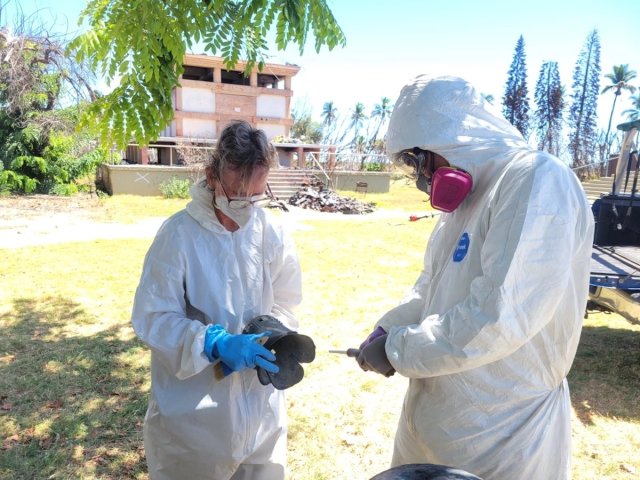
Sharon Lockhart, WINDWARD, 2025 (still). Co-commissioned and co-produced by Shorefast/Fogo Island Arts, The Vega Foundation and the National Gallery of Canada, with the support of The Power Plant Contemporary Art Gallery and Walter Phillips Gallery, Banff Centre for Arts and Creativity. Courtesy the artist and neugerriemschneider, Berlin. © Sharon Lockhart, 2025.
We begin supporting artists and their most ambitious ideas long before a work reaches exhibition. We spend time in artists’ studios, discuss production challenges and help assemble networks of institutional and financial support. We work as commissioner, advocate and convener, helping artists navigate the period before institutional support is fully assembled. Sustaining ambitious artistic production depends not on any single organisation, but on collaborative networks capable of sharing resources, expertise and risk. But collaboration is not simply a financial strategy. Rather, it allows institutions with different strengths—collections, production expertise, commissioning experience, public programming, conservation—to contribute where they are most effective.
Foundations are particularly well positioned to respond to conditions of institutional restraint precisely because they operate differently from public institutions. They are often able to make earlier and quicker decisions, support an artist’s work before formal exhibition commitments are in place, and bring together institutional partners from varying contexts. This flexibility allows foundations to absorb a measure of the uncertainty that is inherent to ambitious artistic production, and early support can create the conditions for artistic risk-taking because it alleviates the stress of fundraising and allows the artist to focus on their work. There is no established handbook for this approach. There are many foundations that are developing creative models in real time, responding to changing conditions while trying to remain focused on artists’ needs. Foundations offer a distinct type of support and are uniquely positioned to be the catalysts to meet this moment.

The challenges facing the cultural sector are unlikely to disappear soon. But periods of uncertainty can also create opportunities to rethink how support is structured. If we want ambitious art to continue being made and seen, we will need deeper partnerships. The future of cultural production will not be sustained by any one type of institution alone. It will depend on a broader ecosystem, one in which different organisations contribute according to their strengths. Foundations have an important role to play within that ecosystem: not as substitutes for public support, but as catalysts that help artists imagine, produce and present work. Ultimately, the goal is to ensure that artists continue to have the freedom, resources and support to take risks and create work that expands how we understand the world around us.
- Elisa Nuyten is the founder and president of The Vega Foundation
- Sharon Lockhart: Fogo, an exhibition organised and developed by The Vega Foundation, opens this month at the Power Plant, Toronto (24 October-21 March 2027)