In May 2020, the Los Angeles-based artist Ian James received a package from Wuhan, China. It was a radio transmitter he had ordered months prior from the e-commerce site Alibaba. The seller—concerned about the scarcity of toilet paper and N95 masks in the US due to Covid-19—padded the crate not with bubble wrap and packing chips, but with masks and toilet rolls. After a long delay at customs, James tells The Art Newspaper, the package arrived “on a wing and a prayer”.
James had ordered the transmitter to use for a New Age pirate radio station in the desert called KHLZ. Beginning this past Saturday (24 October), every day at sunset the secret radio station starts its programming. KHLZ will broadcast overnight between 5pm and 9am—after the FCC monitors turn in for the evening. “It will be this ghost radio station broadcasting as though someone is asleep at the switch,” James says.
In his art practice, James often examines the adoption of spiritual technologies by corporate enterprises and capitalist value systems. His new radio station serves as something of a foil to corporate economies and federal regulatory systems. It operates off the grid as an unlicensed, itinerant broadcast featuring music and compilations from a diverse array of spiritually intoned, New Age musicians from the 1970s to the present. This programming is “good for people’s mental and emotional well-being”, James says.
The impetus for this project began nearly 15 years ago. Starting in 2012, James ran a New Age programme on KCHUNG—an artist-led radio station in Los Angeles. But in 2019, he decided to establish his own station, including it in his solo exhibition in Santa Monica.
Titled The Harmony of the Noosphere, the show drew on the writings of the New Age writer and artist Jose Argüelles, who popularised the concept of the Noosphere: the third sphere surrounding the Earth that serves as a site of human consciousness and mental activity, growing in complexity as planetary consciousness evolves. “Utopic in its goals, the Noosphere’s construction is aided by technological innovations, yet hampered and disrupted by the capitalist machinations that produce and pervert these possibilities,” reads the exhibition statement.
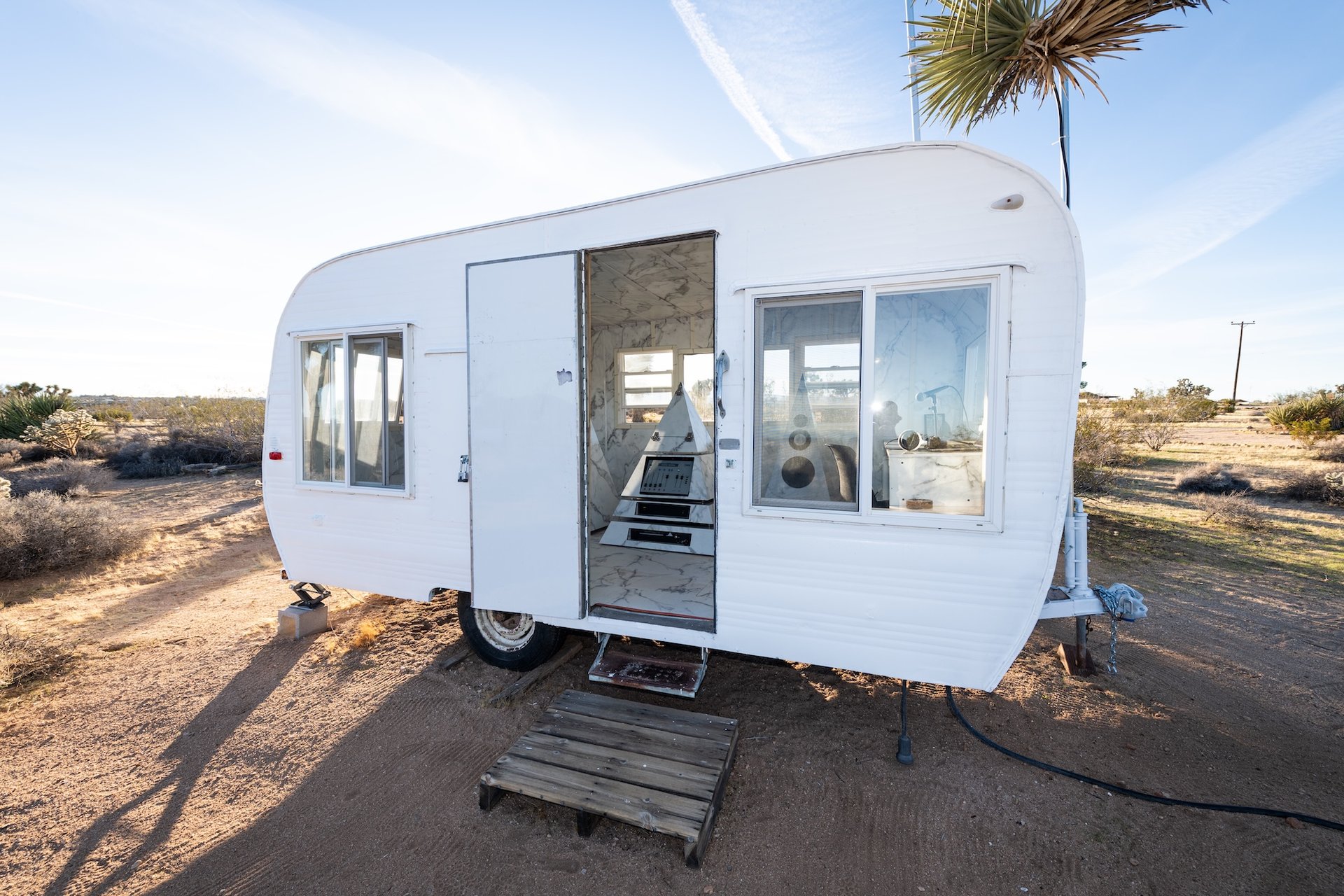
Ian James’s KHLZ Courtesy the artist
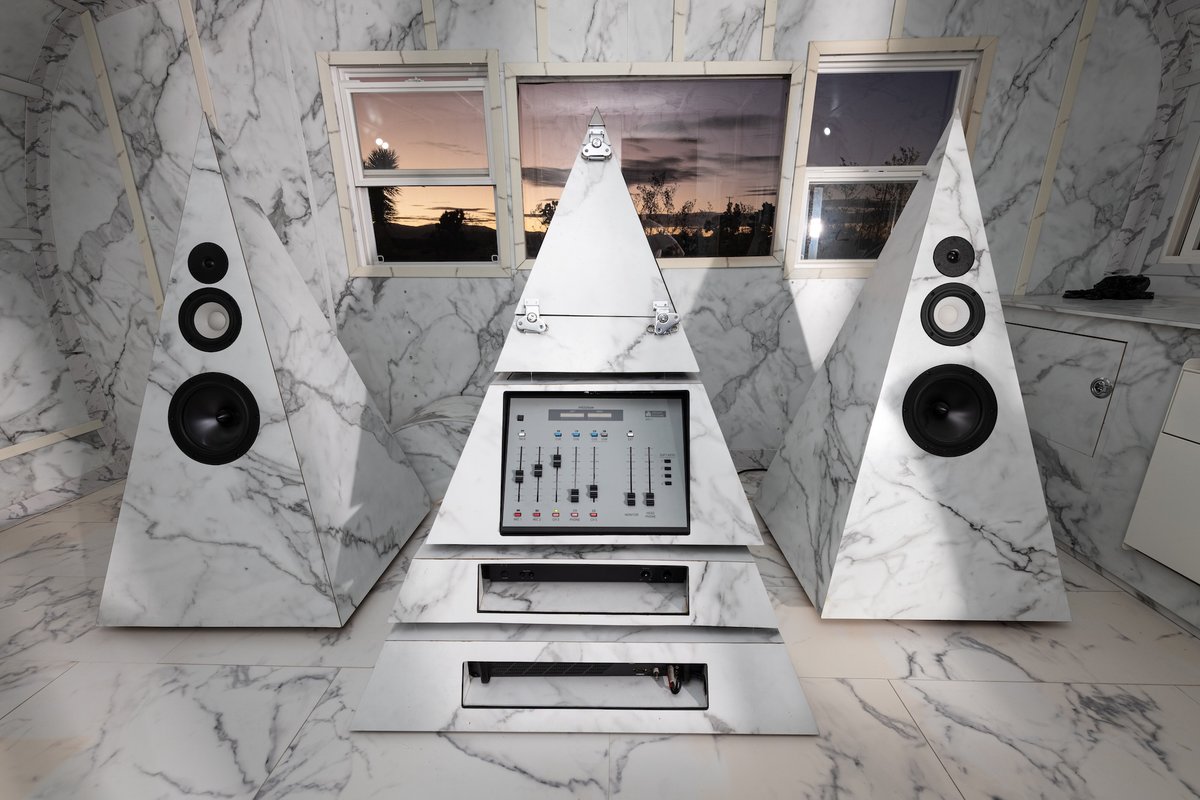
This precisely is the complex relationship that lies at the centre of much of James’s work. The exhibition featured wall works with stock photo-type advertisements for spiritual technologies and a live-streamed meditation session. And there were three pyramid-shaped sculptures housing a transmitter and two speakers, enabling James to broadcast New Age mixes.
While the 2020 exhibition served as the first iteration of James’s radio station, he had always planned to transfer it to a mobile facility and broadcast in perpetuity. Now, six years later, James has officially launched his station in a retrofitted caravan-turned-broadcasting studio near Joshua Tree.
The caravan came into the artist’s possession at a fortuitous and unexpected time. It was given to his partner, the painter Patricia Fernandez, just after the onset of the pandemic. James started renovating it as the federal government began increasing unemployment benefits and sending stimulus checks. “I was getting $1,000 a week or something that I was putting into this radio-station project,” James recalls. “It was stupid and crazy.”
After discovering rat droppings and mould in the caravan’s walls, James completely gutted the interior and decided to cover every surface in a faux-Calacatta marble laminate, which similarly ornaments the three pyramid sculptures inside. Inspired by a glacial cave he had visited in Iceland, James wanted to create a cool (but not cold) space, one that through material specificity—in this case, the simulacra of the oldest continually quarried marble in Italy that has been used in spiritual and governmental sites since antiquity—communicated across generations without need for explanation.
“I was interested in the fact that this marble had a simulacrum made by the Formica corporation,” says James, adding that he liked the idea of using “this repeating pattern that probably came from some small section of marble that is in another building somewhere”.
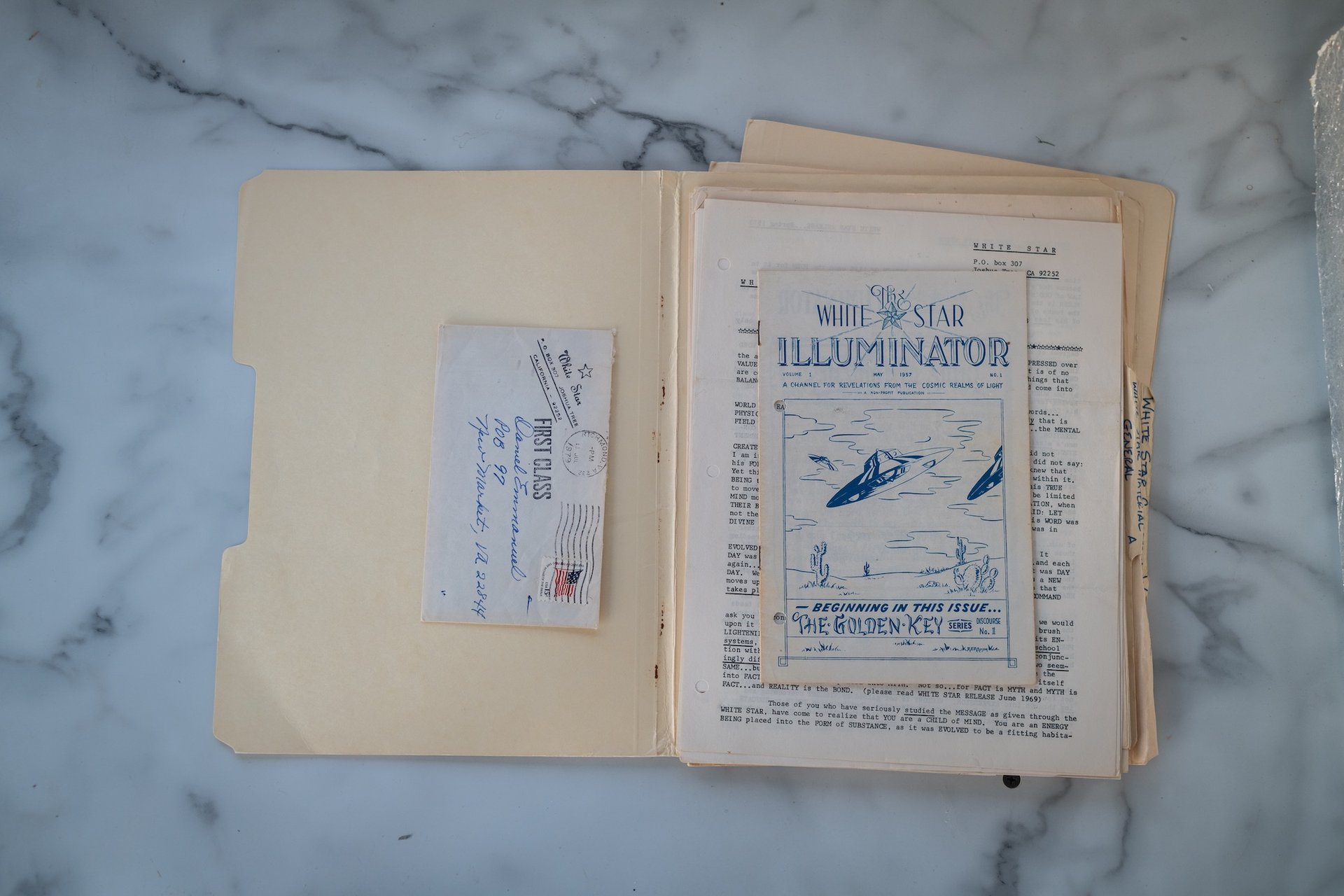
Ian James’s KHLZ archive includes typewritten and Xeroxed newsletters about extraterrestrial contact and interdimensional communication Courtesy the artist
In addition to serving as a broadcasting studio, the caravan houses a growing archive of materials pertaining to the vast culture of New Age practices. It includes every issue of a Michigan-based newsletter called Pyramid Power. It also features a collection of typewritten and Xeroxed newsletters about extraterrestrial contact and interdimensional communication called White Star, given to James by the Ufologist and New Age musician JD Emmanuel—a featured guest on the artist’s old show on KCHUNG.
Alongside cassettes that James sourced from eBay—previously sold at massage parlours, spas and mediation centres—he includes the veritable all-stars of New Age music. These are people like Kat Epple (a close friend and collaborator of Robert Rauschenberg) and Iasos, a jazz student at Stanford University in the late 1960s who claims he was contacted by two interdimensional beings.
Iasos believed the music the aliens shared with him would “help humanity ascend to a higher plane of being”, James says. Only with the growing availability of synthesisers in the early 1970s was Iasos able to re-create the sounds that he had heard. He called it Paradise Music.
James had previously interviewed both Epple and Iasos at KCHUNG. “Iasos was always thinking about how the music can raise people's vibrations,” James says, “and help humanity become more peaceful and empathetic towards each other.”
KHLZ is meant to be “a benevolent thing that people can listen to and participate in”, James says. He imagines that, given its location near Joshua Tree—though it will also stream online and occasionally travel for pop-up events—the station will serve as a meditative soundtrack for people while they do yoga, cook dinner, or “eat mushrooms and run around. As you've probably seen, there’s a lot of ways to be ‘woo-woo’, so the radio station is open to those possibilities.”