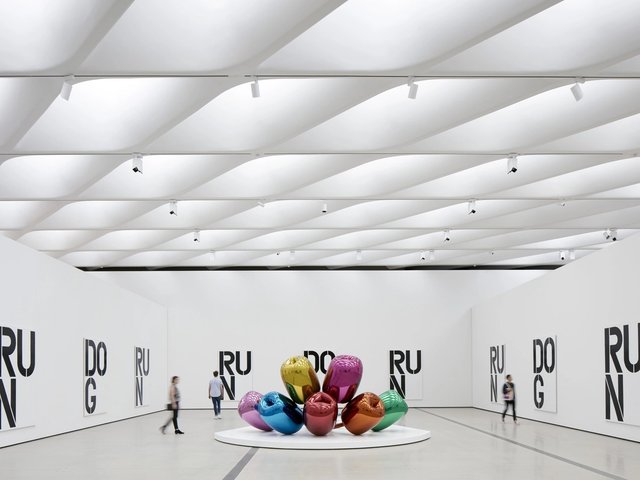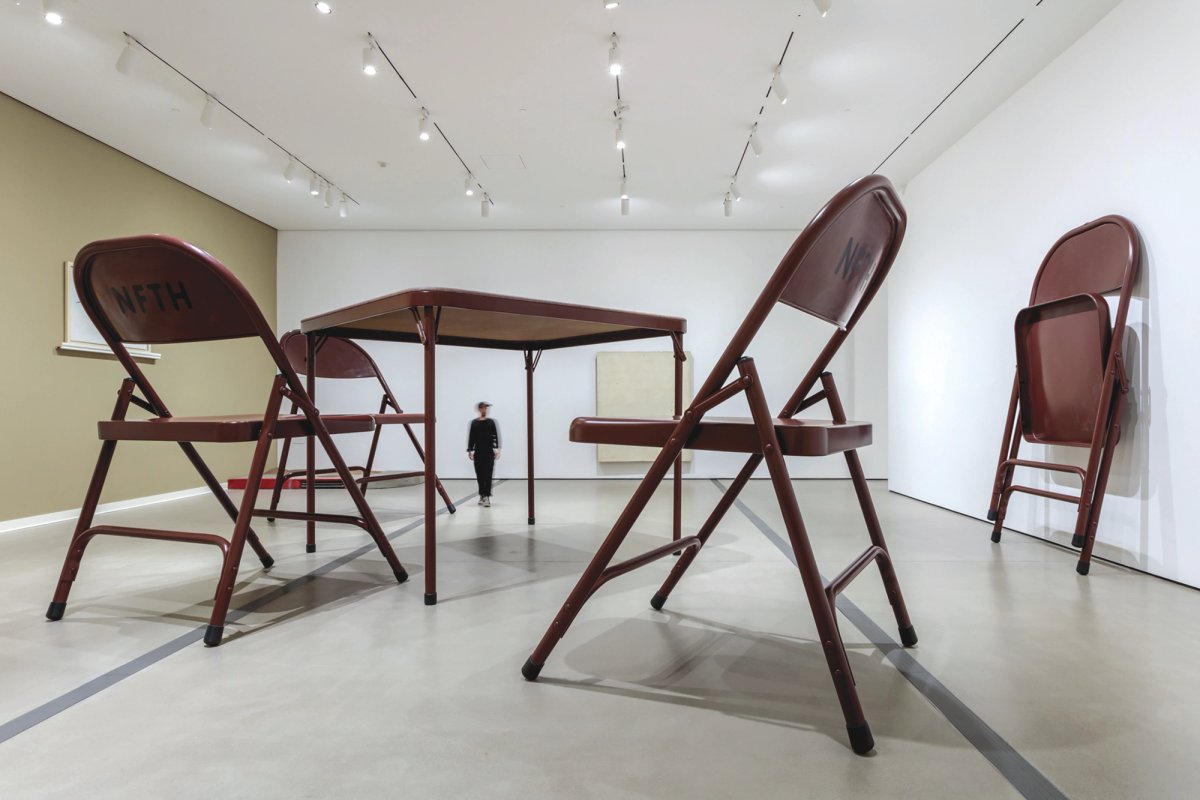
Visitors to The Broad usually ask to see two works of art—the “infinity room” and the “big table and chairs”. The creator of the first work is a familiar name, Yayoi Kusama, but far fewer know who is responsible for the second: Robert Therrien (1947-2019). With the conceptual artist’s largest museum show ever, Ed Schad, the curator of Robert Therrien: This is a Story, hopes to change that.
“He’s an artist that was a major presence in Los Angeles art for almost 50 years, one of the best sculptors to emerge in this town,” Schad says. “But he hides in plain sight. Not enough people know about what makes him the artist that he is. When we look closer at Bob’s work, he was an artist that was a part of the discussion here in Los Angeles for a very long time.”
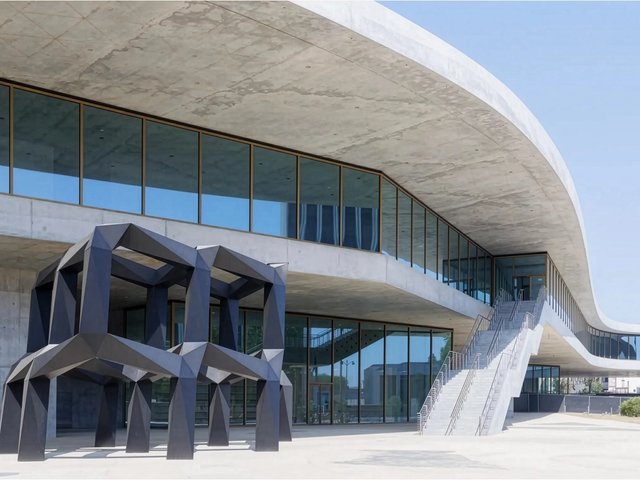
The retrospective features more than 125 works, including many from Therrien’s estate, plus selections from lenders and The Broad’s collection. Therrien’s Under the Table (1994), a 10ft-high hyperrealist rendition of a table and six chairs, was one of the first works moved into The Broad ahead of its opening in 2012. It still stands in its usual location on the third floor, while the current exhibition includes a different set, No title (folding table and chairs, dark brown) from 2007, on loan from Glenstone museum in Maryland. Made of painted steel, aluminium, fabric and plastic, it replicates folding chairs and a matching card table, also large enough for people to walk under.
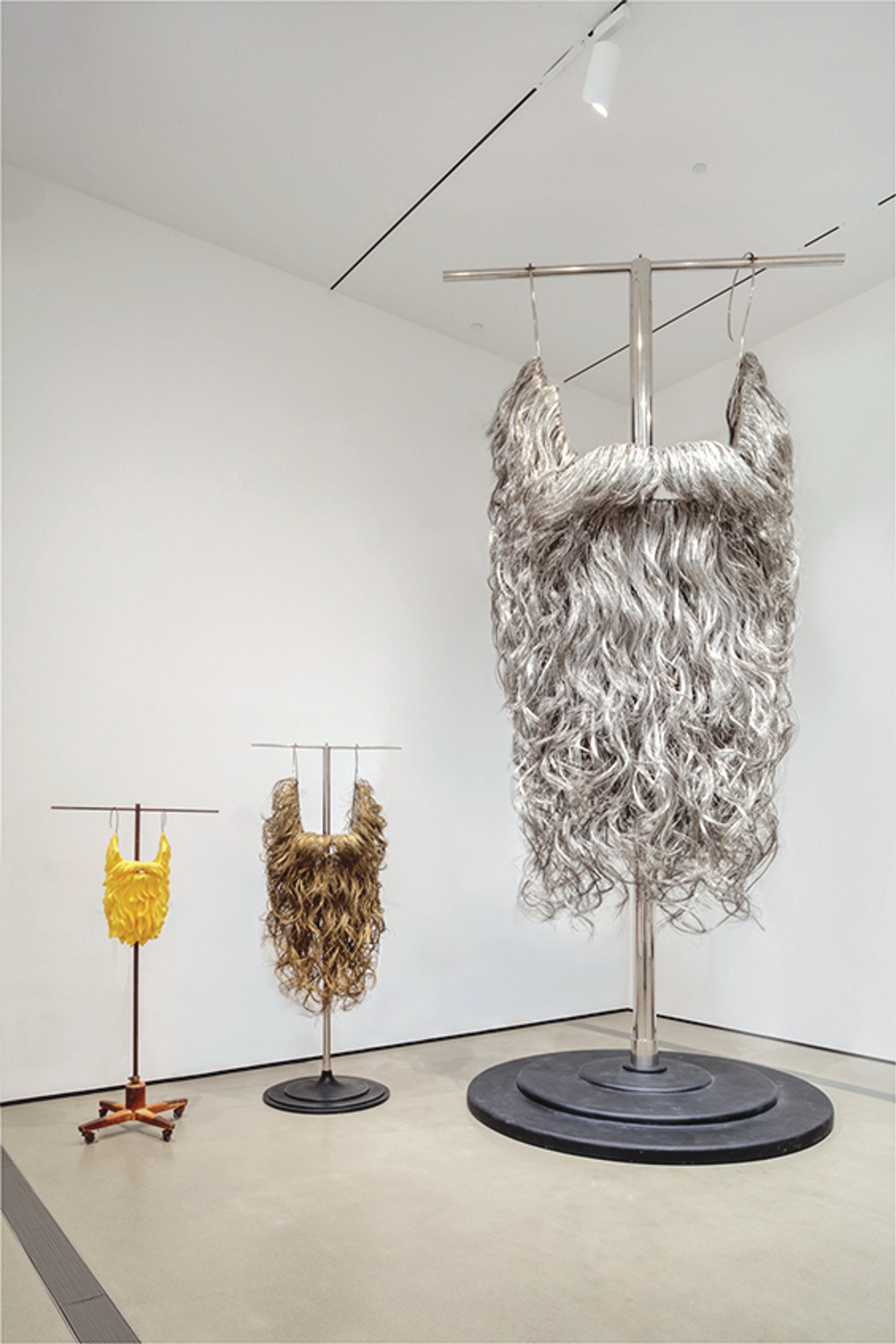
Supersize me: a work of big, bigger, biggest beards Photo: Joshua White; courtesy of The Broad
Therrien was born in Chicago and moved to California with his family because of his asthma. He attended graduate school at the University of Southern California and in 1985 his career was jumpstarted by his inclusion in the Whitney Biennial, which prompted the legendary New York dealer Leo Castelli to take him on. Therrien also showed in the 1992 edition of Documenta in Kassel, had an early solo exhibition in 1984 at the Museum of Contemporary Art in Los Angeles and, in 2000, a travelling survey that originated at the Los Angeles County Museum of Art.
The artist often returned to familiar forms; one gallery here features a set of wall sculptures highlighting some of his favourites, No title (group cutout reliefs, ranch house, chapel, pitcher, and barn) (2019). Although identifiable by viewers, their meanings sometimes shifted. For example, the figure of a three-ball snowman was sometimes a snowman and, when he set on its side or obliquely, could appear as a cloud or smoke signals. Similarly, a chapel could become an oil can or even a witch’s hat.
Private symbols
Each element had personal relevance for Therrien, which is one reason he is not considered a Minimalist. “Strident theorists of Minimalism would not recognise Minimalism in Bob’s work,” Schad says. “The reason is that private symbols [and] any sort of personal narrative were like pollution to Minimalism. Even though his forms are very spare.”
Therrien’s custom-built studio and home still stands in a warehouse area south of downtown Los Angeles. Paul Cherwick and Dean Anes, the co-directors of the Robert Therrien Estate, say the first floor was his workshop and warehouse, full of tools, metal parts, household items and toys. The artist built the second floor partly as a gallery with white walls to see how his work would hang or be displayed. His own modest living space was tucked into a corner, with an eat-in kitchen and rather monastic bedroom.
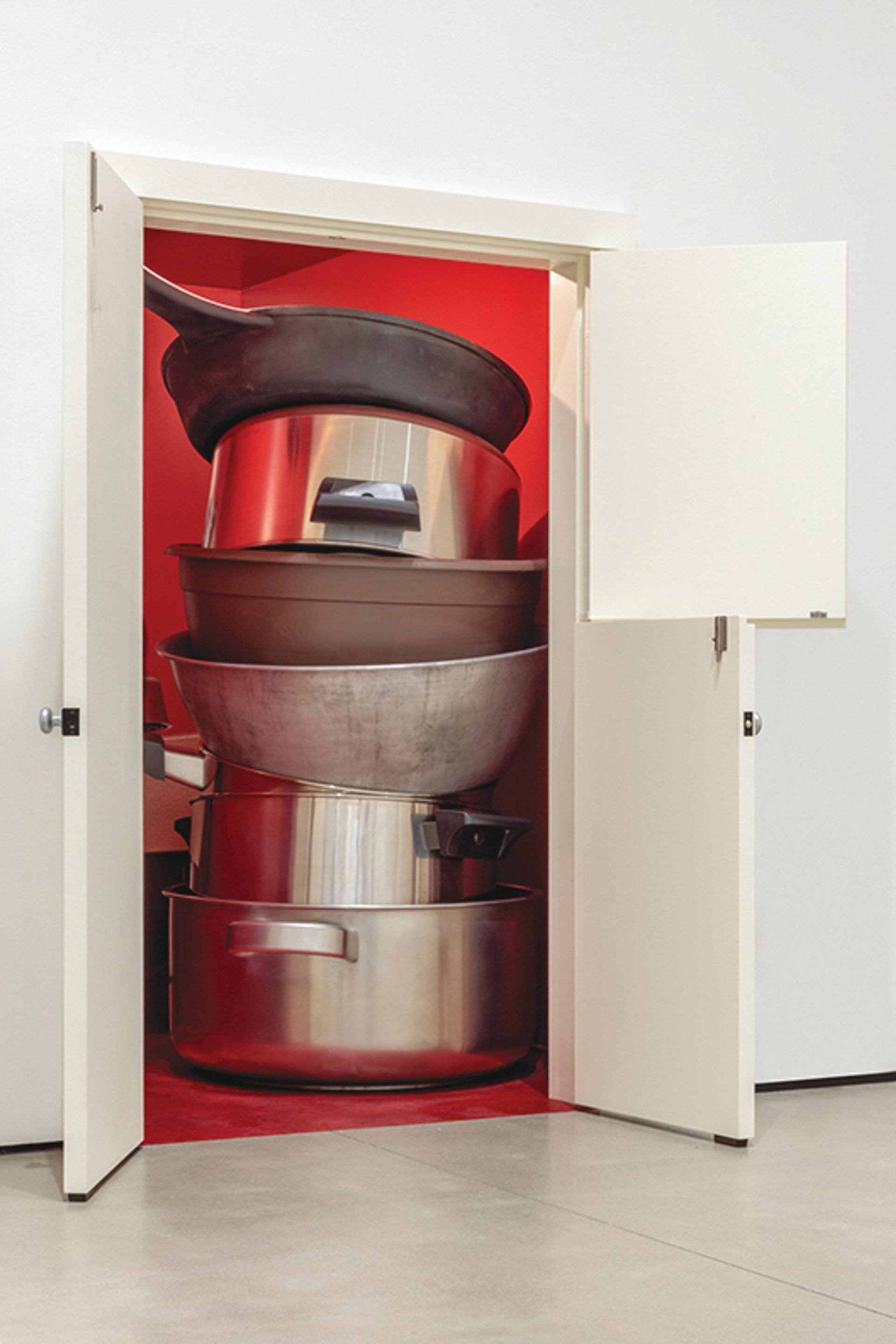
A stack of pots and pans the height of a human, one of Therrien’s sculptures that plays with scale Photo: Joshua White; courtesy of The Broad
He started making oversized sculptures in the early 1990s. Today he is best known for gargantuan versions of everyday objects, from tables and chairs to fake beards and stacks of plates. There are examples of all these in The Broad’s show; the first gallery has a set of white plates stacked taller than a person. Elsewhere there is an off-kilter stack of regular dishes as well as a miniature set of dishes.
“It has something to do with scale as a point of comparison, as a way of addressing one’s expectations about the physical world,” Schad says. “One of the things that makes something a monument is [that] it dwarfs the viewer. And with something that’s smaller than expected, the opposite happens, it can become a toy. The important thing was that the viewer was able to connect with it, emotionally and physically.”
- Robert Therrien: This is a Story, The Broad, until 5 April