In 1963 the longstanding New Yorker contributor Alan Dunn provided a watercolour for the magazine’s cover: the view downtown along Park Avenue from somewhere near the Waldorf Astoria. Walter Gropius’s new Pan Am headquarters looms over a smaller, prettier Beaux-Arts tower from the 1920s, the Helmsley Building.
This juxtaposition was not just comparative, like the nested buildings of different sizes produced by Sir John Soane’s assistants to illuminate his Royal Academy lectures at the turn of the 19th century; rather it was dialectical, argumentative: a bland, bloated future was threatening to overshadow a richer and more resonant past. And if that past was not so very distant—well, this was America (“Some of these buildings are over ten years old!” murmurs the awestruck protagonist of Steve Martin’s 1991 film L.A. Story).
Comedies of manners
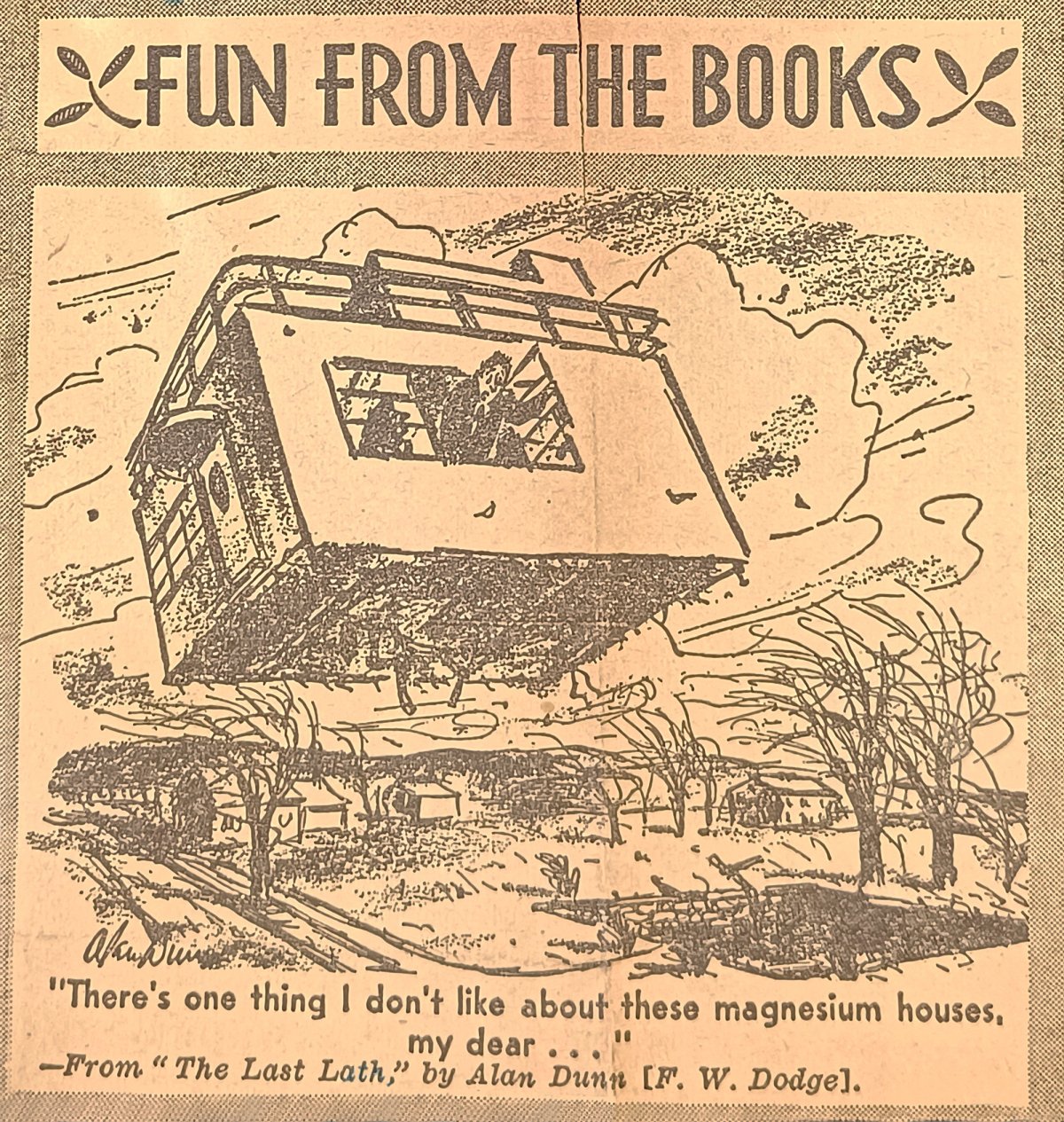
Dunn’s career, here discussed in formidable detail by Gabriele Neri, began with gentle little comedies of manners, viewing architecture essentially as a branch of fashion, much as the UK’s Osbert Lancaster did at around the same time. Dunn started filing spot cartoons of people saying funny things about buildings to The New Yorker in the mid-1920s, then supplied slightly more industry-specific material to the Architectural Record from 1937. The doctrinaire theories and counter-intuitive practices of European Modernism, along with the vertiginous upward growth of New York City itself, meant Dunn was seldom short of material; he was still working in the months leading up to his death in 1974.
One gift Dunn seemed to possess in ample measure was that of prophecy. A cartoon of 1937 anticipates the title, and in a broad sense the content, of Sigfried Giedion’s Space, TIme and Architecture by four years; other images seem to foreshadow Japanese Metabolism, Postmodernist classicism, Robert Venturi’s Learning From Las Vegas (1972), the inside-outisms of Richard Rogers and more.
The fact that what Dunn intended as comedy (his first book was called The Last Lath) would later be presented to the world by several giants of their profession in deadly earnest is perhaps just another layer to be added to the joke, a “topper”, as both architects and comedians say.
Modernist critique
Dunn’s essentially populist critique of Modernism—”Why can’t they design a museum that doesn’t need to be explained?” wonders an exasperated New Yorker in front of Marcel Breuer’s Whitney museum, as if the same had not also been true of McKim, Mead & White’s recondite classical ornament on the Metropolitan Museum of Art across town, say—appealed to small-c conservative writers including Lewis Mumford, Ada Louise Huxtable and the British writer Terence Robsjohn-Gribbings. The latter worked with Dunn’s wife Mary Petty, also a talented illustrator, and whose comments on the “un-American” character of Modernism would find an echo in the decidedly Yahoo-ish From Bauhaus to Our House (1981) by Tom Wolfe.
Even so, Dunn’s love of buildings and respect for the people who go to the bother of designing them comes through in his letters, occasional published writings and elsewhere. And his satire is hardly biting: as he himself described it, “a titillating feather rather than a sword”.
• Gabriele Neri, Alan Dunn: The Cartoonist as Architectural Critic, MIT Press, 360pp, 139 col. + 60 b/w illus., $45 (pb), published 26 May
• Keith Miller is an editor at The Telegraph and a contributor to Apollo and The Literary Review