

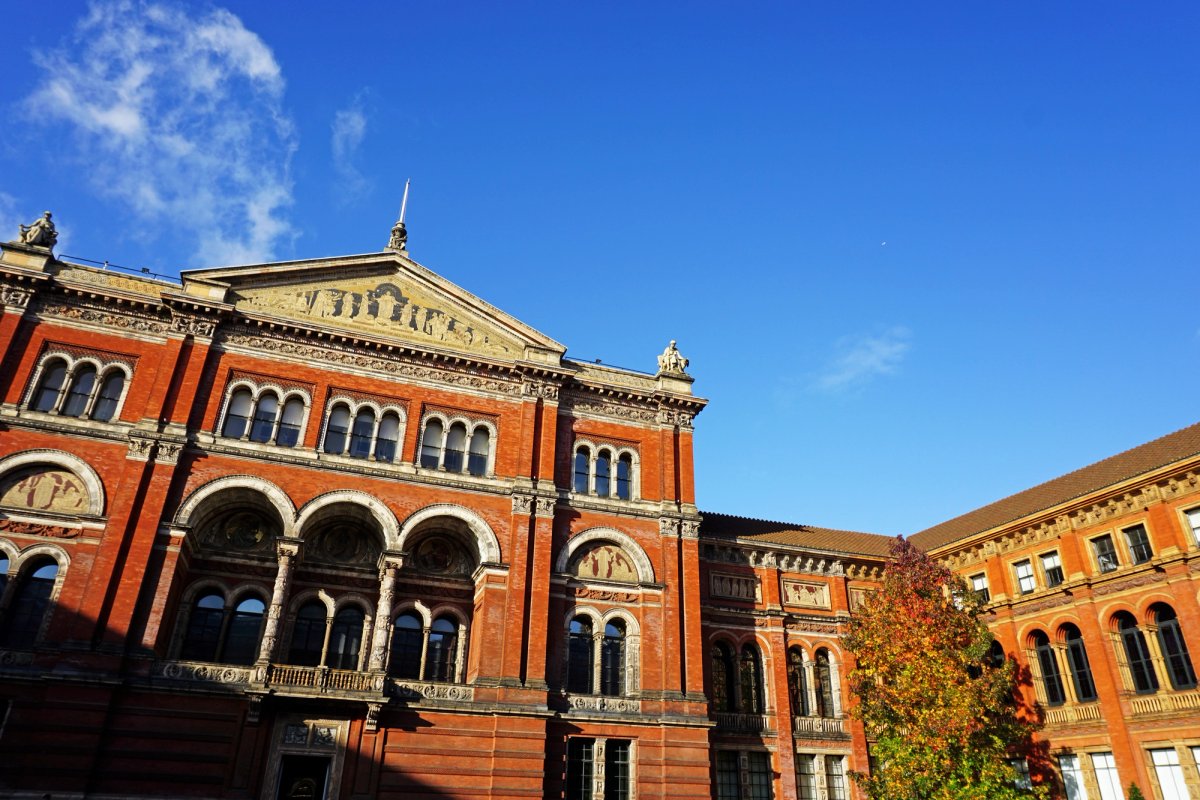
The Victoria and Albert Museum (V&A) has drawn up plans to dismantle much of the V&A Academy, a significant part of its adult-learning programme, by the end of the year, The Art Newspaper has learned. Around 50% of the Academy’s staff may be cut and the future of flagship courses are under threat. Senior figures in other parts of the museum have also been asked to propose cuts to their teams, according to people familiar with the plans.
The V&A has offered adult courses for decades, drawing on its collections and curators in a tradition that goes back to the museum’s origins as a school of design. In 2016 it launched the Learning Academy to run much of its learning programmes. It was later renamed V&A Academy, which today runs expert-led courses, practical workshops and talks. Its courses are taught mainly at the V&A’s South Kensington site and online.
The proposals for cuts to the Academy, which sits within the museum’s commercial department, were communicated to staff on 5 October and justified by management on the grounds that the programme had failed to meet income expectations, according to people with direct knowledge of the discussions. The changes would see many of the Academy’s in-person courses at South Kensington brought to an end, including flagship courses relaunched this year in a ten-week format, with a hybrid option allowing students to attend in person or online.
The Academy’s African heritage programme and professional-development courses for museum-sector workers are among the activities expected to be retained. Selected on-demand and live online courses are also expected to continue.
The consultation period for staff to discuss the proposals with management and provide feedback is due to end today (26 October), according to people with knowledge of the matter that The Art Newspaper spoke to.
The Art Newspaper has spoken to current staff members and others with knowledge of the plans, all of whom asked not to be named for fear of repercussions. “Nobody had any inkling this was going to happen,” says one staff member. Another adds that the museum is “full of people who are feeling very demoralised”. If the proposals go ahead, the Academy will cease to operate in its current form by the end of the year, according to people with knowledge of the plans.
A V&A spokesperson said in a statement sent to The Art Newspaper: “We are currently reviewing the V&A Academy offer and the way in which this is delivered as part of wider efforts to streamline activity and identify efficiencies across our operations to ensure they are financially sustainable and deliver maximum impact. We are still in the consultation phase, and no final decisions have been made, but the current proposals will see us continue to deliver an adult learning programme." The spokesperson made clear that the V&A would not be able to comment further at this time.
The proposed restructuring is striking in light of the Academy’s recent reported performance. The V&A’s 2024–25 annual report says the Academy recorded sales of £1.2m, an increase of more than 22% on the previous year, while its contribution to the museum rose by more than 60% to £365,000.
The 2025–26 annual report does not provide a full breakdown of the Academy’s annual income, expenditure or profit. Instead, it describes the Academy’s hybrid learning strategy as “combining scalable online formats with high-impact in-person art history experiences”, saying the approach expanded the programme’s “reach and resilience” during its first full year and “consolidated” the growth achieved the previous year.
The report also records that the hybrid course Arts of Japan “contributed to V&A Academy’s biggest ever quarter in spring 2026, when total sales exceeded £400,000”.
At the time of writing, one of the Academy’s five flagship 10-week hybrid courses, A History of London: 1066–1666, was marked as sold out on the museum’s website. People familiar with the proposals say all five courses, including Arts of Japan and A History of London, are expected to be discontinued.
Cuts and strikes
The proposed cuts come after a series of challenges for the V&A in recent months, including allegations of racism reported byThe Art Newspaper in July and strikes over pay and working conditions in September. The disputes over conditions continue: on 19 October, the Public and Commercial Services (PCS) union and Prospect announced further strike action across all four V&A sites (South Kensington, East Museum, East Storehouse and Young V&A) on 29 and 30 October. However, statements sent to The Art Newspaper today from both unions said that their members have suspended strike action, to allow for further talks after an “improved offer” from the museum.
The V&A has also launched a voluntary exit scheme open to staff across the institution, which is expected to close on 26 October, according to people with knowledge of its terms. In response to The Art Newspaper’s October report on the voluntary exit scheme, a spokesperson said inflation, economic uncertainty and reduced visitor spending were contributing to financial pressures, while below-inflation government settlements would reduce funding in real terms over the coming years. The V&A’s 2025–26 annual report records a 30% rise in retail net sales to £15.7m.
The accounts show that the museum received £59.9m in government grant-in-aid during the year, up from £56.2m in 2024–25 and representing 42% of the group’s income. A further £5.2m was awarded through the Public Bodies Infrastructure Fund to support essential work to protect the buildings at South Kensington and Young V&A.
The proposals to make cuts at the Academy come against the backdrop of a major expansion of the V&A’s estate, including the opening of V&A East Storehouse in May 2025 and V&A East Museum in April 2026. Some staff believe the South Kensington museum is bearing the cost of expenditure associated with the new east London sites. “We suspect that the South Kensington site is paying for the financial problems associated with V&A East,” says one staff member.
Prospect’s national secretary for heritage, Paula Lamont, tells The Art Newspaper in a statement: “Our members are concerned that the financial cost of opening new sites is falling on them, rather than being absorbed in other areas. Heaping more workload and pressure on an increasingly demoralised workforce is unsustainable and cannot be the answer.”
According to a report by Arts Professional, the PCS union has claimed that the institution is projecting cumulative operational deficits of £19m by 2030. The V&A did not address the figure when asked by The Art Newspaper. Its latest annual report rates the risk to longer-term financial sustainability as high. It says: “Mitigations through commercial growth and cost reduction have been identified and form a central tenet of the V&A’s new five-year strategy 2026-30.”
How many staff may be affected?
The terms offered to V&A Academy staff remain unclear, with concerns that those with less than two years’ service may not qualify for statutory redundancy pay under UK law. The Academy has around 17 permanent staff, but its courses also feature guest lecturers from across the museum and beyond. According to information available via the V&A’s website, for 12 of the Academy’s courses this autumn, five hybrid and seven online-only, there are around 100 lecturers and speakers besides Academy staff, from curators elsewhere in the V&A to freelance lecturers and visiting academics, suggesting the effects of any cuts could be felt far outside the Academy.
Staff are also concerned about proposed cuts to teams across the wider museum, believed to be around 10-15%, which are expected to affect curatorial roles. A former senior member of staff who witnessed the V&A’s 2021 post pandemic restructuring, when approximately 15–20% of staff were let go, says curatorial and conservation teams are not among the museum’s largest costs and are important to its ability to safeguard collections, attract donors and develop projects. Cutting expertise, they argue, risks undermining the very work that helps secure donations.
The proposals have also surprised some in light of the museum’s director, Tristram Hunt, having served in education-focused roles previously. A historian and former Labour MP, Hunt served as shadow education secretary and has a reputation for championing learning.
The V&A’s annual report describes its purpose as promoting public enjoyment and understanding of art, craft and design, including through study and research. Its founder, Henry Cole, placed education and public access at the heart of the museum’s mission, a legacy that the proposed changes risk undermining, according to people familiar with the plans.
“Henry Cole will be spinning in his grave,” says one.

