London bristles with sculptures of men. Only 4% of public monuments in the city are devoted to named women, according to the charity Art UK. It says something about the national psyche that there are twice as many animal statues in the city as there are sculptures devoted to specific women. But right now a pair of radical new works depicting and made by women—Tschabalala Self’s Lady in Blue in Trafalgar Square, and Nicole Eisenman’s Stack outside the Royal Academy of Arts (RA) on Piccadilly—are making their presence powerfully felt in two of the most male-dominated locations in the capital.
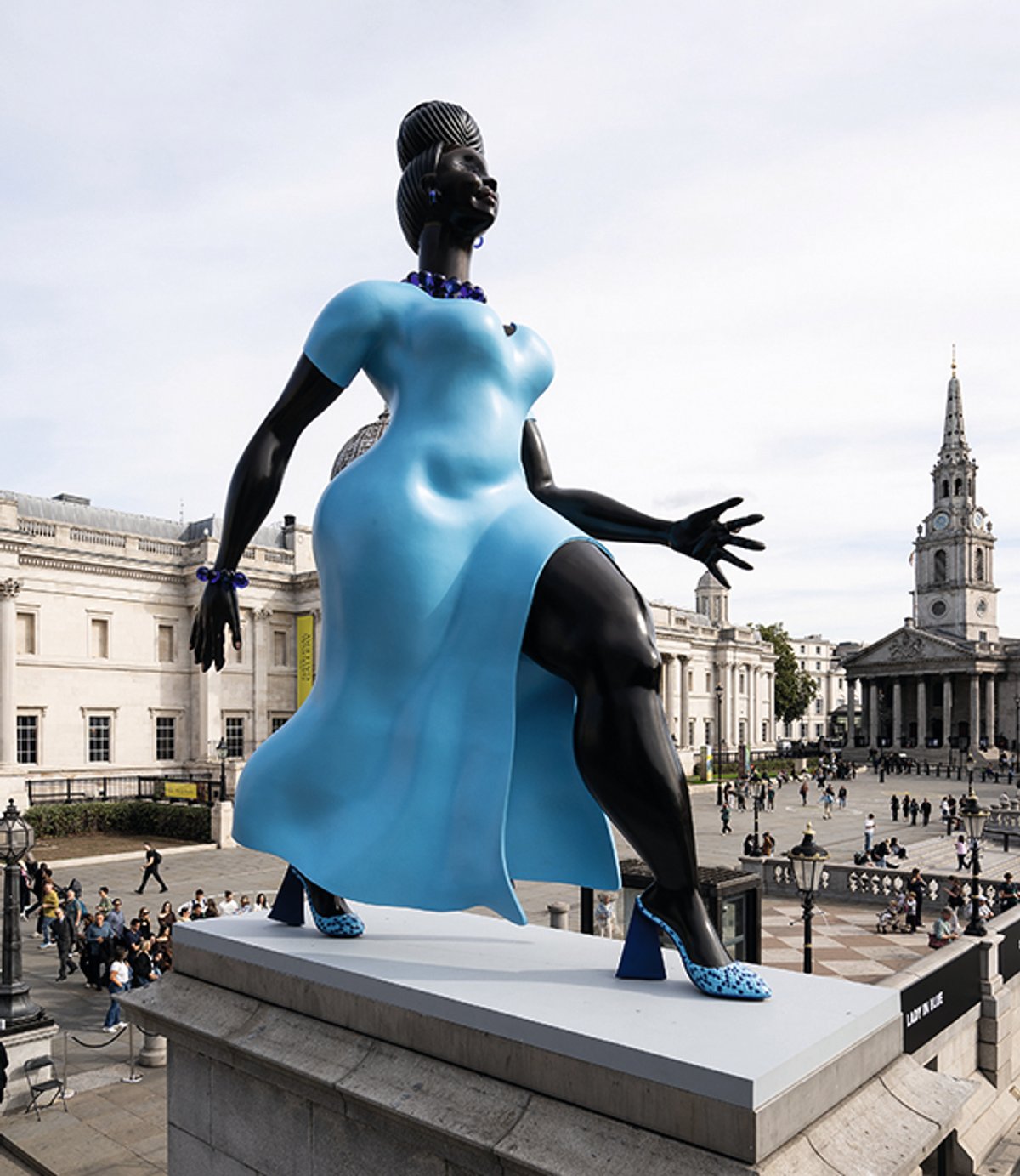
In Trafalgar Square, surrounded by depictions of monarchs and militia and across from Admiral Nelson atop his 51m-high column, Self’s Lady in Blue painted bronze cuts a distinctive dash on the empty plinth to the northwest of the square that, since 1999, has hosted a programme of contemporary sculpture commissions. Head held aloft with her vivid blue dress clinging to her ample curves, she strides forth in high heels, exuding purposeful confidence and optimism. As with all Fourth Plinth sculptures, this impressive female will be in situ for two years, before going to a permanent home in Fornebu in Norway.
“She’s not an idol to venerate or a historic figure to commemorate, she’s an everyday young metropolitan woman much like those who use the square every day,” Self declared at the work’s unveiling, adding: “Lady in Blue is not static, she’s in motion… and I hope she inspires all who see her to find the optimism to move forward in community with all those around them.” In this spirit, Self sees her sculpture as an attempt to redress both racial and gender imbalance in public art whether in her native US, the UK or Norway. “In most cities there’s an underrepresentation of sculptures that depict women, and especially women of colour, so I think that it is important to add more images and visual representation,” she said.
Meanwhile, a few streets away outside the RA, which in 258 years has shown only two living women in its main galleries, New York-based Eisenman has erected Stack, a towering work at over 8m tall. This totem of figures and objects made from an assortment of materials, including bronze, oak, brass, steel, nylon, acrylic resin and tin, is currently having a friendly face-off with Alfred Drury’s grandiose bronze sculpture of Joshua Reynolds, the RA’s first president, who brandishes his paintbrush and easel just outside the main entrance. In 2021 Eisenman got to the shortlist for Trafalgar Square’s Fourth Plinth and now with Stack, she has created her own column, impressive in its scale and magnitude, but also irreverently anti-monumental.
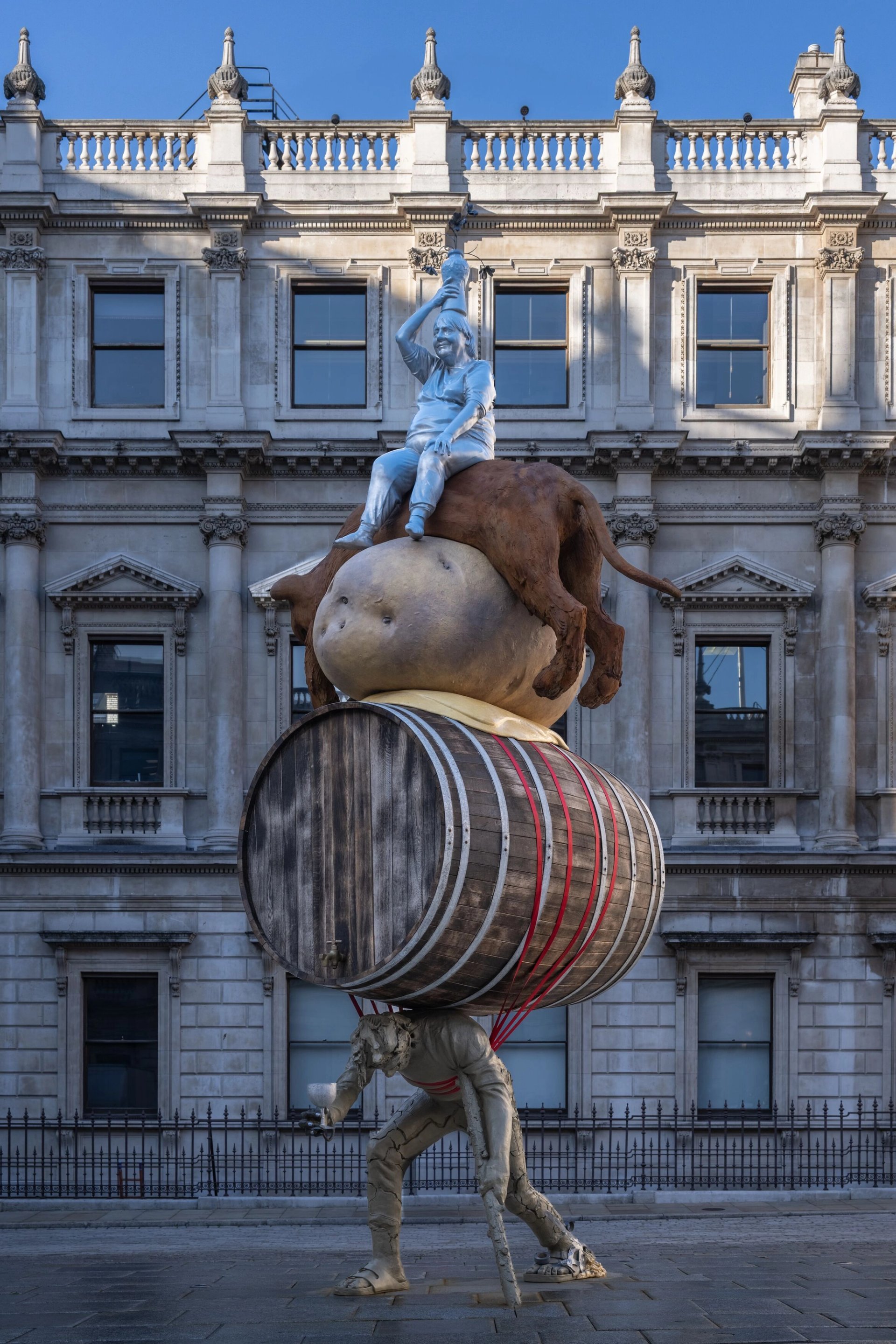
Nicole Eisenman's Stack (2022-24), installed in the courtyard of the Royal Academy
Photo: Damien Griffiths. © Nicole Eisenman. Courtesy the artist and Hauser & Wirth
Eisenman’s column
At its base hunches a craggy, androgynous figure shod in Birkenstocks and with a wooden barrel strapped to its back. A stand-in for the artist, perhaps, abject and emphatically earthbound, clutching not a paintbrush but an empty wine glass. On top of the barrel, rising out of a puddle of what looks like gooey melted cheese is a giant potato, over which lolls a rusty leonine cat modelled on Edie, Eisenman’s studio companion. Rather than a posturing war hero, Stack is topped off by the amiably smiling seated figure of the late artist Phyllida Barlow, rendered in gleaming sky-blue aluminium and jauntily balancing a vase of flowers on her head.
Barlow, who died unexpectedly in 2023, was a Royal Academician. Given where this work is situated, it is hard not to see Stack as a memorial to this much loved and greatly mourned artist. Eisenman is a huge admirer of Barlow, whose colossally ambitious but always defiantly anti-hubristic sculpture she first encountered when they were both in the Carnegie International in 2013. They subsequently became friends to the extent that an apparently amused Barlow went to Eisenman’s New York studio in 2022 to be 3D-printed for this work—“She was really good humoured about it,” Eisenman recalled in a recent talk at the Royal Institution. But while undoubtedly honouring Barlow, Stack is also more than a tribute to one person.
Eisenman is reluctant to offer specific interpretations but in her talk she revealed that the work was conceived with London in mind, declaring: “It’s amazing to me that it is at the RA. I hope it can stay in London.” She also stated that Stack emerged during the pandemic and forms a personal testament to when, as she put it, “life got pared down to the basics: food, wine, art, my cat”.
In strikingly different ways but with similar underlying intent, Stack and Lady in Blue offer alternative monuments to aspects of all our lives that rarely get acknowledged, and most notably the power of great women of all ages and from all origins. May we see more of their kind in all our cities.