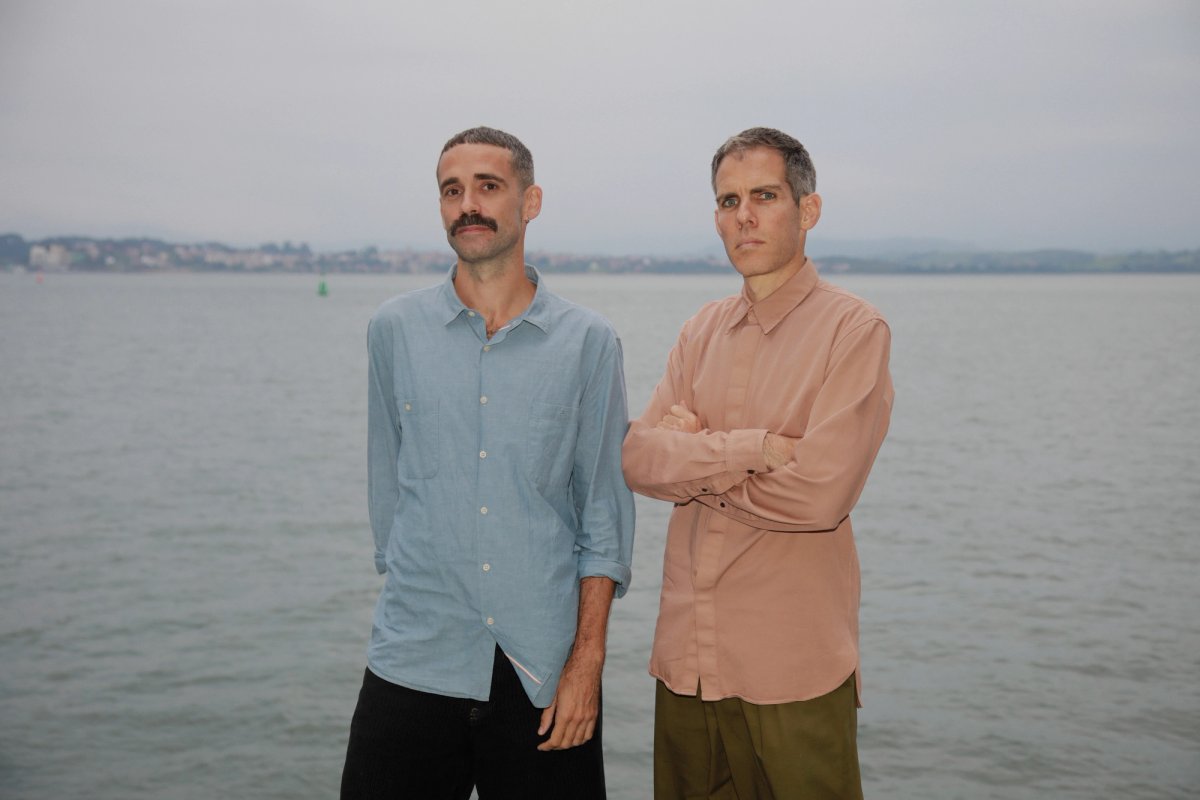
As this column has repeatedly shown, there is no shortage of artists making work that engages with the ecological and climate crisis. But few have achieved so many actionable outcomes as Daniel Fernández Pascual and Alon Schwabe, aka Cooking Sections.
Since the duo got together as fellow students at Goldsmiths Centre for Research Architecture in 2013, they have been using the production and consumption of food as the focus for numerous long-term, site-specific projects that address how we should live—and eat in particular—in the face of climate change. As they put it: “Food is both deeply connected to the environment and to ecology but at the same time is also intersectional: every living organism on this planet is invested and preoccupied with processes of metabolism, ingestion and the acquisition of nutrients.”
Grim realities
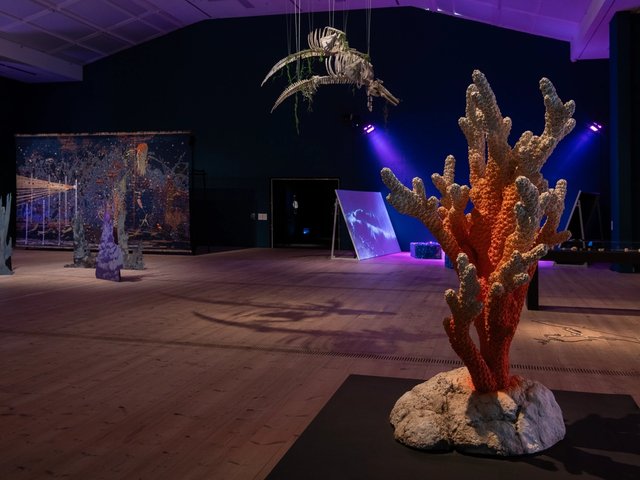
I first became aware of Cooking Sections in 2020 when they showed their installation, Salmon: A Red Herring in the Art Now project room at Tate Britain. Salmon took the form of a sculptural natural history diorama using sound and light to expose the grim realities of how salmon are farmed. While sculptures of animals including a seal, a salmon, a shrimp and a flamingo were illuminated in shades ranging from pale pink to deep blood red, a voiceover related how salmon are crammed into pens for up to two years, with many ending up blind, deaf, riddled with sea lice and often driven to eat each other.
Other depressing details included the destruction of marine life from the polluting pesticides and fish excrement leaching out from the UK’s 76 fish farms, as well as the revelation that, in the absence of a natural diet of baby lobster or krill, all farmed salmon have to be fed synthetic dye pellets to colour their grey flesh a more commercially acceptable shade of pink.
The work resulted in Cooking Sections being nominated for the 2021 Turner Prize and all four Tates—Modern, Britain, St Ives and Liverpool—taking the decision to remove farmed salmon from their cafés and restaurants. Despite energetic lobbying from the UK’s powerful salmon industry, the ban still stands across all Tate catering.
Sustainable schemes
But in keeping with Pascual and Schwabe’s stated dedication to “address ecological questions in a deep and transformative way”, Salmon: A Red Herring is just one manifestation of Cooking Sections’ long-term engagement with Scottish coastal waters, which dates back to an early residency on the Isle of Skye in 2017. This abiding interest has spawned numerous self-sustaining projects involving local communities, ranging from the regenerative farming of mussels, oysters and kelp to apprenticeship schemes in schools and restaurants.
The majority of these continue today, most notably a partnership between local food and construction industries to create a new composite material from the pulverised shells of mussels and oysters. This terrazzo-like product offers an infinitely more eco-friendly—and better-looking—substitute for cement.
Over the years, addressing consumption and climate breakdown has involved Cooking Sections in collaborating across the globe with multiple individuals and organisations. Those collaborations go way beyond the art world, involving chefs, teachers, fisherfolk, surfers, farmers, marine biologists and oyster shuckers. “To do this work, we have to create openings and engage in processes that last for ten, 20 and 30 years, not just for a three-month show in a gallery,” they say. “Our practice is research-driven: it’s shaped by the location we work in and grows through the projects we develop. It’s always about adapting to the local context.”
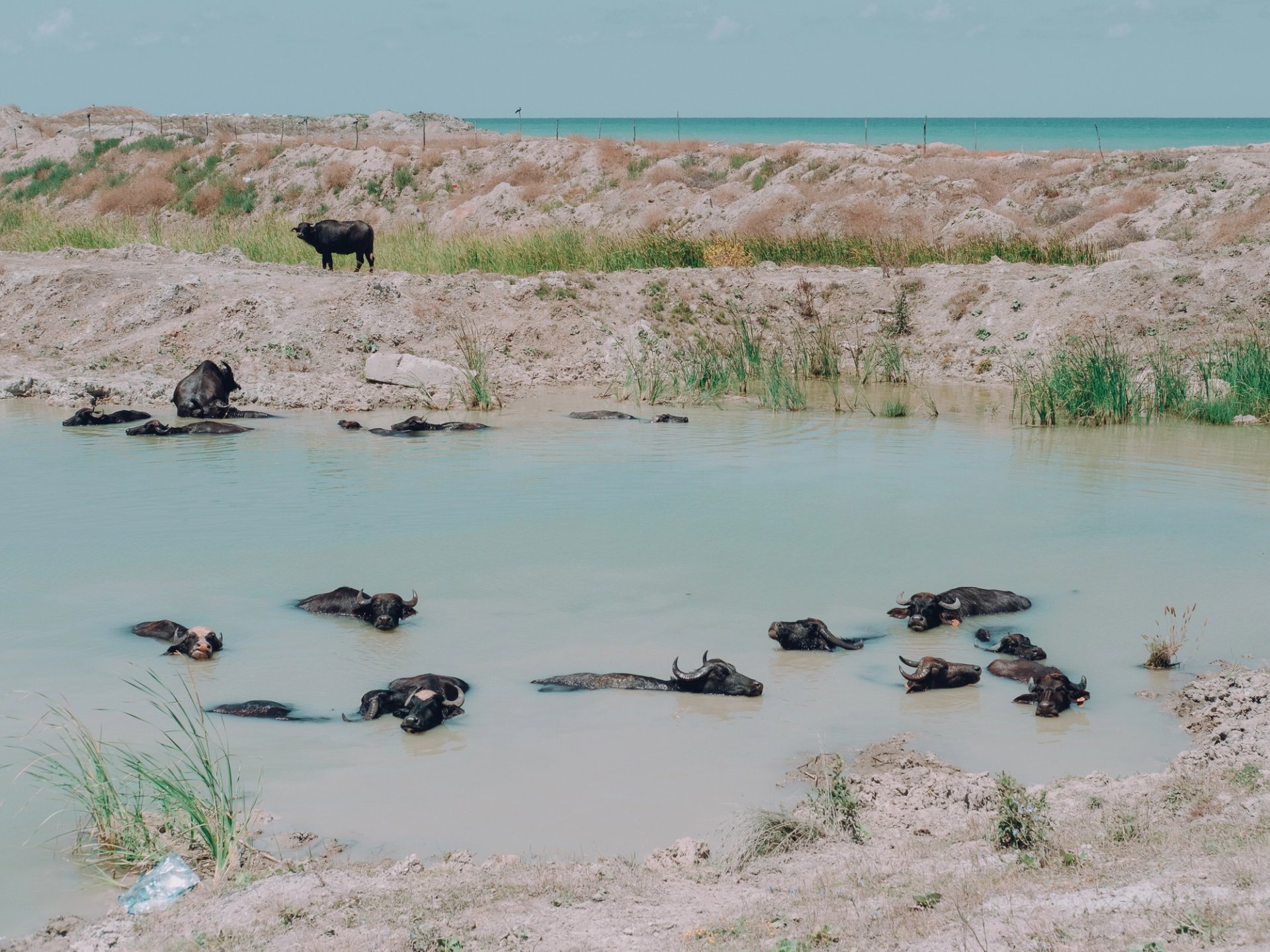
Water Buffalo Commons is a project to help support herders like those working in the post-industrial wetlands near Akpınar Village in Turkey Photo: Ci Demi, courtesy Climavore x Jameel at RCA
Age of the climavore
These local contexts are many and various, stretching from the south coast of England to the farmlands of Sicily and across to the Persian Gulf and the Mississippi Delta. To handle the multiplicity of projects, Pascual and Schwabe have developed the concept of ‘climavore’, a term they first used to describe a diet that responds to climate change while sustaining its surrounding environments, but which they have now also turned into “a research platform that takes the methodologies developed by Cooking Sections and embeds them into more long-term collaborations”.
Examples include Water Buffalo Commons and Monoculture Meltdown, a pair of Climavore and Jameel projects at the Royal College of Art. They have emerged out of a three-year partnership with the philanthropic global organisation Community Jameel and the RCA’s School of Architecture, where Schwabe and Pascual are both currently readers in architecture and spatial practice.
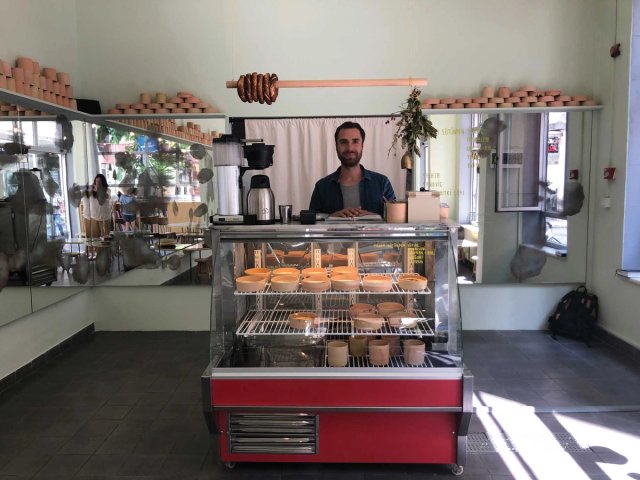
Water Buffalo Commons involves the last remaining populations of water buffalo herders in an ongoing, multistranded Climavore project to preserve the food and ecological heritage of the post-industrial, and now threatened, wetlands of northern Istanbul. The project includes the creation of an annual festival to celebrate all things water buffalo and forging enduring partnerships with restaurants and suppliers to introduce traditional water buffalo dairy products into Istanbul’s restaurants and culinary school curricula.
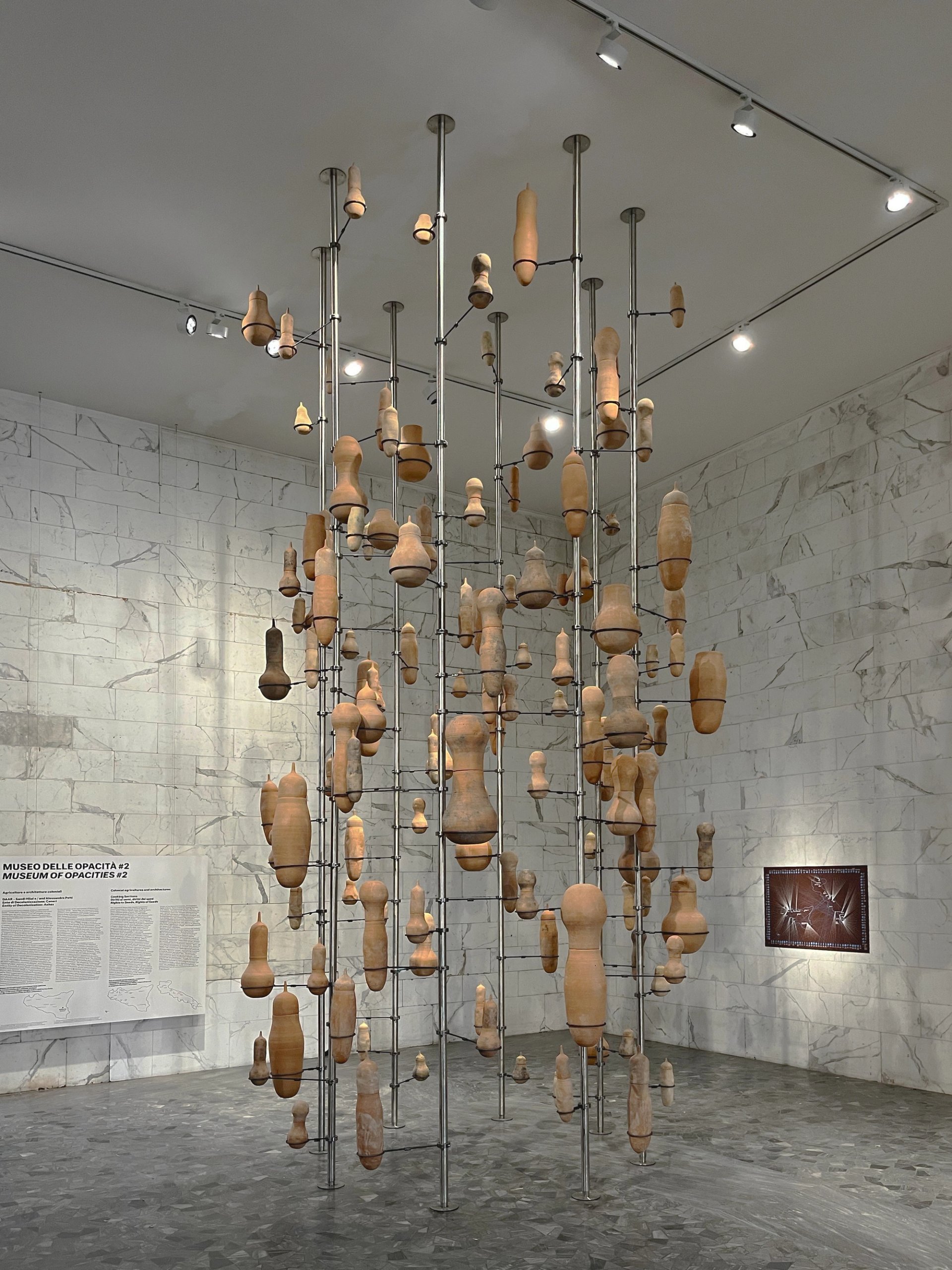
In the installation Rights to Seeds, Rights of Seeds (2025) at Museo delle Civiltà in Rome—part of the Monoculture Meltdown project—various seed varieties were displayed in ceramic vessels in an homage to traditional seed storage methods in southern Italy Photo: Cooking Sections
By contrast, Monoculture Meltdown is focused around the drier landscapes of Puglia in southern Italy and Sicily. In this harsh terrain, Cooking Sections and their team are working with local farmers and cooperatives to preserve and propagate rare drought-resistant, heat-tolerant seed varieties that have been cultivated and exchanged by peasants for generations, but which don’t conform to agribusiness standards and so cannot be commercially grown.
Although they often operate outside art institutions, in this instance Cooking Sections have convened a Climavore Assembly of growers, environmentalists and policymakers to harness the power of the museum in circumventing the stranglehold of corporate hybrids and patents. Under a long-term agreement drawn up between the agroecological farmers and Museo delle Civiltà in Rome, each season the seeds are hosted temporarily in the museum’s ‘living collection’ before being returned to the soil and propagated for ‘cultural purposes’.
Now the team are attempting to roll out this landmark alliance between nature and culture by working with legal advisers to develop laws that will activate regional and national museums across Europe to fulfil a similar function and thus preserve (agri) cultural heritage that is under threat.
Waves Lost at Sea
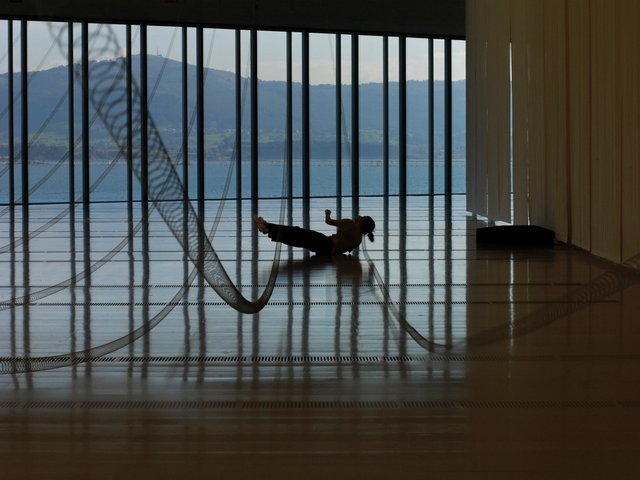
Cooking Sections are also back inside another art space for their most recent project, Waves Lost at Sea, at the Centro Botín in Santander, Spain. The starting point for this sound, sculpture and performative installation was the sudden disappearance in 2003 of a unique surfing wave in the nearby town of Mundaka, which led to the collapse of the local community’s surf-based economy. It turned out that the wave had vanished as a result of dredging operations to improve access to a local shipyard that altered the natural sandbar configuration and therefore the shape of the wave.
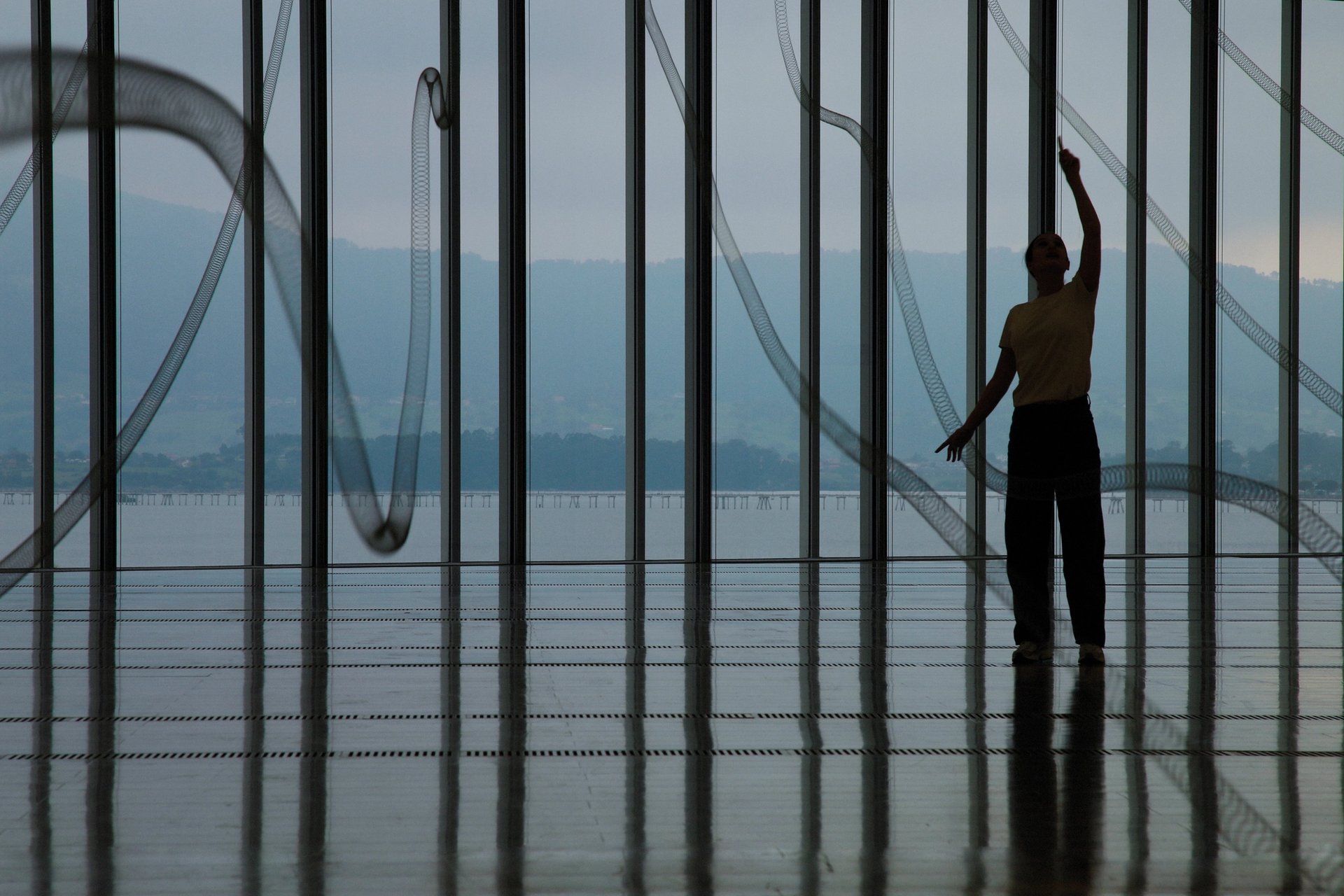
Exhibition view of Cooking Sections: Waves Lost at Sea (Las olas perdidas) at Centro Botín Photo: Lourdes Cabrera
For Waves Lost at Sea, Pascual and Schwabe have gathered together the stories, rhythms and patterns of 11 significant lost waves worldwide, from Mundaka to Ala Moana in Hawai‘i, Cabo Blanco in Peru and El Marsa in the Western Sahara, all of which owe their demise to human-originated alterations of the ocean floor. The information about these waves has been translated by the artist and musician Duval Timothy into 11 musical compositions, which play as performers respond by activating 11 lengthy suspended springs or ‘slinkys’ that extend throughout the Centro Botin, which itself looks directly onto the Atlantic Ocean.
This elegiac homage to the power of waves may not seem overtly food-related, but through the lens of Cooking Sections, everything is interconnected, or as they put it, “metabolised”. Wave disappearance is just another example of how the force of food, whether directly or obliquely, dictates how so much of our world is shaped, whether in the deep dredging needed to accommodate the ever-larger ships that transport our unseasonal groceries, or the industrial fishing ships emptying the oceans and devastating the seabed. As the wide-ranging and hugely important work of this visionary duo demonstrates, if there is to be any chance of saving our planet’s land and seas and therefore ourselves, we had all better embrace our inner climavore—and fast.
- Cooking Sections: Waves Lost at Sea, Centro Botin, until 1 March