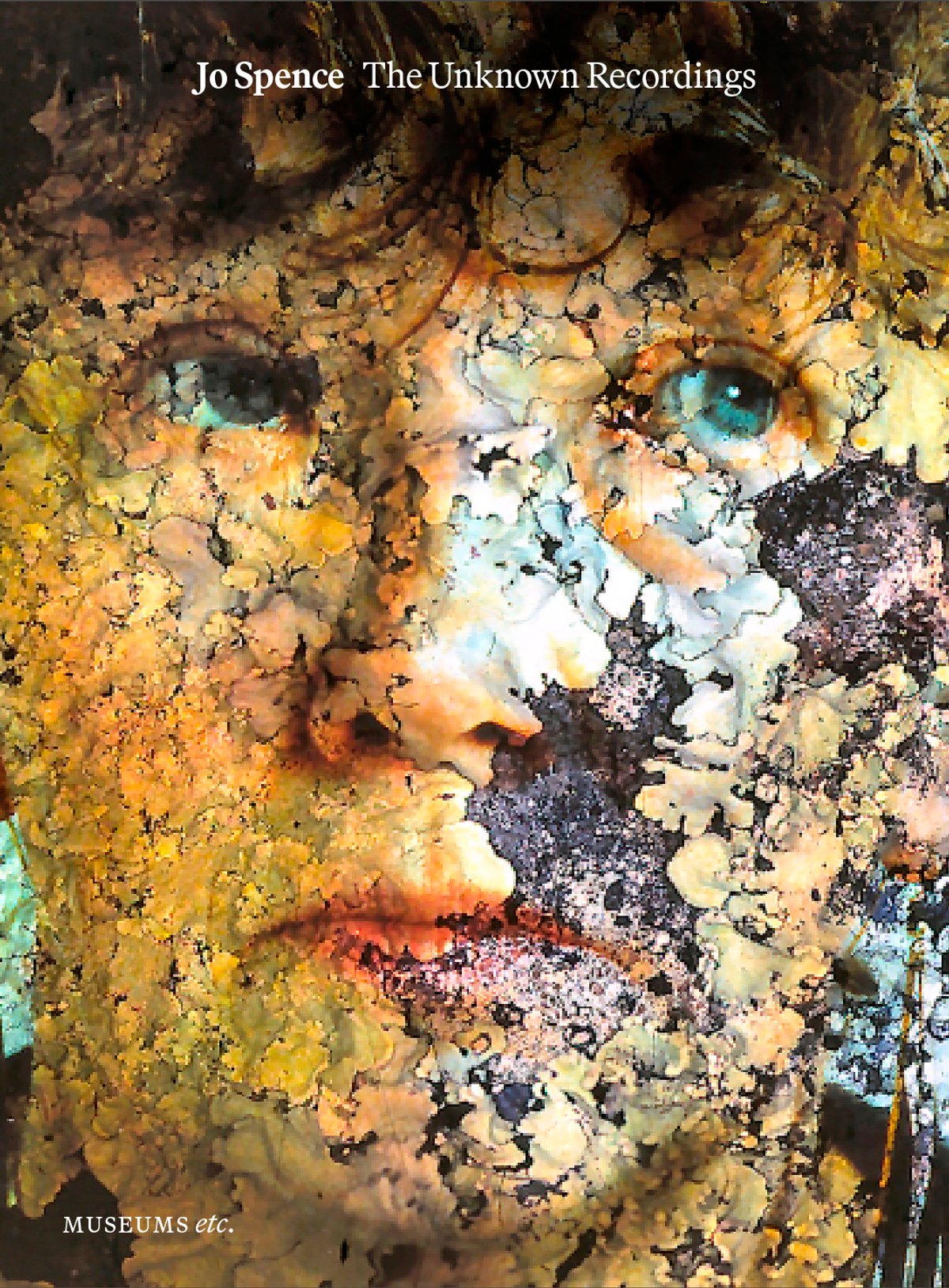
Jo Spence (1934-92) was a London-born and based British photographer, writer, class and health activist and educator. She is best known for challenging the assumptions of what photography could be, for example, by using her own image to question common tropes around female beauty, health, identity and societal expectations. Spence’s achievements centred on the small home and studio on Islington’s Upper Street that she shared with her partner and collaborator Terry Dennett (1938-2018).
The Unknown Recordings is an intimate self-portrait in text form. There are pictures, but surprisingly few. Still, in that respect, Spence’s disarmingly frank autobiography Putting Myself in the Picture (1986) could not be surpassed. Forty years on, this publication makes sense of a textual account largely in the form of transcripts of key historic recordings made with the artist.
The verbatim transcript of Spence’s interview for the British Library’s Oral History of British Photography, recorded in 1991, extends to more than 100 pages. It covers every aspect of her life from childhood experiences to early working life, before progressing to her photographic work, collaborations and politics, as well as her experience of breast cancer and leukaemia.
The conversation between Spence and the interviewer flows, with few fragments and diversions, in a manner that allows us (almost) to hear it. Generous in her sharing of extremely personal ideas and experiences, Spence does not shy away from difficult topics, least of all her own experience of chronic illness and her attempts to regain power over her own body and identity. Her friendship with artist Rosy Martin and their development of phototherapy, a form of psychological therapy centred on photography, is especially raw.
Distress, tears and self-analysis
The transcript of a short personal recording made in 1982, after the breast cancer diagnosis, is more unsettling. This is Spence recording her own thoughts, filled with distress, tears and self-analysis: while it became part of her archive and she often blurred the line between private and public, it does feel a little like eavesdropping. Recorded over two days, it is intensely emotional, as Spence struggles to process and come to terms with the various stressors in her life. In a particularly poignant moment, Dennett is recorded shouting words of support, presumably from another room.
Spence’s interview with visual activist and educator Andrew Dewdney and curator Shirley Read has a political slant. Recorded in the Cockpit Arts Workshop in London in 1989, this conversation gives acute insight into Spence’s commitment to a political as well as photographic practice. It ranges across her ideas relating to different areas of her work, such as the Photography Workshop, Hackney Flashers, Half Moon Photography Workshop and Camerawork magazine. Ultimately, these projects perhaps coalesced around Spence’s focus on people’s right to speak and be seen. It is a powerful conversation.
A series of four appendices act as a kind of postscript to Spence’s voice. There is the documentation of Spence’s sacking from Half Moon over ideological differences; recently discovered images of Spence’s retrospective of 1994; photographs, thoughts and exchanges with artist Pru Clements; and Spence’s CV from March 1987.
This section also includes Dennett’s reworked introduction to Spence’s Putting Myself in the Picture. Here, he makes it clear that Spence’s work was done under difficult circumstances but that she remained focused on the importance of empowering others. Rather than concluding in some fashion or other, together these last documents point the reader to other rich visual and textual archival material that surrounds Spence’s life and legacy. She extended the possibilities of photography to speak about the unspeakable and photograph the unphotographable. Spence was not within the cultural elite, but found a way to tell her own story and hoped it would be a model for others to follow.
• Jo Spence: The Unknown Recordings, Museums etc, 256 pp, 30 colour and 8 b/w illustrations, £35 (pb), £25 (e-b), 1 January